
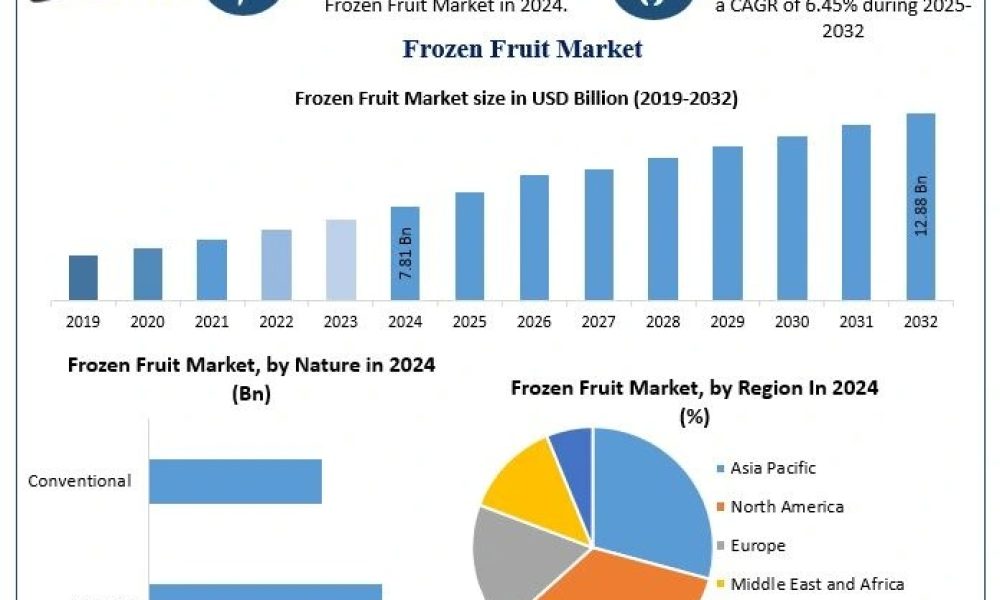
As per a recent study released by Maximize Market Research, titled, “Frozen Fruit Market,” The Frozen Fruit Market, size was valued at USD 7.81 Billion in 2024 and the total Frozen Fruit revenue is expected to grow at a CAGR of 6.45% from 2025 to 2032, reaching nearly USD 12.88 Billion.
Frozen Fruit Market Overview:
Frozen fruit refers to whole or cut fruit items that have been rapidly chilled, typically via blast or individual-quick-freeze (IQF) technology, to preserve their freshness, nutrients and texture. Because they are picked at peak ripeness and frozen almost immediately, these fruits maintain much of the flavour and nutritional content of fresh fruit, while also offering extended shelf life and year-round availability. This makes them an appealing ingredient for consumers looking for convenience as well as quality.
Beyond consumer use, frozen fruits are increasingly integrated into food-service, bakery, smoothie and processing applications. They serve as ingredient inputs in desserts, yoghurt toppings, smoothie blends, sauces, baked goods and ready-to-eat meals. The broad applicability across home consumption, food-service and industrial use underpins the market’s relevance in modern food systems.
Download a Free Sample Report Today : https://www.maximizemarketresearch.com/request-sample/221569/
Frozen Fruit Market Dynamics
One of the key drivers of the frozen fruit market is the increasing consumer focus on health, nutrition, and convenience. Urbanisation, busier lifestyles, dual-income households and the rise of at-home food preparation have all pushed demand for foods that reduce prep time. Frozen fruit, which can be stored, used when needed, and incorporated into smoothies or instant meals, caters to this trend. Furthermore, rising interest in plant-based diets, clean-label foods and year-round access to tropical or berry fruits adds momentum.
At the same time, the market faces important challenges. Frozen fruit production and distribution require significant cold-chain infrastructure, including freezing, transport, and storage — and in many regions that remains a barrier. Also, competition from fresh fruit (particularly where local produce is available), canned fruit and dried fruit offers alternative options with different price and perception trade-offs. Some consumers still hold the view that frozen fruit is inferior in taste or nutrition compared to fresh, which may limit adoption in certain segments.
Frozen Fruit Market Outlook and Future Trends :
Looking ahead, the frozen fruit market is poised for further growth, driven by product innovation and expansion into new applications. For instance, manufacturers are launching ready-to-blend frozen smoothie packs, exotic fruit mixes, organic/clean-label frozen fruit, and portion-controlled formats to satisfy evolving consumer demands. Advances in freezing technologies (e.g., IQF, improved packaging) improve texture, flavour and nutritional retention, making the proposition stronger.
Another important trend is sustainability and supply-chain optimisation. As consumer awareness of food-waste and seasonality increases, frozen fruit offers a way to extend shelf life and avoid spoilage. Emerging markets present considerable opportunity, as rising middle-class incomes, urbanisation and changing diets drive demand for convenience, imported flavors and non-seasonal produce. Meanwhile, value-chain players are focused on improving cold-chain logistics, exploring direct-to-consumer or e-commerce channels, and developing fruit varieties with enhanced freezing performance.
Frozen Fruit Market Regional Insights:
In North America, the frozen fruit market benefits from high consumer awareness about health-and-nutrition, well-established retail cold-chain infrastructure and strong usage in smoothies, desserts and baking applications. Consumers here are accustomed to frozen fruit as a convenient staple and the penetration of online grocery, subscription services and ready-to-blend packs helps fuel demand.
By contrast, in the Asia-Pacific region, growth is faster though from a lower base; rapid urbanisation, growing disposable incomes, expansion of modern retail and rising interest in imported/tropical fruit variants are all supporting uptake. In many of these markets, frozen fruit helps bridge seasonality gaps and extends the offering of fruits that may otherwise be expensive or unavailable. Other regions such as Europe, Latin America, Middle East & Africa also provide incremental growth opportunities, each with their unique mix of infrastructure challenges, changing consumer habits and increasing demand for convenience and health-oriented foods.
Frozen Fruit Market Segmentation
by Nature
Organic
Conventional
by Form
Diced
Whole
Sliced
by End Use
Food Processing Industry
Smoothie
Frozen Dessert
Ice Cream
Yogurt
Others
Food Services Provider
Retail
Others
Some of the current players in the Frozen Fruit Market are:
1. Kendall Fresh Frozen Fruits, Inc.
2. Del Monte Produce Inc.
3. Nomad Foods
4. Nature’s Touch
5. HARVEST FOOD GROUP
6. Titan Frozen Fruit
7. Meel Corp
8. Val-Mex Frozen Foods, LLC
9. Royal Ridge Fruits
10. SunOpta Inc.
11. Arla Foods
12. Danone
13. Dean Foods
14. Nestle
15. Inventure Foods Inc.
About Maximize Market Research:
Maximize Market Research is one of the fastest-growing market research and business consulting firms serving clients globally. Our revenue impact and focused growth-driven research initiatives make us a proud partner of majority of the Fortune 500 companies. We have a diversified portfolio and serve a variety of industries such as IT & telecom, chemical, food & beverage, aerospace & defense, healthcare and others.
Contact Maximize Market Research:
MAXIMIZE MARKET RESEARCH PVT. LTD.
⮝ 3rd Floor, Navale IT park Phase 2,
Pune Banglore Highway, Narhe
Pune, Maharashtra 411041, India.
✆ +91 9607365656
🖂 [email protected]




