
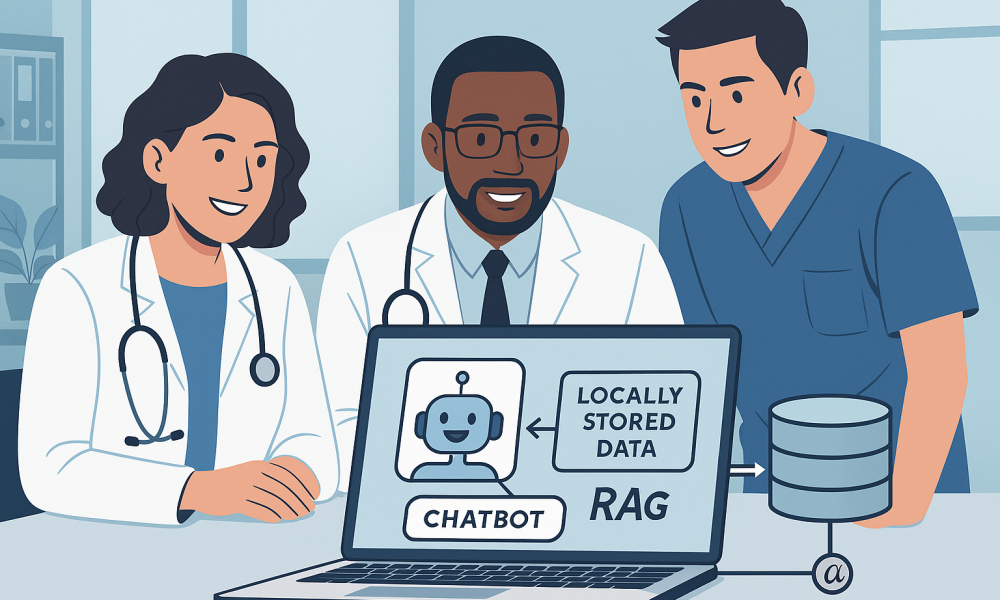
A new RAG (Retrieval-Augmented Generation) system has been integrated into AI Live Chat PRO, enabling the chatbot to reference and respond based on your own business knowledge that is stored locally on your server. This is a major distinction from typical cloud chatbot services. With AI Live Chat PRO, all customer chat logs, knowledge base documents, and internal training materials remain inside your hosting environment, not transmitted to external third-party servers.
This architecture ensures that every response is evidence-based and aligned with your documented policies — while also meeting data-residency, privacy, and compliance obligations. For industries that handle sensitive information — such as financial services, healthcare, legal practices, insurance, education, and professional consulting — this local data storage model is often a requirement, not a preference.
In short: the AI is smart — but your data stays yours.
Learn more or install it: https://www.sitetrail.com/plugins/ai-live-chat-pro/
This development addresses a critical limitation found in conventional chatbots. Most AI chat systems respond using general model training without confirming those responses against organizational knowledge. As a result, chatbots often produce confident yet incorrect statements. Retrieval Augmented Generation corrects this by retrieving relevant sections of stored documents first, and only then generating the final message. The output reflects actual policies, product specifications, instructions, or guidance already authored by the organization. (Read more about AI Chatbots with RAG)
The implementation is engineered specifically for WordPress hosting environments without reliance on external vector databases. Knowledge base content uploaded to the system—such as PDF manuals, help center articles, support scripts, internal procedures, or onboarding documents—is automatically segmented into small semantic units. These are converted into 1536-dimensional vector embeddings and stored locally in the WordPress MySQL database. Metadata links each chunk to its original document, maintaining source traceability.
When a site visitor asks a question, the system generates an embedding of the query and performs cosine similarity scoring directly on the server to identify the nearest relevant knowledge chunks. The selected text is then passed to the language model to produce a response that is both contextual and verifiable. Because the content retrieval layer precedes generation, the system does not speculate. It synthesizes from known information.
This localized approach to embedding storage supports strict data governance requirements. Many organizations cannot transfer proprietary or sensitive operational documents to third-party AI platforms or hosted knowledge repositories. Keeping all embeddings and text on the organization’s server ensures that internal knowledge remains under the same legal and custodial controls that already apply to the website’s hosting environment. Only the user’s query text is transmitted to the OpenAI API for language interpretation. The organization’s own knowledge base is not exposed externally.
RAG does increase contextual token usage because more text is processed during response assembly. However, selecting an appropriate model balances cost and reliability. In this configuration, ChatGPT 3.5 Turbo becomes the optimal default runtime model. With retrieval in place, the model no longer needs to infer missing information, eliminating the need for a higher-cost model to compensate for uncertainty. GPT-4 can be reserved for specific cases requiring advanced reasoning or structured multi-step synthesis. This keeps conversational AI cost-stable while maintaining quality and accuracy.
The system supports revisions, versioning, and source updates. When documentation changes, new embeddings replace outdated ones, ensuring the chatbot’s responses remain aligned with current operational standards. Response tone, verbosity, formality level, and customer interaction style can be configured to match the organization’s communication norms. The interface can be deployed on public websites, support portals, membership dashboards, and e-commerce product environments.
This development marks a transition from generative novelty to operational-grade AI assistance. It moves WordPress-based businesses toward automated support interactions that are accurate, auditable, compliant with data-handling regulations, and consistent with organizational messaging. By grounding AI responses in verifiable documentation, the system prevents the reputational and legal risks associated with hallucinated or inaccurate chatbot output.
The focus has shifted from AI that merely responds to AI that represents.
FAQ: RAG AI Chatbot for WordPress
What is RAG in the context of AI chatbots?
RAG (Retrieval Augmented Generation) is a method where the chatbot retrieves relevant text from a stored knowledge base before generating a response. Instead of relying only on general AI training, the system grounds answers in documented information supplied by the organization.
How does this RAG chatbot store and retrieve knowledge?
Uploaded knowledge content is automatically segmented into semantic chunks and converted into vector embeddings. These embeddings and their associated metadata are stored locally in the WordPress MySQL database. During conversation, the chatbot embeds the user’s question and uses cosine similarity to locate the closest matching text segments prior to generating a reply.
Does this require a separate vector database like Pinecone or Weaviate?
No. The embeddings are stored directly in the existing WordPress database. This removes reliance on external hosting providers and avoids additional infrastructure management or data transfer outside the organization’s hosting environment.
Can proprietary or confidential documents be used with this system?
Yes. The RAG implementation keeps all documents and embeddings stored locally. Only the end-user query is sent to the OpenAI API. The organization retains full control and custody of its internal knowledge base, which is important for compliance-driven environments.
Why not just use GPT-4 or another advanced model without retrieval?
Without retrieval, even the strongest models can invent answers because they are responding based on general training rather than validated business-specific knowledge. RAG ensures the output is derived from actual source material. It also allows more cost-efficient models to perform reliably because they do not need to infer missing context.
Why use ChatGPT 3.5 Turbo in a RAG system?
All models up to ChatGPT5 can be used, likewise Grok4. But remember: RAG systems include additional contextual text during generation, which increases token usage. ChatGPT 3.5 Turbo processes these cases effectively because retrieval supplies the necessary information. This stabilizes ongoing operational costs and makes the system scalable for high-volume support environments. In cases where more is spent on a higher character count, it is reasonable to use GPT3.5 Turbo to save on costs.
Can the chatbot tone and communication style be adjusted?
Yes. Tone, wording, verbosity, and response style can be configured so that replies align with the organization’s communication standards, whether formal, minimal, conversational, or directive.
What happens when documentation changes?
When knowledge base content is updated, the system regenerates embeddings and replaces outdated vector data. This ensures the chatbot remains aligned with the organization’s current policies, product specifications, and guidelines.
Does this system reduce support workload?
In most deployment environments, a large percentage of repetitive inquiries are resolved automatically. The chatbot can handle routine clarification questions, policy explanations, onboarding steps, and product guidance, allowing support teams to focus on exceptions and escalations.
Is the output auditable for compliance or accuracy review?
Yes. Because responses are always sourced from identifiable document segments, the origin of the information can be traced. This supports internal review, legal oversight, and operational accountability.