
Definition
Global Generative AI Data Center refers to specialized facilities specifically designed to accommodate the high-performance computing needs of generative artificial intelligence applications. These data centers are purpose-built to handle intensive workloads associated with AI model training, inference, and deployment. Unlike conventional data centers, generative AI data centers support high-density GPU and TPU clusters that require power densities 5-10 times higher than traditional IT infrastructures.
Key features defining the Generative AI Data Center market include:
- High-Performance Computing Architecture: Optimized for AI training with GPUs, TPUs, and AI accelerators.
- Advanced Cooling Solutions: Liquid cooling, immersion cooling, and heat reuse systems to manage extreme thermal loads.
- Ultra-Low Latency Networks: Designed to support real-time AI workloads and ensure uninterrupted data transfer.
- Modular & Scalable Design: Enables infrastructure to scale dynamically based on workload demands, from small-scale inference operations to hyperscale AI training.
- Energy Efficiency & Sustainability: Integration of renewable energy, carbon-neutral operations, and AI-driven thermal management to minimize environmental impact.
Generative AI data centers are becoming critical in sectors like finance, healthcare, manufacturing, and smart technologies where real-time decision-making, algorithmic processing, and AI model deployment are essential. Their rise is fueled by exponential growth in AI adoption across enterprises and the need for dedicated infrastructure that traditional data centers cannot support efficiently.
Recent Developments in Generative AI Data Center Market
The generative AI data center market is undergoing a rapid evolution, primarily characterized by a massive surge in demand for high-density, specialized computing infrastructure. A key development is the unprecedented scale of investment by hyperscalers—such as Google, Microsoft, and Meta—who are building “AI factories” equipped with vast arrays of powerful Graphics Processing Units (GPUs), largely supplied by companies like NVIDIA and increasingly by competitors like AMD. This shift is driving innovations in power and cooling, with a move away from traditional air cooling to highly efficient liquid cooling methods, including direct-to-chip and immersion cooling, to manage the extreme heat of high-density AI racks. Furthermore, there’s a growing trend toward optimizing power distribution, such as experimenting with 800V DC architectures, to improve energy efficiency and meet the soaring power demands of synchronous AI workloads, as sustainability and energy scarcity become critical constraints.
Market Size
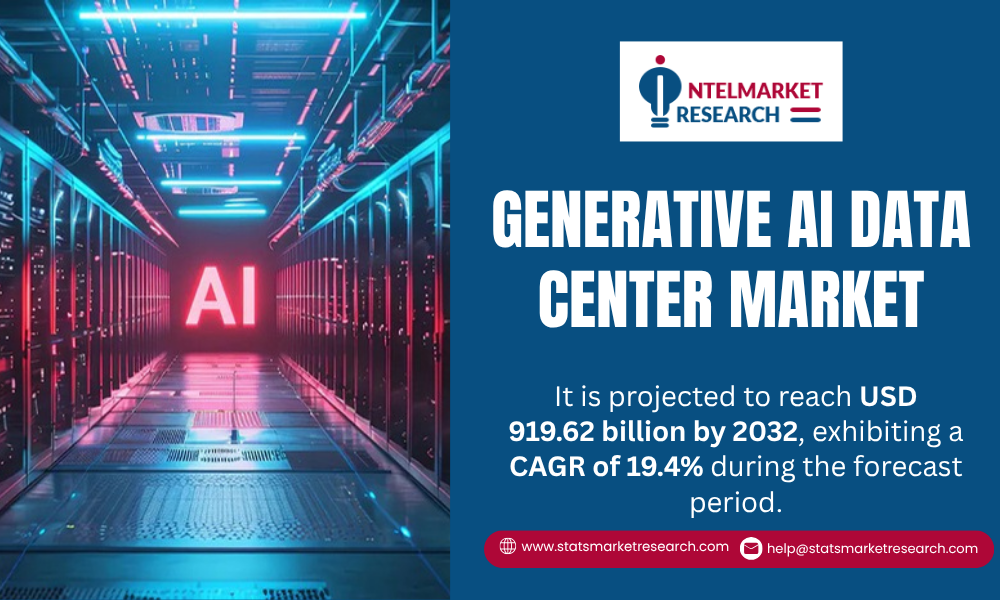
Global Generative AI Data Center market was valued at USD 6.01 billion in 2024 and is projected to reach USD 7.14 billion in 2025. By 2032, the market is expected to expand to USD 19.62 billion, reflecting a CAGR of 19.4% over the forecast period.
Get FREE Sample of this Report at https://www.intelmarketresearch.com/download-free-sample/1581/generative-ai-data-center-2025-2032-139
Historical Growth Trends:
- The market witnessed early adoption driven by hyperscale cloud providers and AI startups integrating GPU-intensive workloads.
- Between 2020-2024, infrastructure expansion primarily focused on high-performance GPU clusters to accommodate growing AI workloads.
- Liquid cooling and modular data center deployment have contributed significantly to adoption rates.
Key Market Drivers:
- Exponential Growth in AI Adoption: Enterprises globally are integrating AI-powered solutions, leading to higher demand for AI-specific infrastructure.
- Innovations in Cooling Technology: Liquid and immersion cooling solutions have increased operational efficiency by up to 90%, enabling higher power densities.
- Government Policy & Investments: National AI strategies, tax incentives, and grants for sustainable data centers are accelerating market expansion.
Market Restraints:
- Massive Energy Requirements: A single generative AI training session can consume more electricity than 100 households annually, restricting growth in energy-scarce regions.
- Regulatory & Data Sovereignty Challenges: Compliance with regional data privacy and localization policies complicates international expansion.
- Supply Chain Disruptions: Long lead times (12-18 months) for critical GPUs and advanced cooling systems delay capacity expansions.
Regional Analysis
The market is geographically diverse, with North America leading, followed by Asia-Pacific and Europe.
North America:
- Dominates market share due to early infrastructure development, advanced technology, and strong cloud ecosystem presence.
- Major U.S. investments include Microsoft Azure’s $80 billion AI data center initiative and Meta Platforms’ multi-gigawatt supercluster projects.
- High energy availability and established regulatory frameworks facilitate rapid deployment of high-density AI infrastructure.
Asia-Pacific:
- Rapidly growing due to digitalization initiatives, government incentives, and strong demand for AI solutions in China, Japan, and Singapore.
- Companies like GDS Holdings and Princeton Digital Group are developing liquid-cooled facilities to meet regional AI demands.
Europe:
- Growth driven by sustainability mandates, carbon-neutral targets, and renewable energy adoption.
- Waste heat recycling and integration of AI-optimized cooling solutions are reshaping infrastructure design in Northern and Western Europe.
Middle East & Africa:
- Emerging markets with limited infrastructure are slower in adoption but present opportunities for renewable-powered AI facilities.
Global Generative AI Data Center: Market Segmentation Analysis
This report provides a deep insight into the global Generative AI Data Center market, covering all its essential aspects. This ranges from a macro overview of the market to micro details of the market size, competitive landscape, development trend, niche market, key market drivers and challenges, SWOT analysis, value chain analysis, etc.
The analysis helps the reader to shape the competition within the industries and strategies for the competitive environment to enhance the potential profit. Furthermore, it provides a simple framework for evaluating and assessing the position of the business organization. The report structure also focuses on the competitive landscape of the Global Generative AI Data Center. This report introduces in detail the market share, market performance, product situation, operation situation, etc., of the main players, which helps the readers in the industry to identify the main competitors and deeply understand the competition pattern of the market.
In a word, this report is a must-read for industry players, investors, researchers, consultants, business strategists, and all those who have any kind of stake or are planning to foray into the Generative AI Data Center market in any manner.
Market Segmentation (by Application)
The market is segmented based on application into:
- Financial Services
- Medical
- Smart Manufacturing
- Others
Market Segmentation (by Type)
The market is segmented based on type into:
- GPU Data Center
- CPU Data Center
- Others
Key Company
Key players profiled include:
- Digital Realty (U.S.)
- EQUINIX (U.S.)
- GDS Holdings (China)
- STACK Infrastructure (U.S.)
- IBM (U.S.)
- Adaptive Computing (U.S.)
- NTT Global Data Centers (Japan)
- Air Trunk (Australia)
- Princeton Digital Group (Singapore)
- ST Telemedia Global Data Centres (Singapore)
Get the Complete Report & TOC at https://www.intelmarketresearch.com/ict-and-media/1581/generative-ai-data-center-2025-2032-139
FAQ
Q1: What is the current market size of the Global Generative AI Data Center market?
A1: The market was valued at USD 6.01 billion in 2024 and is projected to reach USD 19.62 billion by 2032, growing at a CAGR of 19.4%.
Q2: Which are the key companies operating in the Generative AI Data Center market?
A2: Key players include Digital Realty, EQUINIX, GDS Holdings, STACK Infrastructure, IBM, Adaptive Computing, NTT Global Data Centers, Air Trunk, Princeton Digital Group, and ST Telemedia Global Data Centres.
Q3: What are the key growth drivers in the Generative AI Data Center market?
A3: Key drivers include exponential AI adoption, advancements in cooling technology, government investments, and rising demand for low-latency and high-density AI infrastructure.
Q4: Which regions dominate the Generative AI Data Center market?
A4: North America currently leads the market, followed by Asia-Pacific due to rapid digitalization and government support for AI infrastructure development.
Q5: What are the emerging trends in the Generative AI Data Center market?
A5: Emerging trends include adoption of high-density computing infrastructure, vertical-specific AI solutions, sustainability initiatives, modular data center designs, and edge AI deployments.
About Us
Intel Market Research is a leading provider of strategic intelligence, offering actionable insights in information technology, digital media solutions, and communication infrastructure. Our research capabilities include:
- Real-time competitive benchmarking
- Global technology adoption monitoring
- Country-specific regulatory and market analysis
- Over 500+ technology reports annually
Trusted by Fortune 500 companies, our insights empower decision-makers to drive innovation with confidence.
🌐 Website: https://www.intelmarketresearch.com
📞 International: +1 (332) 2424 294
📞 Asia-Pacific: +91 9169164321
🔗 LinkedIn: Follow Us




