
Definition
The Global SMD Current Sensing Resistor Market encompasses the production, distribution, and utilization of surface-mount resistors specifically designed for current measurement applications in electronic circuits. These precision components play an essential role in monitoring and controlling electrical currents in modern systems, ensuring safety, reliability, and energy efficiency. Surface-Mount Device (SMD) current sensing resistors are characterized by their compact form factor, low resistance values, and high accuracy, making them indispensable in power management systems, automotive electronics, industrial machinery, telecommunications infrastructure, and consumer devices.
An SMD current sensing resistor functions as a vital element for measuring current flow through voltage drop detection. In practice, these resistors are integrated into printed circuit boards (PCBs) using surface-mount technology (SMT), which allows high-density circuit design, miniaturization, and superior thermal performance compared to traditional through-hole components. The resistor’s value and tolerance determine its ability to deliver precise current measurements—an essential requirement in sensitive electronic systems.
These resistors are typically manufactured using materials such as metal alloys, metal foils, thick films, and thin films, depending on performance requirements. Metal alloy and metal foil resistors are known for their superior precision and low temperature coefficient of resistance (TCR), making them ideal for high-performance applications such as electric vehicles (EVs), renewable energy systems, and advanced industrial automation. Thick and thin film resistors, on the other hand, provide cost-effective solutions for consumer and telecommunications electronics, where moderate accuracy and stability are sufficient.
The importance of SMD current sensing resistors has grown exponentially with the global transition toward electrification, digitalization, and renewable energy. These resistors are integral to battery management systems (BMS), power converters, motor drives, and smart devices, where real-time current measurement directly influences efficiency, safety, and functionality. In electric vehicles, for instance, SMD current sensing resistors enable precise monitoring of charging and discharging cycles, preventing overcurrent conditions and extending battery life.
Read Full Report: https://semiconductorinsight.com/report/smd-current-sensing-resistor-market/
As modern electronic systems continue to shrink in size while increasing in functionality, the need for highly reliable, thermally stable, and compact current sensing resistors is becoming more pronounced. Manufacturers are focusing on innovations that deliver lower resistance ranges (below 1 ohm) with tighter tolerance levels (±1% or better) to ensure minimal power loss while maintaining accuracy. Moreover, the growing complexity of power management systems in data centers, renewable grids, and electric mobility is driving the integration of advanced SMD resistors capable of handling high currents and wide temperature ranges.
In summary, the SMD Current Sensing Resistor Market represents a fundamental building block of modern electronics. It bridges the gap between energy control and safety in both analog and digital systems, supporting a vast array of industries—ranging from automotive and industrial automation to consumer electronics and renewable energy. The ongoing push toward sustainable, energy-efficient systems ensures that SMD current sensing resistors will remain at the forefront of electronic innovation throughout the coming decade.
Market Size
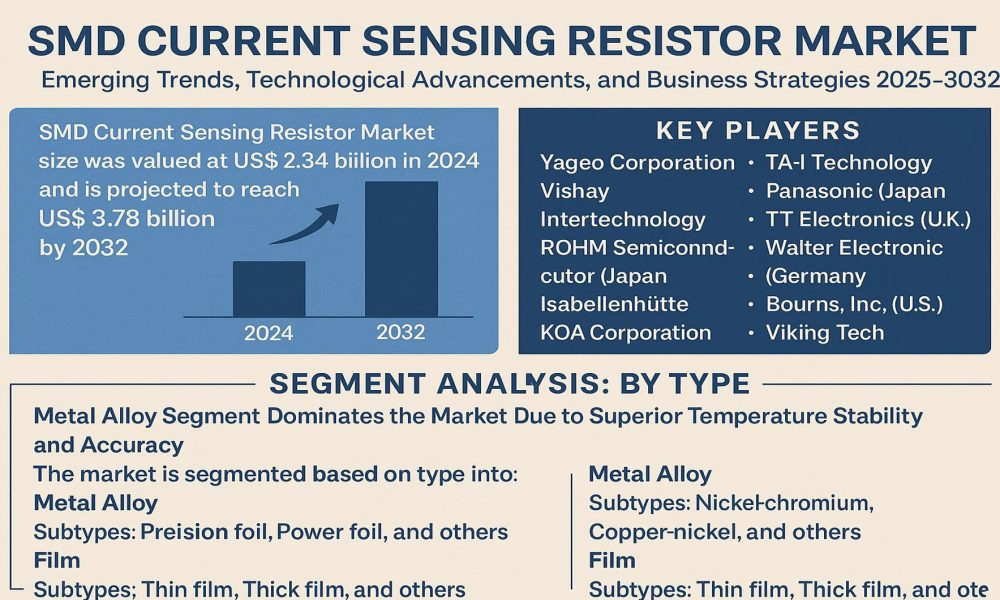
The global SMD Current Sensing Resistor Market was valued at US$ 2.34 billion in 2024 and is projected to reach US$ 3.78 billion by 2032, growing at a compound annual growth rate (CAGR) of 6.2% from 2025 to 2032. This growth trajectory underscores the increasing dependence of modern electronics on precision current measurement components, especially within high-growth sectors such as electric mobility, industrial automation, and renewable energy systems.
The expansion of the market is driven primarily by the global surge in electric vehicle (EV) production, which demands high-precision current sensing for battery management systems, motor control, and charging infrastructure. The EV industry alone accounts for approximately 42% of total SMD current sensing resistor consumption, highlighting its dominant role in shaping market trends. By 2026, the EV battery management system market is anticipated to exceed US$ 15 billion annually, with current sensing resistors being an indispensable component in ensuring accurate energy monitoring and system protection.
Another key factor fueling growth is the industrial automation revolution. As industries adopt smart manufacturing practices, the need for precise current sensing to optimize energy consumption, detect anomalies, and improve operational efficiency has risen sharply. Automated control systems, robotic machinery, and predictive maintenance solutions rely heavily on accurate current measurement, making SMD resistors a core technology in the industrial IoT (IIoT) ecosystem.
The consumer electronics sector also contributes significantly to market expansion, particularly with the proliferation of compact, energy-efficient devices such as smartphones, wearables, laptops, and smart home systems. These applications demand miniaturized components capable of maintaining consistent performance under thermal and electrical stress. SMD resistors fit this requirement perfectly due to their compact design, reliability, and adaptability to mass production processes.
From a technological standpoint, the market is witnessing a steady transition toward metal alloy and metal foil resistors, which offer superior stability, precision, and durability compared to traditional thick film types. These materials are particularly favored in high-power and high-temperature environments, reflecting the industry’s move toward higher voltage systems and stringent reliability standards.
The global supply chain for SMD current sensing resistors is highly regionally concentrated, with Asia-Pacific accounting for about 68% of global production and consumption. This concentration is attributed to the dense presence of electronic manufacturing hubs in China, Taiwan, South Korea, and Japan, as well as the region’s leadership in EV manufacturing and semiconductor production. Meanwhile, North America and Europe remain critical markets due to strong adoption in automotive and renewable energy sectors.
Investments exceeding US$ 300 billion in EV and semiconductor production infrastructure through 2030 are expected to sustain demand momentum for SMD current sensing resistors. Additionally, advancements in materials science and precision manufacturing will further enhance the performance and reliability of these components, opening new opportunities across aerospace, telecommunications, and medical device industries.
Download Sample Report: https://semiconductorinsight.com/download-sample-report/?product_id=97845
Global SMD Current Sensing Resistor Market: Market Segmentation Analysis
This report provides a deep insight into the global SMD Current Sensing Resistor Market, covering all its essential aspects. This ranges from a macro overview of the market to micro details of the market size, competitive landscape, development trend, niche market, key market drivers and challenges, SWOT analysis, value chain analysis, etc.
The analysis helps the reader to shape the competition within the industries and strategies for the competitive environment to enhance the potential profit. Furthermore, it provides a simple framework for evaluating and assessing the position of the business organization. The report structure also focuses on the competitive landscape of the Global SMD Current Sensing Resistor Market. This report introduces in detail the market share, market performance, product situation, operation situation, etc., of the main players, which helps the readers in the industry to identify the main competitors and deeply understand the competition pattern of the market.
In a word, this report is a must-read for industry players, investors, researchers, consultants, business strategists, and all those who have any kind of stake or are planning to foray into the SMD Current Sensing Resistor Market in any manner.
Market Segmentation (by Application)
- Automotive Electronics
- Industrial Equipment
- Telecommunications Infrastructure
- Consumer Electronics
- Medical Devices
- Renewable Energy Systems
Market Segmentation (by Type)
- Metal Alloy Resistors
- Metal Foil Resistors
- Thick Film Resistors
- Thin Film Resistors
Download Sample Report: https://semiconductorinsight.com/download-sample-report/?product_id=97845
Key Company
- Yageo Corporation (Taiwan)
- Vishay Intertechnology (U.S.)
- ROHM Semiconductor (Japan)
- Isabellenhütte (Germany)
- KOA Corporation (Japan)
- TA-I Technology (Taiwan)
- Panasonic (Japan)
- TT Electronics (U.K.)
- Walter Electronic (Germany)
- Bourns, Inc. (U.S.)
- Viking Tech (Taiwan)
- TE Connectivity (Switzerland)
Geographic Segmentation
- North America
- Europe
- Asia-Pacific
- Latin America
- Middle East & Africa
Download Sample Report: https://semiconductorinsight.com/download-sample-report/?product_id=97845
FAQ
- What is the current market size of the SMD Current Sensing Resistor Market?
The global market is valued at US$ 2.34 billion in 2024 and is projected to reach US$ 3.78 billion by 2032, growing at a CAGR of 6.2%. - Which are the key companies operating in the SMD Current Sensing Resistor Market?
Major companies include Yageo Corporation, Vishay Intertechnology, ROHM Semiconductor, KOA Corporation, Panasonic, TT Electronics, and Bourns, Inc. - What are the key growth drivers in the SMD Current Sensing Resistor Market?
The primary growth drivers include the electric vehicle revolution, industrial automation expansion, and rising demand for precision energy management in consumer and renewable systems. - Which regions dominate the SMD Current Sensing Resistor Market?
The Asia-Pacific region dominates the market with approximately 68% of global demand, driven by EV manufacturing and semiconductor production. - What are the emerging trends in the SMD Current Sensing Resistor Market?
Key trends include the shift toward metal alloy resistors, miniaturization for compact systems, and integration with high-voltage EV architectures for improved energy efficiency.




