
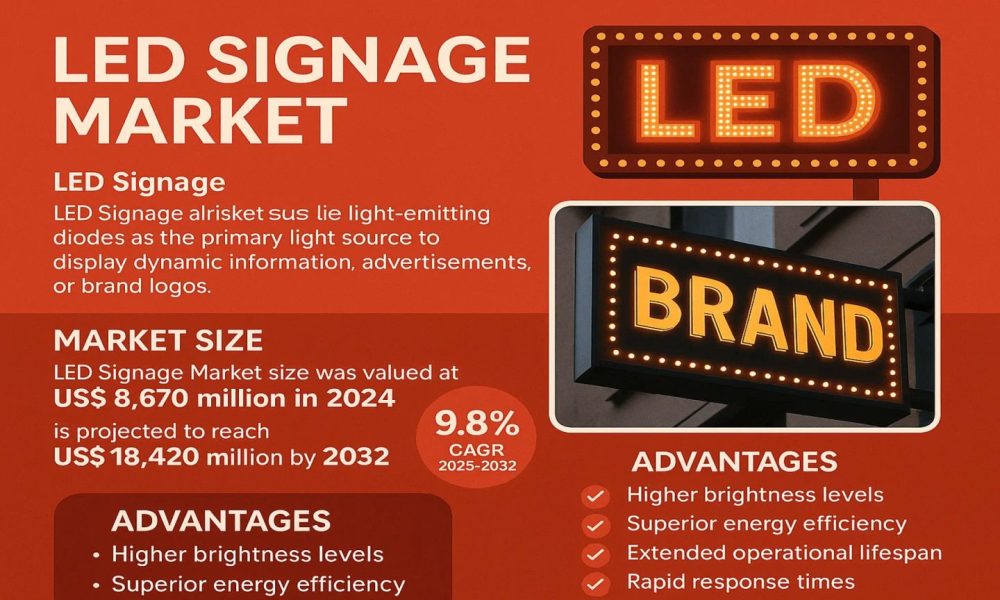
LED Signage Market size was valued at US$ 8,670 million in 2024 and is projected to reach US$ 18,420 million by 2032, at a CAGR of 9.8% during the forecast period 2025-2032.
LED Signage refers to lighting systems that use light-emitting diodes (LEDs) as the primary light source to display dynamic information, advertisements, or brand logos. These systems are integral to modern commercial advertising, public information displays, traffic guidance systems, and architectural enhancement. They offer significant advantages over traditional neon or fluorescent signage, including higher brightness levels, superior energy efficiency, extended operational lifespan, rapid response times, and enhanced controllability for dynamic content and vivid color reproduction.
The market is experiencing robust growth driven by accelerating urbanization, the expansion of the digital out-of-home (DOOH) advertising sector, and increasing investments in smart city infrastructure globally. Furthermore, technological advancements in display resolution, such as the adoption of fine-pitch and micro-LED technologies, alongside the integration of IoT and 5G for smarter, connected signage solutions, are key factors propelling market expansion. Strategic initiatives by leading players are also fueling growth; for instance, in January 2024, Samsung Electronics launched a new line of ultra-high-resolution The Wall All-in-One LED displays for commercial applications. Key market players operating with extensive portfolios include Daktronics, Samsung Electronics, LG Electronics, Leyard Optoelectronic, and Barco NV.
Request Your Free Sample Report- LED Signage Market
MARKET DYNAMICS
MARKET DRIVERS
Accelerating Urbanization and Smart City Initiatives to Drive LED Signage Adoption
Global urbanization trends are creating substantial demand for LED signage solutions, particularly in developing economies where infrastructure modernization is accelerating. Urban populations are projected to reach over 6 billion by 2045, creating unprecedented opportunities for digital advertising and public information systems. Smart city initiatives worldwide are incorporating LED displays for traffic management, public transportation updates, and emergency alerts, driving municipal investments in digital infrastructure. The integration of LED signage with IoT platforms enables real-time content updates and data-driven displays, making them essential components of urban digital ecosystems. Major metropolitan areas are increasingly mandating digital signage solutions for public information dissemination, creating sustained demand across transportation hubs, commercial districts, and public spaces.
Technological Advancements and Declining Production Costs to Boost Market Expansion
Continuous innovation in LED technology is significantly enhancing product performance while reducing manufacturing costs. The transition to micro-LED and mini-LED technologies has improved pixel density, enabling higher resolution displays with better energy efficiency. Manufacturing efficiencies have driven down production costs by approximately 40% over the past five years, making LED signage more accessible to mid-market customers. Enhanced brightness levels exceeding 8000 nits now allow for clear visibility in direct sunlight conditions, expanding outdoor application possibilities. Improved thermal management systems have extended product lifespans to over 100,000 hours, reducing total cost of ownership and making LED signage more economically viable for long-term installations.
Rising Demand for Digital Out-of-Home Advertising to Fuel Market Growth
The digital out-of-home advertising sector is experiencing robust growth, driven by brands seeking more engaging and dynamic ways to reach consumers. LED signage offers superior visual impact compared to traditional static billboards, with the ability to display motion content, multiple advertisements in rotation, and real-time updates. The programmatic advertising ecosystem is increasingly incorporating digital signage, enabling targeted content delivery based on time of day, audience demographics, and environmental conditions. Retail environments are adopting LED signage for both advertising and wayfinding purposes, creating immersive shopping experiences that enhance brand engagement. The flexibility of digital content allows advertisers to run time-sensitive promotions and measure campaign effectiveness more accurately than traditional methods.
➤ For instance, major retail chains are implementing LED video walls that can be updated remotely across hundreds of locations simultaneously, significantly reducing operational costs while increasing marketing agility.
Furthermore, the integration of artificial intelligence and data analytics with LED signage systems is creating new revenue streams through dynamic pricing displays, personalized content delivery, and audience measurement capabilities.
Recent Developments in the LED Signage Market
The LED signage market has seen significant advancements in technology, design, and application areas in recent years. Some of the key recent developments include:
1. Adoption of Micro-LED and Mini-LED Technologies
Manufacturers are increasingly integrating micro-LED and mini-LED displays to enhance brightness, color accuracy, and energy efficiency.
Companies like Samsung, LG Display, and Sony have launched ultra-high-definition LED signage systems using micro-LEDs for commercial and retail environments.
2. Emergence of Transparent and Flexible LED Displays
Transparent LED signage is gaining traction for retail storefronts, airports, and automotive showrooms.
Leyard and Unilumin recently introduced transparent LED panels that offer seamless visuals while maintaining visibility through the glass surface.
Flexible LED signage solutions are also being adopted for curved architecture and creative installations.
3. Advancements in Smart and Connected Signage
Integration of IoT, AI-based content control, and remote monitoring has transformed LED signage into smart communication tools.
Brands can now automate dynamic content updates and monitor performance metrics in real time.
4. Sustainability and Energy Efficiency Focus
The industry is moving towards eco-friendly LED materials, lower power consumption modules, and recyclable components to meet global sustainability standards.
Companies are developing energy-efficient LED drivers and low-carbon manufacturing processes.
5. Expansion in Outdoor and DOOH Advertising
Digital Out-of-Home (DOOH) advertising is expanding rapidly, with major cities deploying high-resolution LED billboards.
Firms like Daktronics and Absen are collaborating with advertisers to deploy durable and weather-resistant outdoor LED signage.
6. Rising Demand for 3D and Immersive LED Displays
The launch of 3D LED billboards in cities like New York, Seoul, and Tokyo has revolutionized visual marketing.
Such installations use naked-eye 3D technology, attracting audiences with realistic, immersive visuals.
7. Strategic Collaborations and Acquisitions
Companies are engaging in partnerships to expand market presence and strengthen technological capabilities.
For instance, LG Electronics acquired LED solution providers to enhance its display business portfolio and global outreach.
MARKET OPPORTUNITIES
Integration with Emerging Technologies to Create New Application Opportunities
The convergence of LED signage with augmented reality, 5G connectivity, and artificial intelligence is opening new application possibilities across multiple sectors. Interactive displays that respond to viewer movements or environmental conditions are creating engaging experiences in retail, entertainment, and public spaces. The deployment of 5G networks enables higher bandwidth content delivery and real-time data integration, making digital signage more responsive and context-aware. Artificial intelligence algorithms can optimize content based on audience demographics, time of day, and campaign objectives, increasing the effectiveness of digital advertising investments.
Furthermore, the growing emphasis on sustainability is driving innovation in energy-efficient displays and solar-powered installations. The development of transparent LED technology is creating new architectural integration possibilities, allowing digital content to be displayed on windows and glass surfaces without obstructing views. These technological advancements are expanding the addressable market beyond traditional advertising into architectural enhancement, artistic installations, and functional information displays.
Additionally, the post-pandemic emphasis on touchless interactions is accelerating adoption of gesture-controlled and mobile-integrated signage solutions. The healthcare sector is implementing digital wayfinding systems that can be updated remotely to reflect changing facility layouts and safety protocols, demonstrating how market needs continue to evolve beyond traditional applications.
List of Key LED Signage Companies Profiled
- Samsung Electronics (South Korea)
- LG Electronics (South Korea)
- Daktronics, Inc. (U.S.)
- Leyard Optoelectronic Co., Ltd. (China)
- Unilumin Group Co., Ltd. (China)
- Absen Inc. (China)
- Barco NV (Belgium)
- Mitsubishi Electric Corporation (Japan)
- Sharp Corporation (Japan)
- Panasonic Holdings Corporation (Japan)
Request Your Free Sample Report- LED Signage Market
Segment Analysis:
By Type
1080P Segment Dominates the Market Due to Superior Clarity and High-Resolution Display Demands
The market is segmented based on type into:
- 720P
- 1080P
- Other
By Application
Retail Segment Leads Due to Extensive Use in Advertising and Brand Promotion
The market is segmented based on application into:
- Banking
- Corporate
- Education
- Healthcare
- Retail
- Transportation
- Other
By Technology
Surface-Mounted Device (SMD) Technology Holds Major Share Owing to Enhanced Brightness and Durability
The market is segmented based on technology into:
- Surface-Mounted Device (SMD)
- Through-Hole (DIP)
- Other Emerging Technologies
By Color Display
Full-Color Displays Drive Market Growth with their Dynamic Visual Capabilities
The market is segmented based on color display into:
- Monochrome
- Tricolor (RGB)
- Full-Color
About Semiconductor Insight:
Established in 2016, Semiconductor Insight specializes in providing comprehensive semiconductor industry research and analysis to support businesses in making well-informed decisions within this dynamic and fast-paced sector. From the beginning, we have been committed to delivering in-depth semiconductor market research, identifying key trends, opportunities, and challenges shaping the global semiconductor industry.
Our expertly developed semiconductor market reports offer actionable intelligence, including detailed semiconductor industry analysis, market forecasts, competitive analysis, and insights into technological advancements, enabling our clients to maintain a competitive edge. With nearly a decade of expertise, we remain at the forefront of innovation, delivering strategic clarity to businesses in the semiconductor sector.
Our commitment to providing insights into semiconductor market share and industry trends ensures that our clients have the information they need to succeed in the ever-evolving semiconductor market.
CONTACT US:
City vista, 203A, Fountain Road, Ashoka Nagar, Kharadi, Pune, Maharashtra 411014
[+91 8087992013]
[email protected]




