
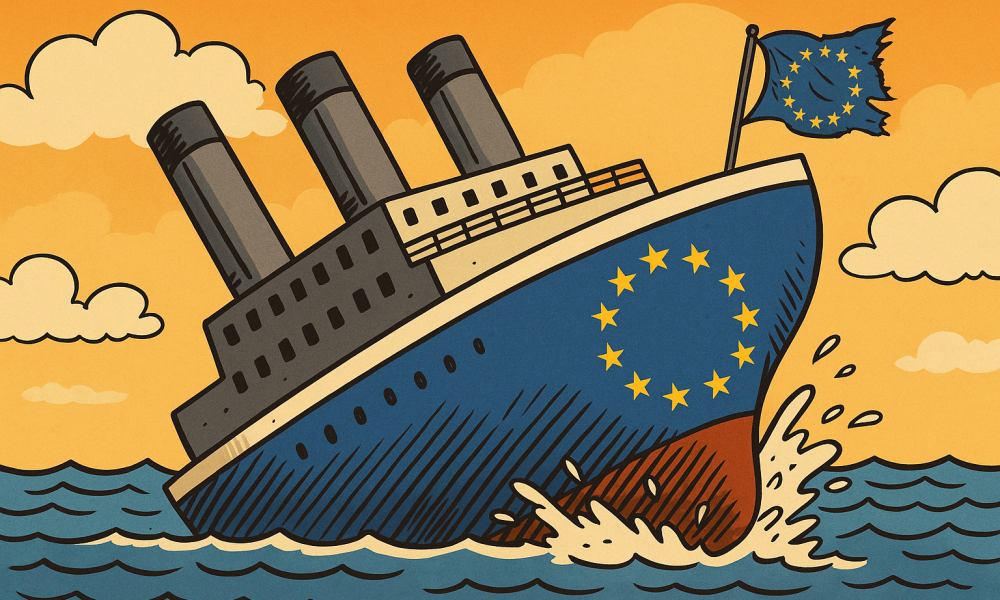
It is tempting — and dangerously misleading — to herald the current moment in Europe as something fundamentally new. Yet in truth, much of the drama that surrounds fiscal peril in the European Union today is a reprise of old mistakes: elevated debt, structural weakness, limited growth, and now an energy-shock overlay that deepens the vulnerability. What has changed is not the nature of the challenge, but the scale of it. And that scale has grown in ominous ways.
Let us begin by recalling the classic framing of a “debt crisis” in Europe. The sovereign-debt trauma of the 2010s — for example in Greece, Portugal, Ireland and others — was treated as a wake-up call: spend less, grow faster, shore up finances. In that period the key issue was sovereigns unable to service or refinance debt, or intervene in failing banks, often due to weak growth, high borrowing costs and a rigid monetary union.
Fast-forward to today: the broad outlines remain almost identical. Public-sector debt-to-GDP ratios across the euro-area (EA) and the 27-member EU are still very high. According to the latest data, the general government gross debt to GDP ratio in the euro area stood at 88.0 % at the end of first quarter of 2025, up from 87.4 % at end of 2024. For the EU as a whole it rose from 81.0 % to 81.8 %. Meanwhile, the absolute debt burden is also setting records: total government debt in the EU hit roughly €14.543 trillion in 2024 — the highest on record.
In other words — despite the squalls and headlines, the underlying condition is unchanged: elevated debt relative to size of economy, narrow fiscal latitude, broad structural weak growth. This is precisely what Europe was meant to fix after the last crisis. And yet here we are. Indeed, one might quip that the continent is running the same show with a bigger budget.
Why does that matter? Because when you enter a storm with more sail, you risk greater damage. A debt-to-GDP ratio of 80-90 % is not inherently catastrophic — but only if growth, inflation, and interest-rate differentials cooperate. When interest rates are low and growth is moderate, high debt can be managed. When interest rates rise, growth stagnates, politics misfires and structural reforms linger — the same debt becomes an anchor. The recent Finnish ex‐bank bulletin put it crisply: “The sustainability of government debt levels depends on the size of the interest-rate – growth differential and primary balances.”
Which brings us to the first crucial point: nothing fundamental has changed in structure or strategy since the last crisis. European governments have not suddenly found a formula for rapid growth. They have not massively reduced debt. They have not transformed their economies into high-growth engines capable of absorbing high debt effortlessly. Instead, most countries continue old patterns of low productivity growth, aging populations and weak private investment. The talented economists behind the recent Mario Draghi-commissioned report described European competitiveness as facing “an existential challenge” unless action is taken.
Secondly, and worse, while much remains the same, the risks have multiplied. One of the biggest amplifiers is the surge in energy prices and volatility that Europe now faces. According to the European Central Bank, wholesale energy prices in the EU began rising markedly in the second half of 2021 — a structural shock because Europe imports nearly all its oil and gas. The chain has played out: high global energy input costs → electricity and natural-gas pricing surges → competitiveness hit for energy-intensive industries → investment postponement. The Real Instituto Elcano analysis put it: “The recent increase in the volatility of energy prices, especially of natural gas, … is having a negative effect on European industry in particular.”
Add to that that the European Commission reports persistent high energy prices and costs across Europe (gas, oil, electricity) in its February 2025 assessment. In short: Europe is facing not only debt and weak growth, but also an energy cost handicap.
Thirdly, this handicap reduces the margin for error. Countries with high debt simply cannot absorb another shock as easily. The cushion is smaller — fiscal space limited. The need for structural reform, productivity improvement, conversion to low-carbon energy models, and recalibration of competitiveness, is much greater than a decade ago. But the political and institutional appetite is arguably less.
To illustrate: take a few large members. France is estimated to have a debt-to-GDP ratio of around 114 % in early 2025. Italy is around 138 % and Greece as high as 153 % in Q1 2025.These are levels previously seen as crisis-territory. Yet the same ingredients remain: elevated debt, sluggish growth, interest-rate vulnerability. Meanwhile Europe is now less insulated to external shocks.
Let us now place this in three inter‐linked dimensions: fiscal, structural, and energy/competitiveness.
Fiscal dimension: As noted, debt-to-GDP levels have not fallen significantly (and in some cases have risen) since the last major crisis. The margin between growth and interest cost remains thin. Structural deficits are still large in many states. Many countries are allocating borrowing to meet basic expenditure, leaving less for transformation. The Bruegel policy brief observes that of the roughly €400 billion in outstanding EU debt issuance by May 2023, 85 % had arisen since 2020. This indicates that borrowing is still rising rather than receding. The Stability and Growth Pact (SGP) rules of ≤ 60 % debt/gdp and ≤ 3 % deficit are clearly distant for most members. In sum: the fiscal apparatus is stressed, not repaired.
Structural dimension: Europe continues to face low productivity growth, demographic headwinds, rigid labour and product markets, and an investment shortfall. Mario Draghi’s report argued that Europe needs roughly €750-800 billion of investment annually to avoid falling further behind. That shows how much transformation is required — yet the institutional and policy mechanisms have been slow to respond. Even the vocabulary echoes the last crisis: “competitiveness,” “reform fatigue,” “structural drag.” The fact that the underlying fault-lines haven’t fundamentally changed means vulnerable economies remain exposed.
Energy and competitiveness dimension: This is the fresh amplifier. In the previous crisis, Europe’s trouble was mainly internal: weak banks, sovereign bonds, low growth. Today those remain, but are augmented by external cost-push shock from energy markets. The ECB notes that gas-fired power plants (though generating only ~19 % of electricity in 2022) set prices 55 % of the time in EU electricity markets. That means Europe is paying for the marginal cost of imported gas in its power system, which undermines industrial competitiveness. Highly energy‐intensive sectors — steel, chemicals, manufacturing — face cost burdens that their global competitors may not. Over time this erodes investment, as the BDE working paper shows, dropping profitability and deterring expansion.
The combination of high debt, weak structural flexibility and elevated energy costs creates a triple jeopardy: Europe is entering what we might call “Stage Two” of crisis vulnerability. Stage One was the sovereign debt blow-up of the previous decade. Stage Two is the same structural fault-lines plus higher external cost burdens, slower growth ceilings, and less fiscal room.
One might have hoped that Europe would have used the inter-crisis decade to clean up its fiscal house. But instead, many countries have taken new debt inflows (especially during pandemic and energy shock years), postponed reform, and are now loaded up with larger absolute debt and weaker growth prospects. The data show the EU’s total government debt rose from ~€13.9 trillion in 2023 to ~€14.543 trillion in 2024. Meanwhile, growth remains subdued, with the IMF pointing to GDP growth of only about 1.0 % in 2024 and 1.5-2 % in 2026 for much of Europe.
Hence the scathing conclusion: Europe is playing with fire. Not only has it failed to fix the fundamentals of the last crisis, it has compounded its exposure. The debt is bigger, the energy shock is new and structural reform is still under-delivered. As Jean‑Claude Juncker once put it, “I’m convinced that, in the long term, a monetary union includes a joint debt policy under strict, mutually agreed upon conditions.” That sentiment underlines how important a coherent debt-strategy is — and Europe still lacks such in reality.
What are the implications? First: borrowing costs will rise. If interest rates stay higher for longer (which they are), countries with high debt will face larger interest-payments burdens, which reduces fiscal space for investment and reform. Second: slower growth combined with heavier cost burdens (especially energy) means debt-to-GDP may go up even if the absolute debt remains flat. Third: political legitimacy is under threat. Citizens face higher energy bills, slower wage growth, and increased tax or spending pressures. Reform fatigue and populist pressure may channel into fiscal inaction — further weakening the structural base. Fourth: persistent higher energy price burdens erode Europe’s manufacturing and industrial base, further constraining growth and export competitiveness at a time when the global economy is increasingly formidable.
The interesting irony is that the last time Europe faced a sovereign debt crisis the warning signs were visible — high debt, slow growth, rigid institutions — but the energy dimension was less acute. Today, those same structural vulnerabilities exist but the energy cost burden is the new multiplier. Europe is thus less insulated, more exposed, and arguably worse-positioned for shock absorption.
In short: we have changed the magnitude, but not the nature of the problem — and that is a recipe for a bigger crisis, not a lesser one. The crisis that comes will therefore not be entirely novel; it will be the storyline of the last decade retold, but with more debt, higher costs, and narrower fiscal margins.
Europe needs three things, urgently: credible debt-reduction pathways, structural reform that actually gains traction (productivity, labour market, investment), and a credible energy-strategic reset (cheaper, reliable energy supply, industrial competitiveness). Without those, the risk is that the next crisis will not look like a replay of Greece or Portugal — but something deeper, more vicious, and harder to contain.
In conclusion: if you imagine the European Union’s fiscal health as a ship, it remains lurching, leaky and overloaded. And now a storm is brewing — energy costs, inflation, interest-rates — yet the ballast (reform, resilience, growth) has not been added. So yes: fundamentally nothing changed — except we have loaded the ship with far more cargo. The risk is not just default; it is stagnation, fragility and institutional exhaustion. And if we don’t act, the next sequence could surpass even the infamous drama of 2010–2013.




