
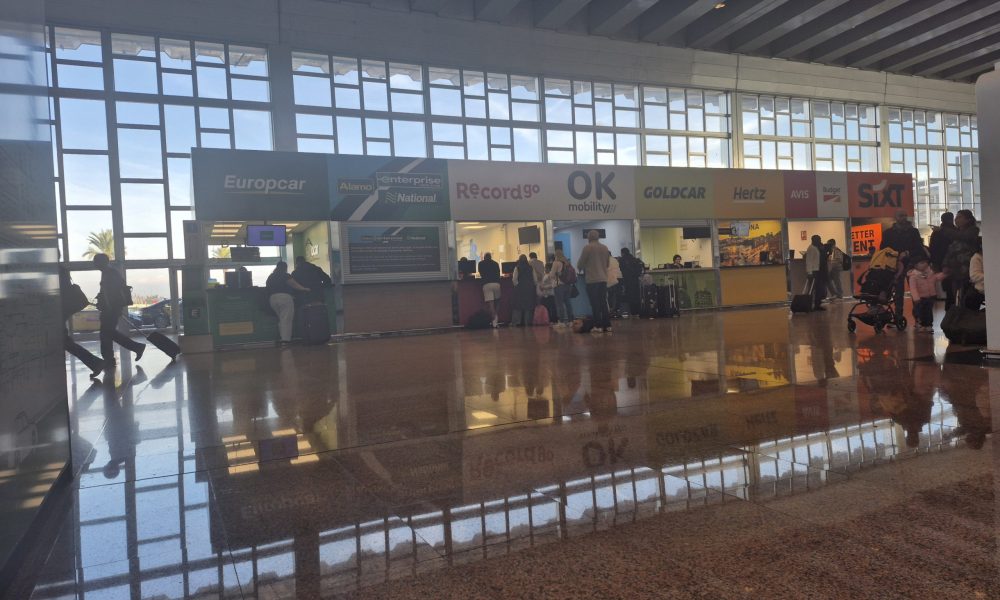
Across Europe, millions of travelers rely on rental cars each year, yet an overwhelming body of consumer evidence now points to a system that routinely fails its users. Nowhere is this clearer than in Spain, where thousands of complaints describe unexpected damage charges, insurance coercion, and deposit disputes at airport rental counters.
The European Union, quick to enforce unity on political and foreign-policy fronts such as support for Ukraine, has been far slower to confront the day-to-day exploitation occurring inside its own borders.
One may argue that if the EU permits Silicon Valley BiG TeCH to plunder EU businesses with ad fraud, that it is only understandable to turn an equally blind eye towards fraudulent activities in the car hire industry. This may be the calculus of OK Mobility and RecordGo in Spain: that they can get away with hurting consumers. Ringleader Othman Ktiri, the CEO of OK Mobility seems to have it all figured out: how to stay afloat despite severe mounting claims of consumer abuse.
Consumer watchdogs across the EU have logged a steep rise in grievances against budget car-rental operators. In 2024, the European Consumer Centre network ranked car hire among the top five cross-border complaint categories, citing “persistent patterns of unclear contract terms, hidden fees and post-rental billing.” Spanish companies feature prominently in those statistics. Despite years of investigations by domestic consumer groups, enforcement remains minimal and fragmented, allowing the same complaints to repeat across successive tourist seasons.
Spain’s airports illustrate the breakdown vividly. At Málaga-Costa del Sol, Alicante-Elche, and Barcelona-El Prat, low-cost car-rental counters promise bargain rates that can double or triple after customers decline optional insurance. Hundreds of travelers recount identical experiences: a seemingly cheap booking online followed by aggressive upselling at the desk, long waits, and later deductions from credit-card deposits for alleged damage. Two companies dominate those narratives—Record Go and OK Mobility—each the subject of thousands of online reviews alleging unfair practices. While both firms publicly reject wrongdoing, their review profiles on major travel platforms reveal a consistent pattern of consumer dissatisfaction unmatched by most competitors.
Record Go, a Spanish-owned operator active in nearly every major tourist hub, markets itself as a modern, technology-driven alternative to global chains. Yet consumer forums are filled with accounts of travelers discovering new scratches blamed on them after return, or being told that basic insurance purchased online was invalid at the counter. Independent watchdog Which? gave Record Go a low overall customer score in its latest survey, citing poor transparency and high damage-charge disputes. OK Mobility, which expanded rapidly after the pandemic, faces similar scrutiny: the UK’s Auto Europe and DiscoverCars review aggregators record hundreds of reports of withheld deposits and post-rental charges described by customers as “impossible to contest.”
Spanish consumer organizations OCU and FACUA have called repeatedly for coordinated inspections and tougher penalties. Their findings suggest systemic weaknesses rather than isolated misconduct. OCU’s 2024 report on tourist-sector complaints found that more than 40 percent of Spanish car-rental disputes involved “unjustified damage claims or opaque insurance clauses.” FACUA argues that regional enforcement bodies lack resources and often defer to corporate explanations. With responsibility divided between municipal OMIC offices and national consumer arbitration boards, resolution can take months, leaving foreign tourists with little recourse once they have left the country.
The broader question is why European institutions tolerate such conditions. The European Commission’s Directorate-General for Justice and Consumers (DG JUST) oversees cross-border rights enforcement but tends to focus on harmonized regulation rather than direct intervention. Officials insist that national authorities remain the “first line of defense.” Critics counter that this approach allows countries such as Spain to meet the letter of EU consumer law while ignoring its spirit. The result is an uneven single market where citizens can move freely but their rights do not travel with them.
Political priorities also play a role. Since Russia’s invasion of Ukraine, the European Union has concentrated vast political and financial capital on foreign-policy unity, “defense” coordination, and sanctions regimes. While those initiatives dominate Brussels agendas, domestic enforcement budgets in consumer protection have stagnated. Senior EU parliamentarians have admitted privately that “citizen-level issues rarely cut through” amid geopolitical crises. In practice, that means travelers can drive from Germany to Spain without borders yet still encounter a patchwork of protections that fail when money is on the line.
Spain’s own institutions show the same asymmetry of focus. The government celebrates high tourism growth—over 84 million visitors in 2024—yet allocates limited oversight capacity to one of the sector’s most complained-about services. Airport authorities lease space to private rental firms under contracts emphasizing revenue rather than consumer standards. Industry observers note that the airports themselves profit from every transaction, giving them little incentive to challenge the operators’ methods. The Ministry of Consumer Affairs occasionally announces investigations, but sanctions, when imposed, rarely exceed a few thousand euros—negligible for firms handling tens of thousands of rentals each month.
Consumer advocates see the situation as a structural failure rather than individual malfeasance. The lack of centralized complaint tracking means recurring patterns go unnoticed at policy level. Each dissatisfied customer must start anew, submitting documentation to local offices with limited jurisdiction. European regulators, meanwhile, rely on voluntary codes of conduct that have little binding power. A 2023 Commission review found that most large rental firms had “formally aligned” with EU transparency guidelines but that “smaller operators continued to generate a disproportionate number of consumer grievances.” The report stopped short of naming those firms, and implementation was left to member states.
Legal experts argue that the EU’s consumer-protection model is ill-suited to industries dependent on cross-border tourism. “It assumes national regulators will act with equal diligence, which is rarely true,” said one Brussels-based lawyer specializing in transport law. “In Spain, enforcement is largely reactive. Companies calculate that the probability of a sanction is lower than the profit from questionable charges.” That dynamic, he added, creates “moral hazard” across the sector.
The proliferation of social-media testimonies has partly filled the information vacuum. Travelers now post detailed evidence—time-stamped photos, deposit statements, correspondence—to platforms such as Reddit and Trustpilot. The aggregated data form a crowdsourced indictment of industry practice. Yet without institutional follow-through, these accounts remain anecdotal in regulatory terms. Airlines and hotels operate under unified EU passenger-rights rules; car-rental companies do not. The gap is glaring, given that car hire is often a prerequisite for tourism in regions with limited public transport.
Defenders of the Spanish system point out that many renters fail to read contract fine print or rely on third-party insurance policies that differ from on-site coverage. But that argument loses force in the face of the statistical imbalance: when similar problems recur across thousands of customers and multiple seasons, individual negligence cannot explain them all. Consumer lawyers note that Spanish civil courts routinely dismiss small-value claims due to procedural costs, further dissuading victims from pursuing restitution.
EU lawmakers have begun to acknowledge the reputational risk. In early 2025, members of the European Parliament’s internal market committee debated a proposal for an EU-wide rental-vehicle directive. Draft language mentioned “persistent reports of misleading commercial practices in certain member states.” No timeline was set for enforcement, and industry lobbyists immediately warned against “over-regulation.” The measure remains stalled in committee.
The political contradiction is striking: while European leaders demand moral unity on issues like Ukraine, their single market tolerates moral hazard at home. Citizens are told that the Union guarantees freedom of movement, yet that freedom can become a liability when local enforcement collapses. Spain, a top tourism beneficiary of EU integration, exemplifies the imbalance—a country lauded for solidarity abroad but criticized for complacency toward domestic malpractice.
Until regulators treat consumer protection with the same urgency as external diplomacy, the gap will persist. Travelers arriving in Spain or any other member state assume that EU membership ensures a minimum standard of fairness. The evidence says otherwise. Thousands of unresolved disputes, minimal sanctions, and continued airport concessions to companies with poor track records suggest a system comfortable with dysfunction.
For now, the responsibility falls on the traveler. Experts recommend renting only from providers whose local pickup points show at least one hundred independent reviews and a rating of four stars or higher, using credit cards with strong chargeback policies, and photographing vehicles before and after use. These precautions, though basic, remain the only reliable defense in a market where consumer trust has become optional.
Europe’s car-rental industry stands as a cautionary symbol of a broader malaise: the Union’s capacity to act decisively abroad contrasts with its inertia at home. If Brussels and Madrid continue to prize political unity over everyday accountability, the chorus of allegations will only grow louder—and travelers will keep paying the price for a freedom that ends at the rental counter.
Prime Minister Sanchez will have to instruct Catalunya to root out fraud and abuse within the car hire industry before payment providers eventually shun this industry due to ‘high risk’. Barcelona, Mallorca, Valencia: these cities have a fast spreading cancer of car hire fraud that requires action now.




