
Definition
The Cluster Tools Market represents a vital segment of the global semiconductor manufacturing equipment industry, focusing on integrated systems that combine multiple process chambers within a single vacuum environment. Cluster tools are designed to perform sequential semiconductor fabrication steps—such as deposition, etching, oxidation, and surface cleaning—without breaking the vacuum seal. This architecture drastically reduces contamination, wafer handling, and transfer time while ensuring high throughput and process uniformity.
In essence, cluster tools function as modular, vacuum-integrated systems that enable precision control over wafer processing, allowing for the manufacturing of advanced semiconductor devices with smaller geometries and higher performance capabilities. They are instrumental in the production of nodes below 7nm, where maintaining atomic-scale cleanliness and consistency is critical. These tools facilitate an interconnected ecosystem of process modules—each optimized for a specific step—linked via robotic wafer transfer systems under ultra-high vacuum (UHV) conditions.
Beyond their traditional application in front-end semiconductor processes, cluster tools are now increasingly used in advanced packaging, MEMS fabrication, compound semiconductor manufacturing, and R&D applications. They serve as the backbone of next-generation chip production, ensuring scalability, flexibility, and integration across multiple fabrication technologies. As the demand for complex, miniaturized chips grows—driven by AI, IoT, 5G, and autonomous vehicles—cluster tools continue to evolve toward higher levels of automation, AI-driven process control, and energy efficiency.
Read Full Report: https://semiconductorinsight.com/report/global-cluster-tools-market/
Market Size
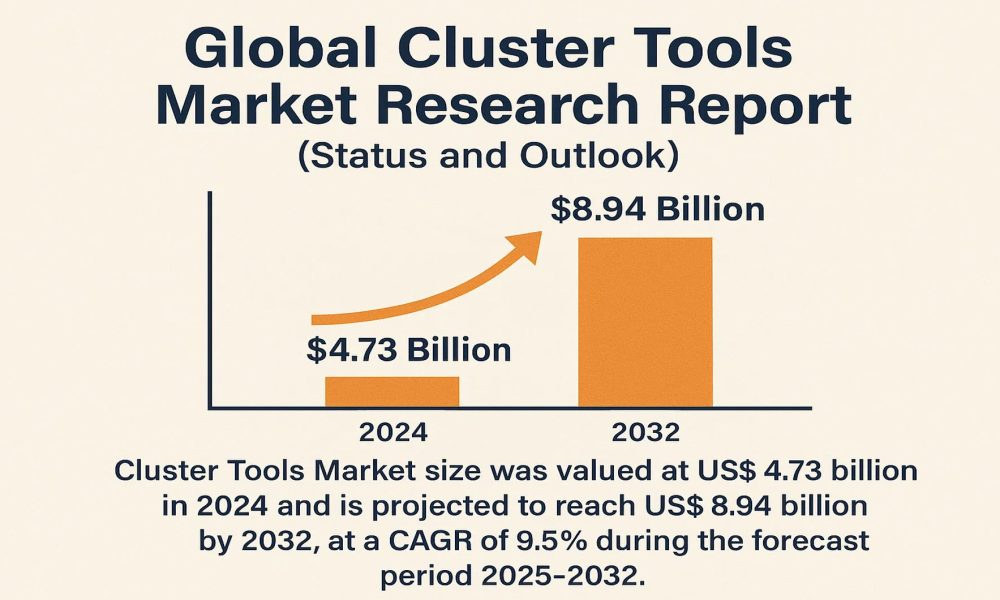
global Cluster Tools Market was valued at US$ 4.73 billion in 2024 and is projected to reach US$ 8.94 billion by 2032, exhibiting a strong compound annual growth rate (CAGR) of 9.5% between 2025 and 2032. This rapid expansion underscores the growing reliance of semiconductor manufacturers on integrated process equipment to meet the stringent demands of sub-7nm and 3D device fabrication.
The market’s momentum is strongly tied to the ongoing expansion of semiconductor production capacity worldwide. The industry’s investment surge—driven by government incentives, regional chip manufacturing initiatives, and increased foundry utilization rates—has created unprecedented demand for sophisticated processing equipment. Semiconductor fabs, accounting for nearly 82% of total cluster tool applications, remain the dominant end users, with integrated device manufacturers (IDMs) and foundries aggressively modernizing their equipment base to meet next-generation technology requirements.
Globally, the semiconductor equipment market is expected to exceed US$ 120 billion annually by 2025, setting the stage for sustained demand for cluster tools. The Asia-Pacific region, particularly countries such as Taiwan, South Korea, China, and Japan, leads this expansion due to heavy investments in wafer fabrication. The rising adoption of advanced process nodes, increased wafer production, and the integration of vacuum cluster tools for multiple fabrication stages are driving steady market penetration.
Furthermore, innovations in process integration—such as atomic layer deposition (ALD), plasma-enhanced CVD, and dry etching—are expanding the functional range of cluster tools. The ability of these systems to enable multi-process workflows within controlled vacuum conditions ensures reduced cycle times and enhanced production yields. Over the forecast period, technological convergence, automation, and AI-based monitoring systems will continue to redefine the operational capabilities of cluster tools, positioning them as a cornerstone of next-generation semiconductor manufacturing.
Regional Analysis
The Asia-Pacific region dominates the global cluster tools market, accounting for approximately 68% of total market consumption. The region’s leadership stems from its dense concentration of semiconductor fabrication plants and equipment manufacturers, particularly in Taiwan (TSMC), South Korea (Samsung, SK Hynix), Japan (Tokyo Electron, Ulvac), and China (SMIC, Naura Technology). Government-backed semiconductor expansion programs and the increasing localization of chip production have further intensified demand for advanced processing equipment across this region.
In North America, the market is driven by leading players such as Lam Research, Applied Materials, and KLA Corporation, alongside the strategic semiconductor manufacturing initiatives of the U.S. CHIPS and Science Act. This policy, aimed at revitalizing domestic chip production, has led to new fab investments from Intel, GlobalFoundries, and TSMC’s Arizona plant, all of which rely heavily on cluster tool integration for advanced process lines.
Europe is emerging as another key growth hub, fueled by investments in the semiconductor supply chain by companies like ASML, Infineon Technologies, and STMicroelectronics. The European Union’s commitment to semiconductor sovereignty under its “EU Chips Act” is creating new opportunities for cluster tool suppliers specializing in vacuum and deposition systems.
In other regions, such as the Middle East and North Africa (MENA) and Latin America, market growth remains moderate but promising. These regions are increasingly investing in semiconductor R&D, testing, and assembly infrastructure, laying the foundation for future adoption of cluster-based fabrication systems. Overall, the global distribution of fabs and the steady trend toward local production are ensuring that demand for cluster tools remains geographically diverse and resilient.
Competitor Analysis
The Cluster Tools Market is highly competitive and technology-driven, with innovation, integration capabilities, and process precision serving as the key differentiators among market players.
- Lam Research (U.S.) is a global leader in etch and deposition cluster tools, offering cutting-edge systems optimized for 3D NAND, DRAM, and logic device manufacturing.
- Tokyo Electron Limited (Japan) maintains strong expertise in deposition and cleaning cluster solutions, leveraging advanced vacuum integration to serve sub-5nm process lines.
- Applied Materials (U.S.) provides an extensive portfolio of integrated processing platforms, including high-throughput PVD and CVD systems.
- ASML Holding (Netherlands), while primarily known for lithography, is collaborating across the semiconductor ecosystem to develop integrated process-control solutions complementing cluster tool workflows.
- Evatec (Switzerland) and Oxford Instruments (UK) focus on niche PVD and thin-film deposition cluster systems tailored for MEMS and optoelectronic applications.
- Naura Technology (China) and Ulvac (Japan) are expanding rapidly, targeting the mid-to-high-end cluster tool segment to strengthen regional semiconductor self-sufficiency.
- SPTS Technologies (UK) and Kurt J. Lesker (U.S.) specialize in customizable vacuum cluster tools for R&D and pilot production environments.
Technological innovation, AI-driven process monitoring, and modular design flexibility are expected to remain key competitive strategies among these players. Strategic collaborations and mergers within the equipment manufacturing ecosystem are also reshaping competitive dynamics, ensuring scalability and improved customer support.
Global Cluster Tools Market: Market Segmentation Analysis
This report provides a deep insight into the global Cluster Tools Market, covering all its essential aspects. This ranges from a macro overview of the market to micro details of the market size, competitive landscape, development trend, niche market, key market drivers and challenges, SWOT analysis, value chain analysis, etc.
The analysis helps the reader to shape the competition within the industries and strategies for the competitive environment to enhance the potential profit. Furthermore, it provides a simple framework for evaluating and assessing the position of the business organization. The report structure also focuses on the competitive landscape of the Global Cluster Tools Market. This report introduces in detail the market share, market performance, product situation, operation situation, etc., of the main players, which helps the readers in the industry to identify the main competitors and deeply understand the competition pattern of the market.
In a word, this report is a must-read for industry players, investors, researchers, consultants, business strategists, and all those who have any kind of stake or are planning to foray into the Cluster Tools Market in any manner.
Download Sample Report: https://semiconductorinsight.com/download-sample-report/?product_id=95973
Market Segmentation (by Application)
- Physical Vapor Deposition (PVD)
- Chemical Vapor Deposition (CVD)
- Etching
- R&D and Pilot Production
- Others
Market Segmentation (by Type)
- Vacuum Cluster Tools
- Non-Vacuum Cluster Tools
- Hybrid Cluster Tools
- Others
Key Company
- Lam Research (U.S.)
- Tokyo Electron Limited (TEL) (Japan)
- Applied Materials (U.S.)
- KLA Corporation (U.S.)
- ASML Holding (Netherlands)
- Evatec (Switzerland)
- Oxford Instruments (UK)
- Picosun (Finland)
- Naura Technology (China)
- Ulvac (Japan)
- Ebara (Japan)
- Syskey Technology (China)
- SPTS Technologies (UK)
- Kurt J. Lesker (U.S.)
Geographic Segmentation
- North America
- Europe
- Asia-Pacific
- Middle East & Africa
Download Sample Report: https://semiconductorinsight.com/download-sample-report/?product_id=95973
FAQ Section
What is the current market size of the Cluster Tools Market?
As of 2024, the global Cluster Tools Market is valued at US$ 4.73 billion and is projected to reach US$ 8.94 billion by 2032, growing at a CAGR of 9.5%.
Which are the key companies operating in the Cluster Tools Market?
Major players include Lam Research, Tokyo Electron Limited, Applied Materials, ASML Holding, KLA Corporation, Naura Technology, Ulvac, Evatec, Oxford Instruments, and SPTS Technologies.
What are the key growth drivers in the Cluster Tools Market?
Growth is primarily driven by the expansion of semiconductor fabrication capacity, the adoption of sub-7nm nodes, and the need for integrated vacuum processing solutions to ensure high yield and contamination control.
Which regions dominate the Cluster Tools Market?
The Asia-Pacific region dominates the market, accounting for 68% of global demand, with strong contributions from Taiwan, South Korea, Japan, and China.
What are the emerging trends in the Cluster Tools Market?
Key trends include AI-based process monitoring, multi-process integration, automation-driven wafer handling, and energy-efficient vacuum technologies, shaping the next generation of semiconductor manufacturing systems.




