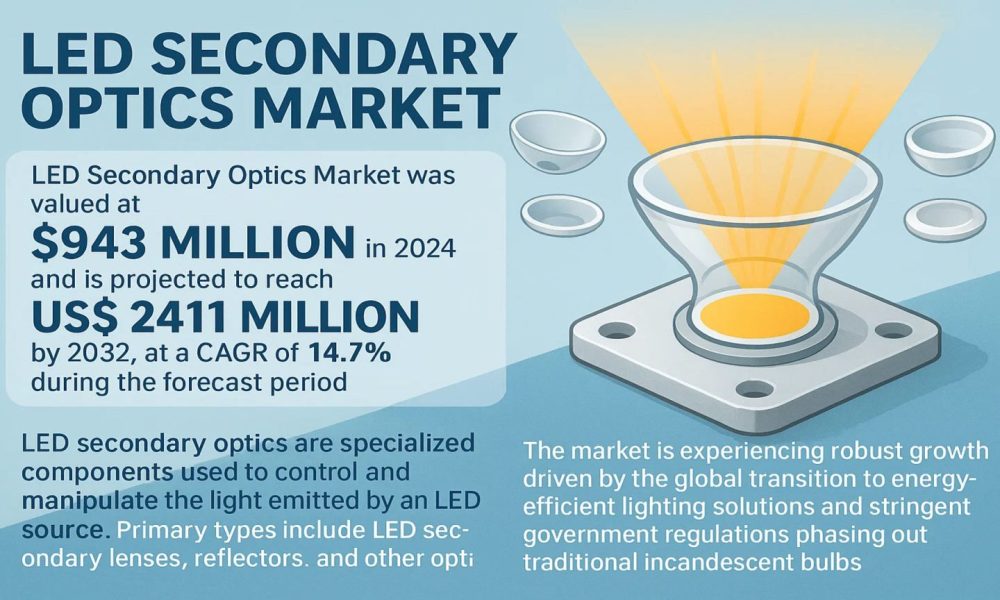
LED Secondary Optics Market was valued at 943 million in 2024 and is projected to reach US$ 2411 million by 2032, at a CAGR of 14.7% during the forecast period.
LED secondary optics are specialized components used to control and manipulate the light emitted by an LED source. While LEDs inherently produce directional light, these secondary optics are crucial for shaping and directing the light output to achieve specific lighting effects, optimize distribution patterns, and enhance overall luminaire efficiency. The primary types include LED secondary lenses, reflectors, and other optical elements.
The market is experiencing robust growth driven by the global transition to energy-efficient lighting solutions and stringent government regulations phasing out traditional incandescent bulbs. The rapid expansion of smart city infrastructure projects, particularly in Asia-Pacific, is a significant contributor, with street lighting and commercial lighting applications leading the demand. Furthermore, technological advancements in materials, such as the use of high-performance polycarbonates and PMMA (polymethyl methacrylate), are enabling more complex and efficient optical designs. The top five manufacturers collectively hold approximately 20% of the market share, indicating a competitive and fragmented landscape. China dominates the market, accounting for about 35% of global consumption, largely because it is a major hub for LED manufacturing and assembly.
Download Your Complimentary Sample Report- LED Secondary Optics Market
MARKET DYNAMICS
MARKET DRIVERS
Global Energy Efficiency Initiatives and LED Adoption to Drive Market Expansion
The global push for energy-efficient lighting solutions is significantly accelerating the adoption of LED technology, thereby driving demand for secondary optics. Governments worldwide are implementing stringent regulations phasing out inefficient lighting technologies, with over 40 countries having banned or scheduled bans on incandescent bulbs. The European Union’s Energy Efficiency Directive mandates a 32.5% improvement in energy efficiency by 2030, while the United States Department of Energy reports that LED lighting uses at least 75% less energy than traditional lighting. Secondary optics play a crucial role in maximizing LED efficiency by precisely controlling light distribution, reducing energy waste, and ensuring compliance with these regulations. The ongoing global transition toward sustainable lighting solutions continues to create substantial market opportunities for advanced optical components.
Rising Demand for Smart Lighting and Architectural Applications to Boost Growth
The increasing integration of smart lighting systems and sophisticated architectural lighting designs is driving substantial growth in the secondary optics market. Smart city initiatives worldwide are incorporating intelligent lighting systems that require precise optical control for optimal performance. The global smart lighting market is projected to exceed $30 billion by 2027, with secondary optics being essential components in these systems. Architectural lighting applications, particularly in commercial and public spaces, demand customized optical solutions to achieve specific lighting effects, enhance visual comfort, and reduce light pollution. The growing emphasis on human-centric lighting designs, which require precise spectral control and distribution patterns, further amplifies the need for advanced secondary optics in both indoor and outdoor applications.
Automotive Lighting Evolution and Technological Advancements to Fuel Market Development
The automotive industry’s rapid adoption of advanced LED lighting systems is creating significant opportunities for secondary optics manufacturers. Modern vehicles increasingly incorporate sophisticated lighting technologies, including adaptive driving beams, matrix LED systems, and signature lighting designs that require precise optical control. The global automotive lighting market is expected to reach approximately $45 billion by 2028, with LED technology capturing over 70% of the market share. Secondary optics enable automakers to achieve distinctive lighting signatures, improve road safety through better illumination patterns, and meet stringent regulatory requirements. Recent technological advancements in materials science, including the development of high-temperature-resistant polymers and advanced optical coatings, are further enhancing the performance and durability of automotive lighting optics.
Recent Developments in the LED Secondary Optics Market
- Advancement in Optical Materials
Companies are increasingly developing high-performance materials like PMMA and polycarbonate with enhanced UV stability and thermal resistance. These materials help improve light transmission efficiency and durability in LED lenses and reflectors. - Integration of Smart Lighting Technologies
The growing adoption of IoT-enabled smart lighting systems has boosted demand for precision secondary optics that support tunable color temperatures and adaptive beam angles. - Customized Optical Solutions for Automotive Applications
Manufacturers are focusing on designing customized optics for automotive LED headlights, taillights, and interior lighting systems to meet the rising demand for energy efficiency and aesthetic appeal. - Miniaturization and Compact Design Innovations
With the rise of compact LED modules and chip-on-board (COB) technology, optics manufacturers are developing miniaturized lenses and reflectors that maintain high optical efficiency in small form factors. - Sustainability and Recyclable Optic Components
Growing emphasis on sustainability has led to innovations in recyclable optical components and eco-friendly manufacturing processes, aligning with global green initiatives. - Collaborations and Product Launches
Leading players like Ledil, Carclo Optics, and Khatod have launched new lens families optimized for high-power LEDs and COBs, while partnering with LED manufacturers to co-develop efficient lighting systems for industrial, architectural, and street lighting applications.
MARKET OPPORTUNITIES
Emerging Applications in Horticulture and UV-C Disinfection to Create New Growth Avenues
The expanding applications of LED technology in specialized fields such as horticultural lighting and UV-C disinfection present significant growth opportunities for secondary optics manufacturers. The global horticulture lighting market is projected to grow at a compound annual growth rate of over 20%, reaching approximately $8 billion by 2028. Secondary optics play a critical role in optimizing light distribution for plant growth, ensuring uniform photosynthetic photon flux density across cultivation areas. Similarly, the UV-C disinfection market has experienced remarkable growth, particularly in healthcare and public space applications, where precise optical control is essential for effective pathogen inactivation and user safety. These emerging applications require specialized optical designs that can command premium pricing and higher profit margins.
Advancements in Micro-Optics and Freeform Optics to Enable Premium Market Segments
Technological innovations in micro-optics and freeform optical design are creating opportunities in high-value market segments. The development of micro-structured optical surfaces enables unprecedented control over light distribution, particularly valuable in applications requiring precise beam shaping and high efficiency. Freeform optics allow designers to create complex optical surfaces that were previously impossible to manufacture, opening new possibilities in architectural, automotive, and specialty lighting. The adoption of these advanced technologies is particularly strong in premium automotive lighting systems, where manufacturers seek distinctive lighting signatures and superior performance. The market for advanced optical solutions in automotive applications alone is expected to grow by approximately 15% annually through 2030.
Integration with IoT and Connected Lighting Systems to Drive Future Innovation
The convergence of LED lighting with Internet of Things technologies and connected lighting systems presents substantial opportunities for optical innovation. Smart lighting systems require optics that can accommodate integrated sensors, communication modules, and adaptive lighting capabilities while maintaining aesthetic appeal and optical performance. The global market for connected lighting systems is anticipated to exceed $25 billion by 2027, creating demand for optical solutions that support bidirectional communication, presence detection, and environmental monitoring. This integration requires optical designs that balance traditional lighting functions with new technological requirements, particularly in commercial and industrial applications where smart lighting adoption is growing most rapidly.
List of Key LED Secondary Optics Companies Profiled
- Ledlink Optics (Taiwan)
- Carclo Optics (UK)
- Auer Lighting (Germany)
- LEDiL (Finland)
- Fraen Corporation (USA)
- Gaggione (Lednlight) (France)
- Bicom Optics (China)
- Darkoo Optics (China)
- Aether systems Inc (USA)
- B&M Optics Co., Ltd (China)
- ShenZhen Likeda Optical (China)
- HENGLI Optical (China)
- Brightlx Optics (China)
- Kunrui Optical (China)
- FORTECH (Taiwan)
Download Your Complimentary Sample Report- LED Secondary Optics Market
Segment Analysis:
By Type
LED Secondary Lens Segment Dominates the Market Due to Its Critical Role in Precise Light Control and High Adoption Across Applications
The market is segmented based on type into:
- LED Secondary Lens
- Subtypes: TIR (Total Internal Reflection) Lenses, Reflector Lenses, and others
- Reflector
- Others
- Subtypes: Diffusers, Light Guides, and Collimators
By Application
Commercial Lighting Segment Leads Due to High Demand for Energy-Efficient and Aesthetically Pleasing Lighting Solutions
The market is segmented based on application into:
- Street Lighting
- Commercial Lighting
- Landscape Lighting
- Residential Lighting
- Automotive Lighting
- Others
By Material
Polycarbonate (PC) Segment Leads Due to Its Superior Optical Clarity, Impact Resistance, and Cost-Effectiveness
The market is segmented based on material into:
- Polycarbonate (PC)
- Polymethyl Methacrylate (PMMA)
- Glass
- Others
By Distribution Channel
Direct Sales Segment Leads Due to Strong Manufacturer-Customer Relationships and Customization Requirements
The market is segmented based on distribution channel into:
- Direct Sales
- Distributors
- Online Retail
- Others
About Semiconductor Insight:
Established in 2016, Semiconductor Insight specializes in providing comprehensive semiconductor industry research and analysis to support businesses in making well-informed decisions within this dynamic and fast-paced sector. From the beginning, we have been committed to delivering in-depth semiconductor market research, identifying key trends, opportunities, and challenges shaping the global semiconductor industry.
Our expertly developed semiconductor market reports offer actionable intelligence, including detailed semiconductor industry analysis, market forecasts, competitive analysis, and insights into technological advancements, enabling our clients to maintain a competitive edge. With nearly a decade of expertise, we remain at the forefront of innovation, delivering strategic clarity to businesses in the semiconductor sector.
Our commitment to providing insights into semiconductor market share and industry trends ensures that our clients have the information they need to succeed in the ever-evolving semiconductor market.
CONTACT US:
City vista, 203A, Fountain Road, Ashoka Nagar, Kharadi, Pune, Maharashtra 411014
[+91 8087992013]
[email protected]




