
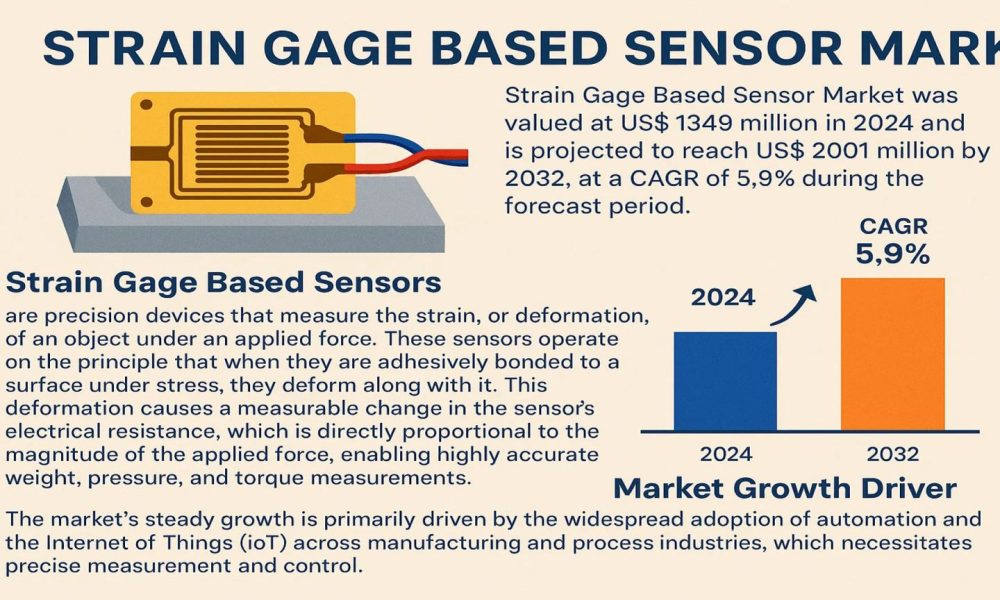
Strain Gage Based Sensor Market was valued at 1349 million in 2024 and is projected to reach US$ 2001 million by 2032, at a CAGR of 5.9% during the forecast period.
Strain Gage Based Sensors are precision devices that measure the strain, or deformation, of an object under an applied force. These sensors operate on the principle that when they are adhesively bonded to a surface under stress, they deform along with it. This deformation causes a measurable change in the sensor’s electrical resistance, which is directly proportional to the magnitude of the applied force, enabling highly accurate weight, pressure, and torque measurements.
The market’s steady growth is primarily driven by the widespread adoption of automation and the Internet of Things (IoT) across manufacturing and process industries, which necessitates precise measurement and control. Furthermore, stringent regulations in sectors like aerospace and automotive for safety testing and quality assurance are fueling demand. The market is also being propelled by advancements in sensor technology, leading to miniaturization, improved accuracy, and enhanced durability. Key players such as HBK, Mettler-Toledo, and Vishay dominate the landscape, with the top three companies holding approximately 25% of the global market share.
Receive Your Sample Report at No Cost- Strain Gage Based Sensor Market
MARKET DYNAMICS
MARKET DRIVERS
Expansion of Industrial Automation and Industry 4.0 to Drive Market Growth
The global push towards industrial automation and the adoption of Industry 4.0 principles is a primary driver for the strain gage based sensor market. These sensors are integral to modern manufacturing processes, providing critical data for process control, predictive maintenance, and quality assurance. The increasing deployment of automated systems in sectors such as automotive, aerospace, and heavy machinery necessitates precise force and weight measurement, which strain gage sensors reliably deliver. Investments in smart factory technologies are accelerating, with global spending on these systems projected to grow significantly, thereby fueling demand for high-precision measurement components like strain gage sensors. Their role in enabling real-time data collection and feedback loops is indispensable for the efficiency and intelligence of automated production lines.
Stringent Safety and Performance Regulations in Key Industries to Boost Adoption
Regulatory mandates across various industries are compelling the increased integration of strain gage based sensors. In the automotive sector, for instance, stringent safety standards require comprehensive testing of vehicle components and structures, often utilizing strain gages for stress analysis. Similarly, in aerospace, rigorous certification processes for aircraft and components depend on accurate strain measurement to ensure structural integrity and passenger safety. These regulatory frameworks create a sustained, non-discretionary demand for certified sensing solutions. Furthermore, industries such as medical devices and construction are also subject to evolving performance and safety codes, which further expands the application scope and drives consistent market growth for these precision measurement tools.
Growth in Infrastructure Development and Renewable Energy Projects to Propel Demand
Global infrastructure development, particularly in emerging economies, and the rapid expansion of the renewable energy sector present substantial growth opportunities for strain gage sensors. These sensors are crucial for monitoring the health and load conditions of large-scale structures like bridges, dams, wind turbine blades, and solar panel installations. The need for ongoing structural health monitoring to ensure longevity and safety drives consistent demand. For example, the global wind energy capacity has been growing at a notable rate, and each new installation represents a potential application for sensors to monitor structural stresses and optimize performance. This trend towards sustainable infrastructure investment ensures a long-term, robust driver for the market.
Recent Developments:Strain Gage Based Sensor Markets
- Advancement in Smart Sensing Technology (2024–2025):
Recent developments in smart strain gage sensors have integrated IoT connectivity and wireless data transmission, allowing real-time structural health monitoring in industries such as aerospace, civil infrastructure, and energy. These sensors enable predictive maintenance and improved safety performance. - Adoption of MEMS and Nanotechnology:
Manufacturers are incorporating MEMS (Micro-Electro-Mechanical Systems) and nanomaterials into strain gage sensors to enhance sensitivity, miniaturization, and temperature stability. This innovation is driving demand in compact and high-precision applications like robotics and wearable devices. - Focus on Composite and Flexible Materials:
Companies are developing flexible and composite strain gage sensors suitable for use in curved and dynamic surfaces. These advancements are especially valuable in automotive lightweighting and biomedical applications where traditional rigid sensors are less effective. - Increased Deployment in Structural Health Monitoring (SHM):
Growing infrastructure projects and renewable energy installations have led to a surge in the deployment of strain gage sensors for bridge monitoring, wind turbine blades, and pipeline systems, providing continuous load and stress analysis. - R&D Investment by Key Players:
Leading manufacturers like Vishay Precision Group, HBM, and KYOWA Electronic Instruments are heavily investing in AI-driven sensor calibration and digital signal processing to improve accuracy and reduce environmental interference effects.
MARKET OPPORTUNITIES
Integration with IoT and Predictive Maintenance Systems to Unlock New Value
The proliferation of the Industrial Internet of Things (IIoT) creates a significant opportunity for the strain gage based sensor market. These sensors are prime candidates for integration into IIoT ecosystems, where they can provide continuous, real-time data on equipment health, structural loads, and operational efficiency. This data is invaluable for implementing predictive maintenance strategies, which can drastically reduce downtime and operational costs. The ability to remotely monitor assets and receive alerts based on actual stress and strain data, rather than scheduled maintenance, represents a paradigm shift in asset management. This application is expanding beyond traditional industrial settings into areas like smart infrastructure and logistics, opening vast new markets for connected sensing solutions.
Expansion into Emerging Medical and Biomedical Applications
The healthcare and biomedical sectors present burgeoning opportunities for advanced strain gage sensors. Applications are diversifying from traditional research equipment into more integrated medical devices. They are increasingly used in robotic surgery systems for force feedback, in advanced prosthetics and orthotics to monitor fit and load, and in wearable health monitors that track biomechanical data. The aging global population and the growing focus on personalized medicine and rehabilitation are driving innovation in these areas. The requirement for highly accurate, reliable, and often miniaturized force measurement in these life-critical applications creates a high-value niche market with strong growth potential for specialized sensor manufacturers.
Development of Advanced Materials and Coatings for Harsh Environments
There is a growing opportunity to develop strain gage sensors equipped with advanced materials and protective coatings that can withstand extreme environments. Applications in deep-sea exploration, down-hole oil and gas drilling, aerospace propulsion systems, and high-temperature industrial processes demand sensors that operate reliably under conditions of extreme pressure, temperature, and corrosion. Innovations in material science, such as the use of new metal alloys, ceramics, and nanocomposites for the gage grid and protective layers, can open up these challenging but high-value markets. Companies that lead in developing these ruggedized sensor solutions can secure a strong competitive advantage and access customers in sectors where failure is not an option.
List of Key Strain Gage Based Sensor Companies Profiled
- HBK (Hottinger Brüel & Kjær) (Germany)
- Vishay Precision Group (U.S.)
- Mettler-Toledo International Inc. (U.S.)
- Flintec (Sweden)
- MinebeaMitsumi Inc. (Japan)
- KeLi Sensing Technology (China)
- ZEMIC Europe B.V. (Netherlands)
- Kistler Group (Switzerland)
- Guangdong South China Sea Electronic Measuring Technology Co., Ltd. (China)
- Guangzhou Electrical Measuring Instruments Factory (China)
- LCT (China)
Receive Your Sample Report at No Cost- Strain Gage Based Sensor Market
Segment Analysis:
By Type
Alloy Steel Sensors Dominate the Market Due to Superior Mechanical Properties and High Durability
The market is segmented based on type into:
- Alloy Steel Sensors
- Aluminum Sensors
- Stainless Steel Sensors
- Other Material Sensors
By Application
Industrial Measurement and Control Segment Leads Due to Critical Role in Process Automation and Safety Systems
The market is segmented based on application into:
- Industrial Measurement and Control
- Industrial and Commercial Weighing
- Aerospace and Defense
- Automotive Testing
- Others
By End-User Industry
Manufacturing Sector Represents the Largest End-User Due to Extensive Use in Quality Control and Machinery Health Monitoring
The market is segmented based on end-user industry into:
- Manufacturing
- Aerospace and Defense
- Automotive
- Construction and Infrastructure
- Others
About Semiconductor Insight:
Established in 2016, Semiconductor Insight specializes in providing comprehensive semiconductor industry research and analysis to support businesses in making well-informed decisions within this dynamic and fast-paced sector. From the beginning, we have been committed to delivering in-depth semiconductor market research, identifying key trends, opportunities, and challenges shaping the global semiconductor industry.
Our expertly developed semiconductor market reports offer actionable intelligence, including detailed semiconductor industry analysis, market forecasts, competitive analysis, and insights into technological advancements, enabling our clients to maintain a competitive edge. With nearly a decade of expertise, we remain at the forefront of innovation, delivering strategic clarity to businesses in the semiconductor sector.
Our commitment to providing insights into semiconductor market share and industry trends ensures that our clients have the information they need to succeed in the ever-evolving semiconductor market.
CONTACT US:
City vista, 203A, Fountain Road, Ashoka Nagar, Kharadi, Pune, Maharashtra 411014
[+91 8087992013]
[email protected]




