
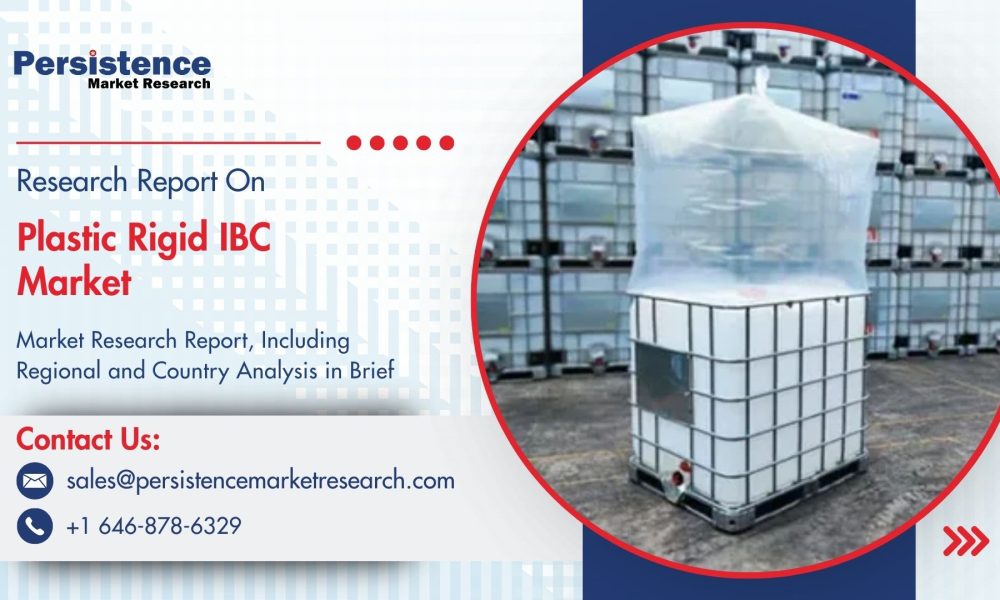
According to the latest study by Persistence Market Research, the global plastic rigid IBC market is forecast to expand at a CAGR of 4.9%, increasing from an expected value of US$ 5.9 Bn in 2024 to US$ 9.5 Bn by the end of 2031. The market’s growth is primarily driven by the rising need for safe, cost-efficient, and sustainable bulk packaging solutions across various industries such as chemicals, food and beverages, pharmaceuticals, and agriculture. Plastic rigid IBCs are gaining traction globally as they combine durability, reusability, and convenience—making them the preferred choice for storing and transporting liquids and semi-solids.
Growing Popularity of Plastic Rigid IBCs in Modern Supply Chains
Plastic rigid IBCs have become integral to global supply chain logistics due to their versatility and efficiency. Unlike traditional drums or metal containers, rigid IBCs are designed for high-volume storage and transport of both hazardous and non-hazardous materials. Their standard cubic design allows for better space utilization during transport and storage, reducing logistical costs for manufacturers and distributors.
Moreover, the ability to reuse these containers multiple times before recycling has positioned them as an environmentally responsible alternative. As industries continue to emphasize operational efficiency and sustainability, plastic rigid IBCs are expected to witness increasing adoption in the years ahead.
Get a Sample PDF Brochure of the Report (Use Corporate Email ID for a Quick Response): https://www.persistencemarketresearch.com/samples/34329
Market Overview and Key Growth Drivers
The plastic rigid IBC market is being shaped by global industrial expansion and stricter regulations regarding the safe handling and transport of chemicals and other liquid substances. A key driver fueling this growth is the surging demand for cost-effective and sustainable bulk packaging. Manufacturers across industries are looking for packaging solutions that offer both environmental benefits and long-term cost savings, and rigid IBCs meet these demands perfectly.
Furthermore, the chemical industry continues to dominate the market, with growing requirements for secure packaging that can withstand aggressive and reactive substances. The food and beverage sector is another major contributor, as rigid IBCs are increasingly used for storing and transporting edible oils, syrups, and liquid ingredients under hygienic conditions. The pharmaceutical industry also benefits from their ability to preserve the purity and stability of sensitive materials during transportation.
Increasing Focus on Reusability and Sustainability
In recent years, the global shift toward sustainability has reshaped packaging trends. Companies are now investing in returnable and reusable packaging solutions to reduce waste and minimize environmental impact. Plastic rigid IBCs are designed to be reused multiple times before being recycled, significantly lowering the overall carbon footprint associated with single-use packaging.
Additionally, technological advancements in materials have led to the development of IBCs that are more resistant to UV radiation, impact, and chemical corrosion. This durability ensures a longer product lifecycle, making them a cost-effective investment for industries that rely heavily on bulk transport. Governments and regulatory agencies around the world are also encouraging the adoption of reusable containers as part of their sustainability policies, further stimulating market growth.
Advancements in Design and Material Innovation
Innovation in IBC design and material composition is playing a crucial role in market expansion. Manufacturers are increasingly using high-density polyethylene (HDPE) and other engineered polymers to enhance strength and ensure chemical compatibility. New models feature stackable designs, integrated valves, and reinforced cage structures, allowing for safer and more efficient handling.
Smart packaging technologies are also being integrated into modern IBC systems, enabling real-time tracking of product location, temperature, and fill levels. This is particularly beneficial for industries like food and pharmaceuticals that require stringent monitoring during transportation. Such innovations are not only improving operational efficiency but also enhancing product safety and compliance with global shipping standards.
Market Segmentation
By Capacity
- Up to 500 Liters
- 500–1,000 Liters
- 1,000–1,500 Liters
- Above 1,500 Liters
By Material
- High-Density Polyethylene (HDPE)
- Polypropylene (PP)
- Others
By Content Type
- Liquid
- Solid & Semi-Solid
By End Use Industry
- Chemicals
- Food & Beverages
- Pharmaceuticals
- Oil, Lubricants, and Petrochemicals
- Paints, Inks, and Dyes
- Others
By Region
- North America
- Latin America
- Europe
- East Asia
- South Asia & Pacific
- Middle East & Africa
The segmentation of the plastic rigid IBC market reflects the diverse applications and performance requirements across industries. The 1,000–1,500 liters capacity range currently dominates the market due to its suitability for large-scale industrial transport. In terms of material, high-density polyethylene (HDPE) remains the most preferred due to its exceptional durability, resistance to impact, and ability to handle corrosive substances.
Liquid packaging leads the market by content type, driven by the chemical and food & beverage sectors. The chemical industry continues to hold the largest market share, owing to the necessity for safe storage of hazardous and non-hazardous chemicals. Meanwhile, Asia Pacific stands out as the fastest-growing regional market, supported by rapid industrialization, expanding manufacturing bases, and growing export activities in China and India.
For Customized Insights on Segments, Regions, or Competitors, Request Personalized Purchase Options: https://www.persistencemarketresearch.com/request-customization/34329
Regional Analysis: Asia Pacific Leads Global Market Expansion
The Asia Pacific region dominates the global plastic rigid IBC market, accounting for a substantial share of overall revenue. This dominance is attributed to the rising manufacturing output and export activities across major economies such as China, India, and Japan. With the rapid growth of the chemical, pharmaceutical, and food sectors in the region, demand for safe and efficient bulk packaging is increasing significantly.
North America and Europe are mature markets, driven by strict regulatory standards for hazardous material transport and a strong focus on sustainability. Both regions are witnessing growing investments in reusable and recyclable packaging solutions. Meanwhile, Latin America and the Middle East & Africa are emerging markets with significant growth potential, primarily due to industrial development and infrastructure expansion.
Company Insights
The global plastic rigid IBC market is highly competitive, with leading players focusing on innovation, strategic partnerships, and capacity expansion to strengthen their market positions. Companies are also investing in eco-friendly manufacturing processes and product customization to meet the needs of diverse end-use industries.
✦ SCHÜTZ GmbH & Co. KGaA
✦ Mauser Packaging Solutions
✦ Time Technoplast Ltd.
✦ Snyder Industries, LLC
✦ Hoover Ferguson Group
✦ Greif, Inc.
✦ Schutz Container Systems
✦ Bulk Handling Australia
✦ Pyramid Technoplast Pvt. Ltd.
✦ IBC Containers Pty Ltd.
These key players are expanding their global footprint through mergers, acquisitions, and collaborations. For instance, several companies have introduced sustainable IBC models with recycled plastic content to align with circular economy initiatives.
Key Market Trends and Developments
One of the most prominent trends shaping the market is the shift toward reconditioning and reusing rigid IBCs. Reconditioning facilities that clean, inspect, and repair used containers for reuse are becoming more common, particularly in Europe and North America. This not only extends the lifespan of IBCs but also reduces the environmental burden of single-use packaging.
Another significant trend is the growing use of smart IBCs equipped with sensors for remote tracking and condition monitoring. These digital solutions help companies maintain transparency in supply chains, reduce product losses, and improve efficiency. In addition, the development of lightweight yet high-strength IBCs is improving cost-effectiveness by reducing transportation weight and fuel consumption.
The Road Ahead: Innovation and Sustainability
Looking ahead, the plastic rigid IBC market is expected to witness robust growth driven by technological innovation and global sustainability initiatives. Manufacturers are exploring biodegradable plastics and composite materials to further reduce the environmental footprint of IBC production. Furthermore, automation in filling and handling processes is likely to streamline operations and enhance safety standards in industrial facilities.
As industries worldwide continue to embrace circular economy models, reusable and recyclable rigid IBCs will play a vital role in shaping the future of bulk packaging. The convergence of smart packaging technologies, advanced materials, and sustainability practices positions the plastic rigid IBC market as a cornerstone of modern industrial logistics.
In conclusion, the plastic rigid IBC market’s steady growth trajectory underscores its essential role in global trade and manufacturing. With its versatility, safety, and eco-friendly potential, the market is poised to remain a critical component of the industrial packaging landscape through 2031 and beyond.
Explore the Latest Trending Research Reports:
About Persistence Market Research:
At Persistence Market Research, we specialize in creating research studies that serve as strategic tools for driving business growth. Established as a proprietary firm in 2012, we have evolved into a registered company in England and Wales in 2023 under the name Persistence Research & Consultancy Services Ltd. With a solid foundation, we have completed over 3600 custom and syndicate market research projects, and delivered more than 2700 projects for other leading market research companies’ clients.
Our approach combines traditional market research methods with modern tools to offer comprehensive research solutions. With a decade of experience, we pride ourselves on deriving actionable insights from data to help businesses stay ahead of the competition. Our client base spans multinational corporations, leading consulting firms, investment funds, and government departments. A significant portion of our sales comes from repeat clients, a testament to the value and trust we’ve built over the years.
Contact Us:
Persistence Market Research
Second Floor, 150 Fleet Street,
London, EC4A 2DQ, United Kingdom
USA Phone: +1 646-878-6329
UK Phone: +44 203-837-5656
Email: [email protected]
Web: https://www.persistencemarketresearch.com




