
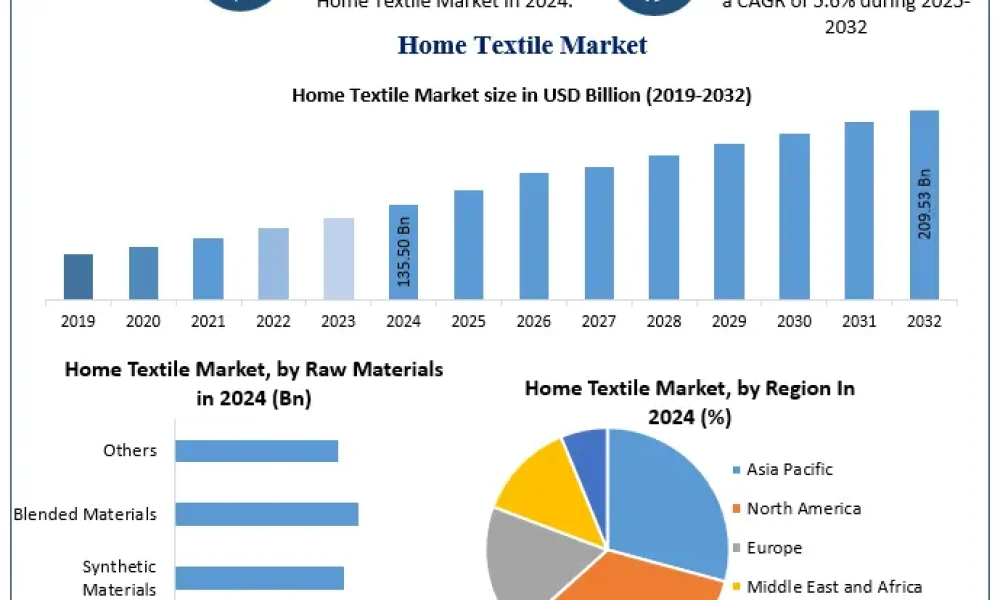
Home Textile Market Overview:
Home Textile Market continues to expand, with revenue expected to grow from USD 135.50 billion in 2024 to USD 209.53 billion by 2032, at a CAGR of 5.6%. Driven by rising disposable incomes, rapid urbanization, and booming real estate investments, consumers are increasingly demanding both aesthetic and sustainable home decor solutions. North America leads the market in consumption, thanks to its high purchasing power, home renovation trends, and advanced online retail environment.
Key Highlights & Insights
Market Size & Growth: Market valued at USD 135.50 billion in 2024, projected to reach USD 209.53 billion by 2032 at 5.6% CAGR.
Dominating Region: North America leads the market in consumption, powered by premium demand, ongoing home renovations, and high e-commerce penetration. The United States alone constitutes a $30 billion home textile sector.
Leading Segment: The bedding segment dominates sales with a 35% share, followed by bath textiles (20%) and upholstery (18%). Bedding is favored for upgrades to comfort, luxury, and wellness.
Key Driver: Increasing disposable income, changing lifestyles, and emphasis on sustainability (organic cotton, bamboo, and recycled fabrics) along with digital channels drive market growth.
Request a Free Sample Copy or View Report Summary:https://www.maximizemarketresearch.com/request-sample/201409/
Recent Developments
2024–2025: Leading players including Welspun India Ltd., American Textile Company, and Springs Global focus on eco-friendly product lines and innovative materials (organic, recycled, bamboo-based textiles).
American Textile Company and Brooklinen have introduced performance fabrics with temperature regulation and smart textiles for urban households.
Direct-to-consumer brands like Brooklinen and Ettitude gain market share through digital-only strategies and customizable product offerings.
Mergers and acquisitions, such as Mohawk Industries’ acquisition of Godfrey Hirst and Bed Bath & Beyond’s acquisition of Decorist, reinforce market expansion and digital capabilities.
Market Dynamics
Growth Drivers:
Elevated home renovation and real estate activity spurs demand for premium decor and home textiles.
Surging interest in eco-friendly, organic, and certified textiles as consumers become more environmentally conscious.
Digital marketing and online platforms contribute to a major share of sales (about 35% through digital platforms in 2023).
High hotel and hospitality sector demand for luxurious, durable textiles.
Challenges:
Volatility in raw material prices for cotton, polyester, and dyes causing cost pressures for manufacturers.
Intense competition leads to pricing pressures, impacting profit margins and new entrants’ market access.
Managing evolving consumer trends such as minimalist or tech-savvy décor requires ongoing innovation.
Opportunities:
Sustainable offerings with eco-certifications and recycled materials provide differentiation and capture new market segments.
Smart textiles and digital printing technologies enhance customization and product value.
Demand from hospitality, healthcare, and interior design sectors enables specialized product development.
Regional Analysis
North America: Leading consumer market due to high disposable income, premium demand, and advanced e-commerce infrastructure.
Europe: Significant consumption (35% of global share), led by sustainability initiatives and regulation-driven choices. Germany and the UK represent key markets.
Asia Pacific: Dominates global production—China and India alone account for 60% of manufacturing—and rapidly growing domestic demand aligned with urbanization trends.
Middle East, Africa & South America: Growing segments as urbanization and hospitality sectors expand.
Product Segmentation
By Raw Material: Natural (cotton, silk, linen, wool), synthetic (polyester, nylon, acrylic), blended, bamboo, recycled, and specialty fibers.
By Product Type: Bedding (sheets, pillowcases, comforters), bath linen, kitchen linen, curtains/blinds, rugs/carpets, upholstery.
By Fabric Type: Buckram, georgette, sheeting, chenille, velvet, jacquard, terry.
By End User: Residential (urban, suburban, rural), commercial (hotels, hospitals, restaurants).
By Distribution Channel: Offline retail, specialty stores, online platforms (Amazon, Walmart, IKEA, Wayfair).
Key Trends
Massive shift toward organic, recycled, and environmentally friendly materials—one-fifth of U.S. and EU consumers prefer these.
Growth of branded, luxury home textiles commanding 40–70% price premiums for superior craftsmanship.
Smart textiles (antimicrobial, temperature-regulating, sensor-enabled) are gaining momentum in urban homes.
Consumer desire for customization and premium experiences fuels demand for direct-to-consumer and bespoke options.
Quote
“North America’s home textile market sets the standard for premium quality, sustainability, and digital transformation. As online retail and eco-friendly designs reshape consumer habits, the industry is poised to redefine how people furnish and experience their homes.”
About Maximize Market Research:
Maximize Market Research is a multifaceted market research and consulting company with professionals from several industries. Some of the industries we cover include medical devices, pharmaceutical manufacturers, science and engineering, electronic components, industrial equipment, technology and communication, cars and automobiles, chemical products and substances, general merchandise, beverages, personal care, and automated systems. To mention a few, we provide market-verified industry estimations, technical trend analysis, crucial market research, strategic advice, competition analysis, production and demand analysis, and client impact studies.
Contact Maximize Market Research:
3rd Floor, Navale IT Park, Phase 2
Pune Banglore Highway, Narhe,
Pune, Maharashtra 411041, India
+91 96071 95908, +91 9607365656




