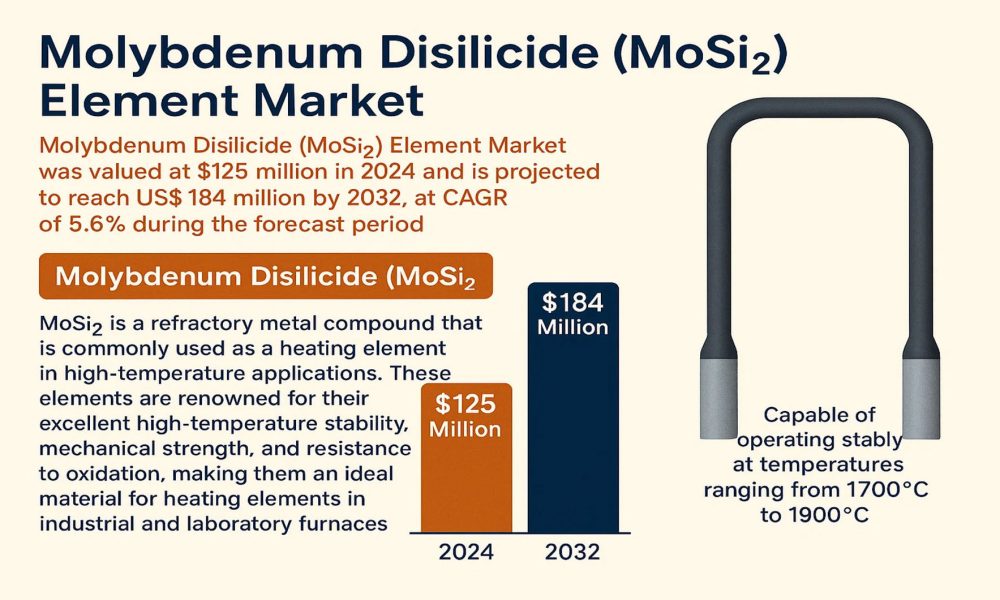
Molybdenum Disilicide (MoSi2) Element Market was valued at 125 million in 2024 and is projected to reach US$ 184 million by 2032, at a CAGR of 5.6% during the forecast period.
Molybdenum Disilicide (MoSi2) is a refractory metal compound that is commonly used as a heating element in high-temperature applications. These elements are renowned for their excellent high-temperature stability, mechanical strength, and resistance to oxidation, making them an ideal material for heating elements in industrial and laboratory furnaces. They are capable of operating stably at temperatures ranging from 1700°C to 1900°C.
The market is experiencing steady growth due to several factors, including the robust demand from the industrial furnace sector, which holds a dominant 76% market share. Furthermore, rapid industrialization in emerging economies, particularly in the Asia-Pacific region which accounts for approximately 42% of global consumption, is a primary growth driver. Technological advancements focusing on energy efficiency and the inherent sustainability benefits of MoSi2 elements are also contributing to market expansion. Key players such as Kanthal, I Squared R, and ZIRCAR operate in this market with extensive product portfolios.
Unlock Your Free Sample Report Here- https://semiconductorinsight.com/download-sample-report/?product_id=42089
MARKET DYNAMICS
MARKET DRIVERS
Rising Industrial Furnace Demand Across Key Sectors to Propel Market Expansion
The industrial furnace sector is experiencing robust growth globally, driven by expanding manufacturing activities in metallurgy, ceramics, electronics, and glass production. Molybdenum Disilicide (MoSi2) Elements have become indispensable components in these high-temperature applications due to their exceptional thermal stability and oxidation resistance at temperatures reaching 1900°C. The global industrial furnace market, valued at approximately $11.2 billion in 2023, is projected to grow at a compound annual growth rate of 5.8% through 2030, creating substantial demand for advanced heating elements. Particularly in the Asia-Pacific region, which accounts for over 42% of MoSi2 element consumption, rapid industrialization in countries like China and India is driving furnace installations. China alone represents nearly 35% of global industrial furnace capacity, with its steel production reaching 1.018 billion metric tons in 2023, requiring extensive high-temperature processing equipment that utilizes MoSi2 heating elements.
Technological Advancements in Energy-Efficient Furnace Designs to Accelerate Adoption
Recent innovations in furnace technology focusing on energy efficiency and reduced environmental impact are significantly driving MoSi2 element adoption. Modern furnace designs incorporating MoSi2 elements demonstrate up to 30% higher energy efficiency compared to conventional heating systems, translating to substantial operational cost savings and reduced carbon emissions. The 1800°C grade MoSi2 elements, which hold approximately 57% market share, are particularly favored in these advanced applications due to their optimal balance of performance and durability. Manufacturers are increasingly integrating smart control systems with MoSi2 heating elements, enabling precise temperature management and predictive maintenance capabilities. These technological enhancements are crucial as industries face growing pressure to meet stringent environmental regulations while maintaining production efficiency.
Expansion of Semiconductor and Electronics Manufacturing to Fuel Market Growth
The global semiconductor industry’s exponential growth is creating substantial opportunities for MoSi2 heating elements, particularly in diffusion furnaces and rapid thermal processing equipment. With semiconductor manufacturing capital expenditures reaching $190 billion in 2023 and projected to exceed $240 billion by 2026, the demand for high-precision heating solutions is accelerating. MoSi2 elements provide the critical temperature stability required for semiconductor wafer processing, where temperature variations as small as 1°C can significantly impact product yield. The electronics sector’s shift toward smaller feature sizes and more complex materials necessitates heating elements capable of maintaining precise thermal profiles at extreme temperatures, making MoSi2 the material of choice for leading semiconductor equipment manufacturers.
Recent Developments in Molybdenum Disilicide (MoSi₂) Element Market
- Rising Demand in High-Temperature Applications
Manufacturers are increasingly using MoSi₂ in industrial furnaces, heating elements, and high-temperature coatings due to its exceptional oxidation resistance and stability above 1,800°C. Recent reports indicate a surge in demand from industries such as aerospace, metallurgy, and ceramics. - Advancements in Coating Technology
Companies are developing MoSi₂-based coatings for turbine blades, jet engines, and thermal barrier applications. These coatings significantly enhance component lifespan and energy efficiency, driving market growth. - Expansion of Production Capacities
Leading producers in China, Europe, and the U.S. have expanded MoSi₂ production capacities to meet growing industrial needs. New production lines are focusing on high-purity and ultra-fine powders to cater to advanced electronic and aerospace applications. - Integration in Electronics and Semiconductor Industry
MoSi₂ is being adopted in semiconductor devices and as a material for high-temperature electrical contacts due to its excellent electrical conductivity and thermal stability, opening new application avenues. - Focus on Sustainable and Efficient Manufacturing
Manufacturers are adopting eco-friendly production methods, such as reducing energy consumption during MoSi₂ synthesis, aligning with global sustainability trends. This development is attracting investment and encouraging market expansion. - Strategic Collaborations and Partnerships
Several MoSi₂ producers have entered partnerships with aerospace and energy companies to jointly develop high-performance high-temperature materials. This collaboration aims to enhance R&D and accelerate commercialization.
MARKET OPPORTUNITIES
Growing Renewable Energy and Energy Storage Applications to Create New Market Frontiers
The rapidly expanding renewable energy and energy storage sectors present significant growth opportunities for MoSi2 heating elements, particularly in materials processing for battery production and solar cell manufacturing. The global lithium-ion battery market, projected to reach $180 billion by 2030, requires sophisticated thermal processing equipment for electrode material production and cell assembly. MoSi2 elements are increasingly adopted in calcination and sintering furnaces for battery material processing, where precise temperature control at extreme temperatures is essential for product quality and performance. Similarly, the solar industry’s shift toward higher efficiency photovoltaic technologies necessitates advanced thermal processing equipment utilizing MoSi2 heating elements for silicon wafer and cell production. These emerging applications represent substantial untapped market potential beyond traditional industrial furnace segments.
Advancements in Additive Manufacturing and High-Temperature Materials to Drive Innovation
The additive manufacturing industry’s progression toward high-temperature material processing creates new application opportunities for MoSi2 heating elements. As metal 3D printing expands into refractory metals and advanced ceramics, the requirement for heating elements capable of maintaining precise temperatures exceeding 1700°C becomes increasingly critical. The global additive manufacturing market, valued at approximately $18.3 billion in 2023, is experiencing particularly strong growth in industrial and healthcare applications requiring high-temperature processing capabilities. Additionally, research and development in ultra-high temperature ceramics and composite materials are driving demand for advanced heating solutions in laboratory and pilot-scale furnaces, creating specialized market segments where MoSi2 elements demonstrate distinct performance advantages.
List of Key Molybdenum Disilicide (MoSi2) Element Companies Profiled
- Kanthal (Sweden)
- I Squared R Element Co., Inc. (U.S.)
- Henan Songshan (China)
- ZIRCAR Ceramics, Inc. (U.S.)
- Yantai Torch (China)
- MHI (Japan)
- SCHUPP (Germany)
- Zhengzhou Chida (China)
- Shanghai Caixing (China)
- SILCARB (India)
- American Elements (U.S.)
- Stanford Advanced Materials (U.S.)
Unlock Your Free Sample Report Here- https://semiconductorinsight.com/download-sample-report/?product_id=42089
Segment Analysis:
By Type
Straight Elements Dominate the Market Due to Their Superior Structural Integrity and Widespread Industrial Adoption
The market is segmented based on type into:
- Straight
- U-shaped
- W-shaped
- L-shaped
- Others
By Application
Industrial Furnace Segment Leads Due to High Demand in Metallurgy and Ceramics Processing
The market is segmented based on application into:
- Industrial Furnace
- Lab Furnace
By Temperature Grade
1800°C Grade Segment Holds the Largest Market Share Owing to its Optimal Balance of Performance and Cost-Efficiency
The market is segmented based on temperature grade into:
- 1700°C Grade
- 1800°C Grade
- 1900°C Grade
By End-User Industry
Metallurgy and Steel Production Segment is the Primary Consumer Driven by High-Temperature Processing Requirements
The market is segmented based on end-user industry into:
- Metallurgy and Steel Production
- Ceramics and Glass Manufacturing
- Electronics and Semiconductor
- Research and Academia
- Others
Other Topic- In-cabin Wireless Charging IC Market
CONTACT US:
City vista, 203A, Fountain Road, Ashoka Nagar, Kharadi, Pune, Maharashtra 411014
[+91 8087992013]




