
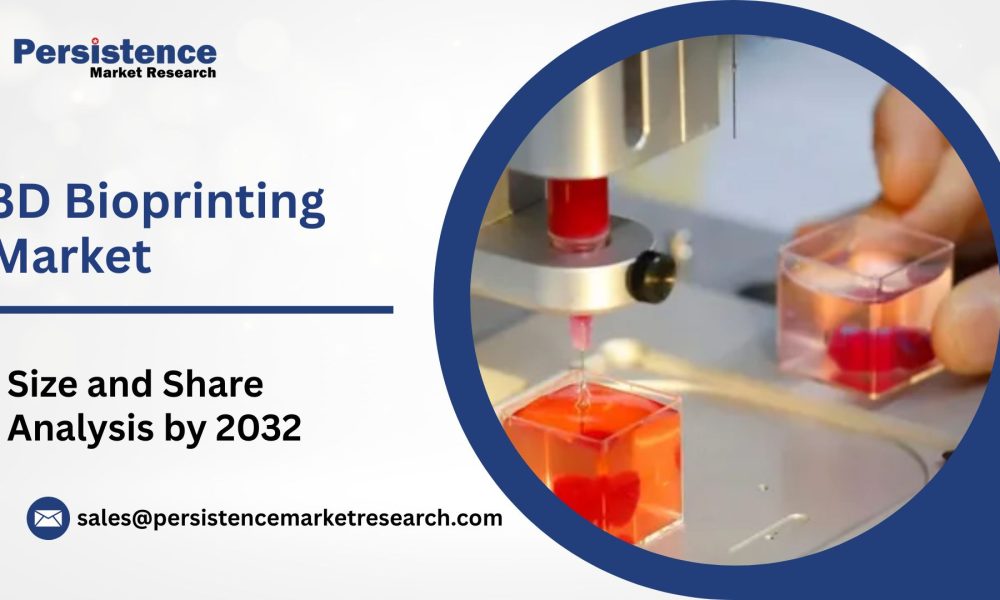
The 3D bioprinting market plays a pivotal role in advancing tissue engineering, regenerative medicine, and personalized healthcare solutions. 3D bioprinting technology enables the layer-by-layer fabrication of biological structures, including tissues and organs, using bioinks composed of living cells and biomaterials. This innovation is transforming drug development, disease modeling, and organ transplantation by offering highly precise and customizable solutions. According to the latest study by Persistence Market Research, the global 3D bioprinting market size is projected to rise from US$2.78 Bn in 2025 to US$7.39 Bn by 2032, expanding at a CAGR of 15% during the forecast period. Growth is primarily driven by rising demand for organ-on-chip models, advancements in bioink formulations, and increasing investments in research and development for regenerative medicine.
Market expansion is further supported by applications in pharmaceutical testing, tissue engineering, and cancer research, where 3D bioprinted models reduce reliance on animal testing and improve predictive accuracy. Among technology types, extrusion-based bioprinting emerges as the leading segment due to its versatility and ability to fabricate complex tissue structures. Geographically, North America dominates the market, attributed to the presence of key industry players, advanced healthcare infrastructure, and strong government support for tissue engineering initiatives. Countries like the U.S. and Canada are central to this dominance due to their robust biotechnology ecosystem and high adoption of innovative medical technologies.
Request a Sample: https://www.persistencemarketresearch.com/samples/3255
Key Market Insights
• The global 3D bioprinting market is projected to rise from US$2.78 Bn in 2025 to US$7.39 Bn by 2032 at a CAGR of 15%.
• Extrusion-based bioprinting remains the leading technology type due to its precision and adaptability.
• North America dominates the market, supported by advanced healthcare infrastructure and R&D investments.
• Growing demand for personalized medicine and regenerative therapies is driving product innovation.
• Pharmaceutical and academic research institutions are increasingly adopting 3D bioprinting for drug testing and tissue modeling.
What are the main drivers of the 3D bioprinting market?
The primary drivers of the 3D bioprinting market include increasing demand for organ-on-chip models, advancements in bioink development, and the expanding applications of tissue engineering and regenerative medicine. Pharmaceutical and biotech companies are leveraging 3D bioprinting to accelerate drug discovery and reduce costs associated with traditional in vivo testing. Furthermore, rising prevalence of chronic diseases and organ failure globally is creating a critical need for bioprinted tissues and organs, fueling market growth. Government support and funding for research initiatives are also significant contributors to market expansion.
Market Dynamics
Drivers: Market growth is fueled by the rising demand for personalized healthcare solutions, increased adoption of bioprinted tissue models in drug testing, and technological advancements in bioinks and printing methods. Strong R&D investments in regenerative medicine further support market expansion.
Market Restraining Factor: High costs of 3D bioprinting systems, stringent regulatory frameworks for clinical applications, and limited availability of skilled professionals are key challenges restraining market growth. Additionally, technical limitations in printing complex organ structures pose adoption barriers.
Key Market Opportunity: The development of advanced bioinks and multi-material bioprinting technologies presents a major opportunity. Companies focusing on biofabrication solutions for complex organ structures and functional tissues can achieve a competitive edge in the evolving healthcare landscape.
Market Segmentation
The 3D bioprinting market can be segmented by technology type, application, and end-user. By technology type, the market includes extrusion-based, inkjet-based, laser-assisted, and stereolithography bioprinting. Extrusion-based printing dominates due to its flexibility in printing various biomaterials and cell types.
By application, the market is categorized into tissue engineering, drug testing, organ-on-chip development, and regenerative medicine. Tissue engineering represents the largest segment, driven by the demand for functional tissue constructs for transplantation and research. Organ-on-chip and drug testing applications are gaining traction, providing cost-effective and accurate alternatives to animal models.
By end-user, the market includes research institutes, pharmaceutical & biotechnology companies, hospitals & clinics, and academic institutions. Research institutes and pharmaceutical companies are the leading end-users due to their strong focus on innovation, R&D, and preclinical testing.
Regional Insights
North America remains the largest market, driven by extensive R&D, adoption of advanced healthcare technologies, and favorable regulatory support. The U.S. is a key hub for 3D bioprinting research and commercialization. Europe follows, supported by strong biotechnology infrastructure and government funding for regenerative medicine. Asia Pacific is witnessing rapid growth due to increasing healthcare investments, rising awareness about regenerative therapies, and emerging bioprinting startups in countries such as China, Japan, and India. Meanwhile, Latin America and the Middle East & Africa are emerging regions, where adoption of bioprinting in research and clinical applications is steadily increasing.
Request a Customization: https://www.persistencemarketresearch.com/request-customization/3d-bioprinting-market
Competitive Landscape
The 3D bioprinting market is highly competitive, with players investing in product innovation, strategic collaborations, and regional expansion to consolidate their positions.
Company Insights
✦ Organovo Holdings, Inc.
✦ CELLINK AB
✦ 3D Systems Corporation
✦ Allevi, Inc.
✦ Aspect Biosystems Ltd.
✦ Cyfuse Biomedical K.K.
✦ EnvisionTEC, Inc.
✦ RegenHu AG
✦ TeVido BioDevices
✦ BioBots (a division of CELLINK)
Key Industry Developments
In recent years, market players have focused on developing advanced bioinks with enhanced biocompatibility and printability. Companies are also exploring hybrid printing technologies that combine multiple bioprinting techniques for better tissue functionality. Collaborations with academic institutions and pharmaceutical firms are helping expand applications in drug testing and personalized medicine. Regional expansions, particularly in Asia Pacific and Europe, are strengthening the global footprint of leading players.
Innovation and Future Trends
The future of the 3D bioprinting market lies in multi-material and organ-scale printing, integration with AI-driven design software, and the development of vascularized tissues. Companies are exploring biofabrication solutions capable of printing fully functional organs for transplantation. Additionally, adoption of digital twins for bioprinted constructs and AI-based optimization in bioink formulation are expected to revolutionize tissue engineering, offering unprecedented precision and efficiency.
Explore the Latest Trending Research Reports:




