
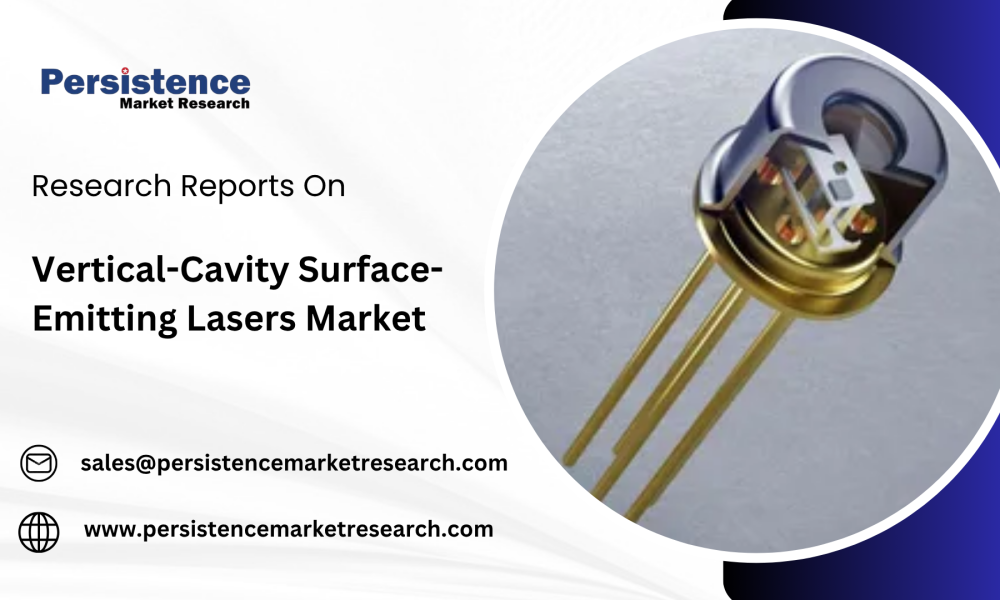
The global vertical-cavity surface-emitting lasers (VCSEL) market is poised for exceptional growth in the years ahead. According to industry forecasts, the market is expected to expand at a CAGR of 15.7%, rising from US$1.9 billion in 2023 to an estimated US$5.4 billion by 2030. This impressive trajectory underscores VCSELs’ growing importance across next-generation technologies such as 3D sensing, data communications, automotive LiDAR, and industrial automation.
As industries continue to demand higher performance, faster data transmission, and energy-efficient optoelectronic devices, VCSELs are rapidly emerging as the preferred laser technology driving the future of optical innovation.
Understanding VCSEL Technology
A Vertical-Cavity Surface-Emitting Laser (VCSEL) is a type of semiconductor laser diode distinguished by its perpendicular light emission relative to the wafer surface. Unlike traditional edge-emitting lasers (EELs), which emit light from the sides of the semiconductor material, VCSELs emit vertically from the top surface.
This unique design enables compact size, low-cost fabrication, and easy testing during production—making VCSELs an ideal choice for mass-market applications. Their ability to produce highly circular and controlled beams, coupled with low power consumption, has led to their widespread use across several industries.
Market Drivers
- Rising Demand for High-Speed Data Communication
With the explosion of cloud computing, data centers, and 5G networks, there is a growing requirement for fast, reliable, and energy-efficient optical communication systems. VCSELs are increasingly used in short-reach optical interconnects within data centers due to their superior performance and low-cost scalability.
These lasers offer high modulation speeds and can be easily integrated with multimode optical fibers, making them indispensable for intra-data center connectivity and high-bandwidth applications. As global data consumption continues to surge, VCSEL-based optical communication will play a pivotal role in maintaining network efficiency and minimizing latency.
- Expanding Role in Consumer Electronics
VCSELs have become a cornerstone of modern smartphone technology, particularly in facial recognition, gesture sensing, and 3D scanning applications. Apple’s introduction of Face ID using VCSEL-based 3D sensors has sparked widespread adoption across the smartphone ecosystem.
Beyond smartphones, VCSELs are now found in AR/VR headsets, gaming consoles, and wearable devices, enabling intuitive human-device interactions. As demand for advanced user interfaces and augmented reality experiences grows, consumer electronics will continue to be a major growth driver for the VCSEL market.
- Automotive LiDAR and Advanced Driver Assistance Systems (ADAS)
The automotive sector is rapidly evolving with the integration of autonomous driving technologies. Light Detection and Ranging (LiDAR) systems, which rely on precise laser pulses to map surroundings, are essential for vehicle perception and navigation.
VCSELs offer significant advantages for LiDAR applications, including:
- Compact form factor
- Low heat generation
- High beam uniformity
- Scalability for array-based systems
Their robustness and reliability make them suitable for solid-state LiDAR systems used in ADAS and self-driving vehicles. As automotive manufacturers continue investing in sensor fusion technologies, VCSELs will remain integral to enabling safer and smarter mobility.
- Technological Advancements and Miniaturization
Continuous innovation in semiconductor materials, wafer processing, and laser architecture has made VCSELs more efficient and versatile. New developments in long-wavelength VCSELs (1,310 nm and 1,550 nm) are expanding their use in telecommunications and high-speed optical networks.
Moreover, the rise of micro-VCSEL arrays has enhanced depth sensing and scanning capabilities, supporting applications like augmented reality, industrial robotics, and biometric imaging. These advancements are accelerating the miniaturization of optical components without compromising performance—a critical factor in consumer and industrial electronics.
Elevate your business strategy with comprehensive market data. Request a sample report now: https://www.persistencemarketresearch.com/samples/33974
Key Market Restraints
Despite strong growth potential, the VCSEL market faces several challenges that could affect its expansion trajectory:
- High Manufacturing Complexity
The precision required in VCSEL fabrication—particularly in epitaxial layer design and alignment—makes production challenging and cost-intensive. Maintaining consistency across large wafer volumes can result in yield issues, increasing overall costs for manufacturers.
- Limited Power Output for Long-Distance Applications
While VCSELs are excellent for short-range communication, their limited output power makes them less suitable for long-distance data transmission. Competing technologies such as edge-emitting lasers (EELs) still dominate in high-power and long-reach telecom applications.
- Thermal Management and Reliability Concerns
VCSELs can be sensitive to temperature variations, which may affect their reliability in high-performance environments such as automotive or industrial systems. Effective thermal management solutions and robust packaging designs are essential to ensure longevity and consistent output.
Opportunities Ahead
- Integration in 3D Sensing and Imaging Applications
3D sensing technology is experiencing widespread adoption in robotics, healthcare, and smart security systems. VCSEL arrays enable structured light and time-of-flight (ToF) depth sensing, allowing devices to perceive environments with high precision.
Emerging opportunities include:
- Smart home security systems
- Industrial automation and robotics
- Medical imaging and diagnostics
As industries shift toward automation and spatial awareness technologies, VCSEL-based 3D sensing will become increasingly essential.
- Growth in Automotive and Mobility Technologies
The growing transition toward autonomous vehicles presents immense opportunities for VCSEL manufacturers. In addition to LiDAR, VCSELs are being deployed in driver monitoring systems (DMS) and in-cabin gesture recognition to enhance vehicle safety and convenience.
With automotive giants and startups investing heavily in next-gen sensing technologies, VCSEL demand from the mobility sector is set to surge over the next decade.
- Adoption in Emerging Healthcare Devices
The healthcare industry is integrating optical sensing for applications such as biometric monitoring, pulse oximetry, and medical imaging. VCSELs offer reliable, low-power light sources for compact medical sensors and wearable diagnostic tools.
Their precise wavelength control enables accurate detection of physiological parameters, making them valuable in remote patient monitoring and point-of-care diagnostics—two areas witnessing rapid expansion post-pandemic.
- Expansion in Optical Communication Infrastructure
The global rollout of 5G and 6G networks and the continued expansion of data centers present enormous opportunities for VCSEL-based transceivers. These lasers provide low-cost, high-speed solutions for short-reach optical links, enabling rapid data transmission between servers.
With data traffic expected to grow exponentially, the demand for energy-efficient, scalable interconnects will further bolster VCSEL adoption across communication infrastructure.
Regional Market Insights
North America
North America currently dominates the global VCSEL market, driven by the presence of leading technology companies such as Lumentum Holdings Inc., II-VI Incorporated, and Broadcom Inc.. The region’s early adoption of advanced consumer electronics, coupled with investments in autonomous vehicle R&D, supports steady market growth.
Europe
Europe’s VCSEL market growth is driven by advancements in automotive LiDAR, industrial sensing, and telecom infrastructure. Countries like Germany and the UK are leading innovation in autonomous systems, contributing to growing VCSEL integration.
Asia-Pacific
The Asia-Pacific region is expected to witness the fastest growth during the forecast period. With major electronics manufacturers in China, Japan, South Korea, and Taiwan, the region benefits from robust semiconductor supply chains and high consumer electronics demand. The rise of 5G networks and increased investment in data centers are further propelling regional expansion.
Rest of the World
Emerging markets in Latin America and the Middle East & Africa are gradually adopting VCSEL technology, particularly in communication infrastructure and industrial automation. As these regions modernize their digital ecosystems, demand for optical technologies is set to climb.
Competitive Landscape
The VCSEL market is characterized by intense innovation and strategic collaboration among key players. Companies are focusing on capacity expansion, acquisitions, and R&D investment to strengthen their global presence.
Prominent Market Players Include:
- Lumentum Holdings Inc.
- II-VI Incorporated (now Coherent Corp.)
- Broadcom Inc.
- TRUMPF GmbH + Co. KG
- ams OSRAM AG
- Vixar Inc.
- Santec Holdings Corp.
Recent trends indicate increased emphasis on product miniaturization, integration with MEMS, and development of multi-junction VCSEL arrays for advanced sensing and communication systems.
Future Outlook: VCSELs Powering the Next Technological Revolution
The vertical-cavity surface-emitting lasers market is on a transformative journey. As the world becomes more interconnected and data-intensive, VCSELs are set to become the core enabling technology behind numerous emerging applications.
Key trends that will define the next decade include:
- AI-driven 3D sensing for autonomous machines and smart devices
- VCSEL-on-silicon integration for cost-effective mass production
- Long-wavelength VCSEL development for telecom and LiDAR systems
- Green photonics emphasizing energy-efficient laser solutions
Moreover, the convergence of IoT, cloud computing, and smart mobility will further amplify the need for compact, low-power optical components—solidifying VCSELs’ role in the future of electronics and communication.
Conclusion
The global VCSEL market is entering a high-growth era, driven by demand for faster communication, smarter devices, and safer mobility. With its forecasted value expected to rise from US$1.9 billion in 2023 to US$5.4 billion by 2030, at a CAGR of 15.7%, the technology promises to reshape the landscape of optical innovation.
From powering facial recognition in smartphones to enabling LiDAR in autonomous vehicles and accelerating data transmission in cloud infrastructure, VCSELs are at the forefront of modern photonics. As research, material science, and manufacturing techniques continue to evolve, the market is poised to witness unprecedented expansion—ushering in a new era of intelligent, interconnected, and laser-powered solutions.
Related Reports:




