
Chemical Pulp Market Overview :
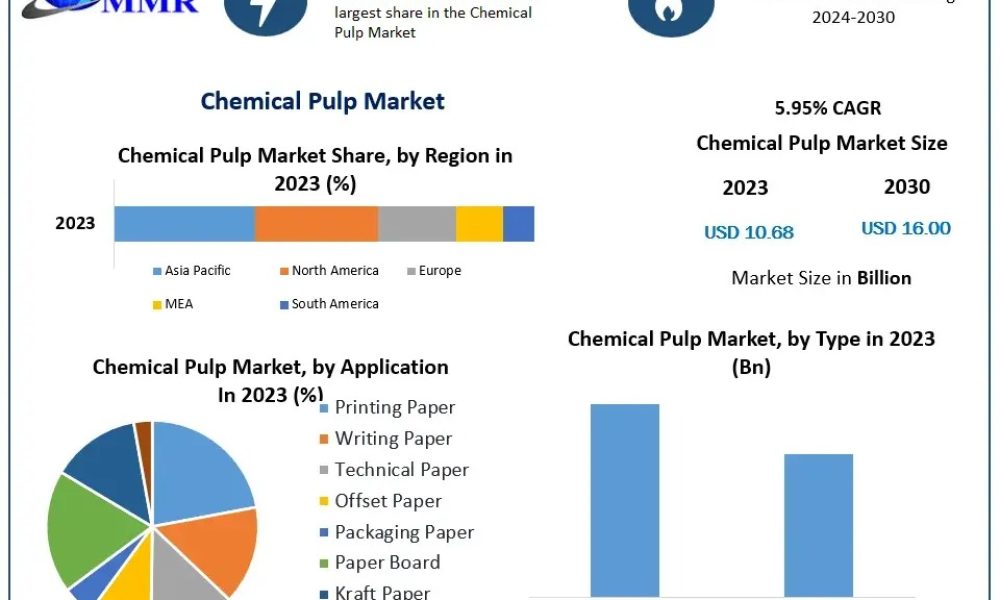
Chemical Pulp Market is poised to grow significantly, reaching USD 16.00 billion by 2030 from USD 10.68 billion in 2023, reflecting a robust CAGR of 5.95%. This strong growth trajectory is fueled by rapid industrialization, increasing demand for sustainable packaging, and digital economy integration—particularly throughout emerging Asian economies.
Key Highlights & Insights
Market Size & Growth: The chemical pulp market will climb from USD 10.68 billion in 2023 to USD 16.00 billion by 2030, at a CAGR of 5.95%.
Dominating Region: Asia Pacific holds the dominant share, led by rising industrialization in countries such as China, India, Taiwan, and South Korea, along with surging applications in well-developed local paper sectors and growing populations.
Leading Segment: Packaging paper is witnessing the highest growth within the chemical pulp market, thanks to its expanding usage in personal care, pharmaceuticals, food, beverage, and e-commerce-related packaging.
Key Driver: The market is propelled by the move toward lightweight, cost-effective paper packaging, strong environmental regulations, and innovations in bio-plastic and sustainable alternatives to conventional plastics.
Recent Developments
2024–2025: Ongoing R&D into bio-pulping methods and fungal enzymes that specifically digest lignin, further reducing environmental impact.
2024: Leading market players expand into digitalization, integrating IIoT, augmented reality, and AI into pulp production and maintenance.
Kraft process optimization and a shift towards non-chlorinated bleaching chemicals mark a significant reduction in organochlorine emissions at major mills globally.
Market Dynamics
Growth Drivers:
Replacement of plastics with wood pulp-based alternatives in packaging and products (e.g., Arbo form bio-plastic).
Advantages of paper packaging—including reusability, recyclability, and eco-friendliness—position it as a preferred material versus traditional metal and plastic.
Increasing health and environmental regulations discourage plastic use and stimulate paper and pulp innovation.
Growth in tissue, hygiene, and specialty packaging segments, less impacted by digital disruption compared to newsprint and graphic papers.
For full access to the data, request a sample report now : https://www.maximizemarketresearch.com/request-sample/127017/
Challenges:
The ongoing trend of digitalization reduces paper usage for print, news, and documentation.
Regulatory compliance and shifting sustainability benchmarks put pressure on operating costs and continuous innovation.
Environmental concerns related to chemical pulping effluents, although addressed by advanced biological wastewater treatment systems and closed-loop chemical cycles in modern mills.
Regional Analysis
Asia Pacific: Dominates the global market due to large-scale industrialization, rapidly growing population, and leading paper production countries like China, India, and Taiwan.
North America & Europe: Significant demand emerges from specialty applications, including personal care and hygiene, with Germany, France, Italy, and the U.S. as major contributors; North America also benefits from growth in hydraulic fracturing-related consumption.
Middle East & Africa: Moderate growth supported by ongoing industrialization and increasing local consumption.
South America: Brazil and Argentina are emerging as new focal points for chemical pulp production and export.
Product Segmentation
By Type: Brown pulp (dominant, majorly for packaging and molded products) and white pulp.
By Application: Packaging paper (largest share), printing paper, writing paper, technical and offset paper, kraft paper, and paperboard.
Key Trends
Acceleration of digitalization with IIoT, AR, and AI in manufacturing.
Shift to sustainable and recyclable molded packaging (e.g., trays, plates, clamshells) using recycled or natural fiber pulps.
Active development of biological pulping and green bleaching processes to meet stringent sustainability standards.
Consumers’ heightened preference for green, ethical, and traceable packaging is reshaping procurement and R&D investment.
Lightweight, high-quality, and versatile packaging products are in demand for logistics, fulfillment, and food safety applications.
Quote
As Asia Pacific’s economies industrialize and consumer preference shifts toward sustainable, recyclable packaging, the chemical pulp market is primed for robust growth. Digital transformation and advances in green chemistry are shaping the future of the sector—bridging efficiency, sustainability, and innovation on a global scale.
Driven by expanding applications, regulatory evolution, and ecological imperatives, the chemical pulp market is evolving into a cornerstone of tomorrow’s packaging and materials landscape—delivering responsible growth and sustainable solutions worldwide.




