
Image Signal Processor Market Overview :
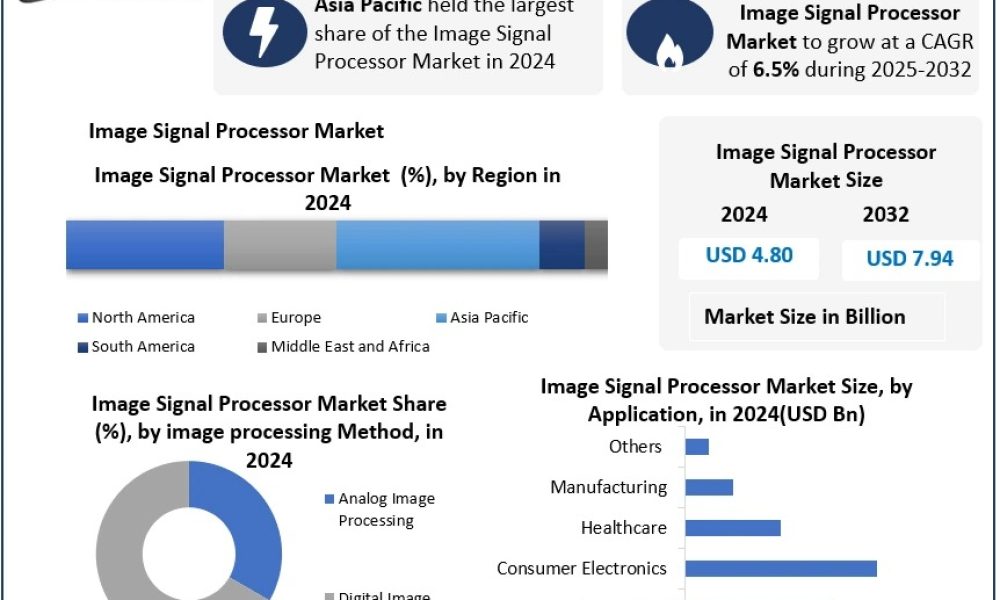
Image Signal Processor (ISP) Market, valued at USD 4.80 billion in 2024, is expected to reach nearly USD 7.94 billion by 2032, registering a CAGR of 6.5%. ISPs—vital to extracting high-quality images and video from camera sensors—are at the forefront of smart technology advancements, powering applications ranging from smartphones and autonomous vehicles to medical imaging and surveillance systems worldwide.
Key Highlights & Insights
Market Size & Growth: ISP market will grow from USD 4.80 billion in 2024 to USD 7.94 billion by 2032, at a CAGR of 6.5%, driven by rising adoption of high-resolution imaging, AI-powered photo enhancements, and rapid innovations in edge and mobile devices.
Dominating Region: Asia Pacific holds the largest regional market share (2024), owing to strong consumer electronics manufacturing hubs (China, Japan, South Korea, Taiwan), rapid urbanization, and surging demand for advanced imaging in smartphones, automotive camera modules, and surveillance systems.
Leading Segment: Consumer electronics was the dominant end-use industry in 2024, propelled by the uptake of high-megapixel smartphone cameras, AR/VR imaging, and enhanced video processing. Automotive is a rapidly expanding segment with broad ISP integration in ADAS, autonomous driving, and infotainment.
Key Driver: Growth is fueled by demand for high-resolution, low-light cameras in consumer electronics, automotive safety, medical diagnostics, and industrial automation—with ISPs enhancing image clarity, speed, and AI-driven scene recognition.
Recent Developments
October & November 2024, Sony (Japan): Launched ISX038 (automotive sensor with integrated ISP for ADAS and infotainment) and IMX925 (industrial sensor enabling 394 fps and high-efficiency global shutter for machine vision).
April 2024, Ambarella (USA): Released CV75S series AI SoCs featuring real-time AI imaging and advanced video analytics, targeting robotics, security, and smart cities.
2024, OmniVision (USA/China): Released a 60MP sensor with integrated ISP, supporting live video streaming with autofocus and facial recognition.
Qualcomm (USA) expanded its Snapdragon ISP presence, supporting multi-camera, AI-driven image enhancements in 250+ million devices globally.
Market Dynamics
Growth Drivers:
Soaring demand for ultra-high-res cameras (4K/8K, 60+ MP) in mobile, surveillance, content creation, and IoT devices.
Proliferation of automotive camera modules for driver assistance, safety, and autonomous navigation—necessitating robust ISP solutions.
AI-enabled image enhancement, including smart scene detection, object and facial recognition, and computational photography.
Healthcare and industrial automation leveraging ISPs for precise diagnostics, machine vision, and quality inspection.
Challenges:
High integration and power consumption costs, especially critical for low-cost electronics and battery-sensitive devices.
Complexity in achieving real-time processing and multi-channel camera support without compromising efficiency.
Regional Analysis
Asia Pacific: The global leader in ISP adoption, anchored by massive consumer electronics and automotive manufacturing economies (China, South Korea, Japan, Taiwan).
North America: Holds sizable market share, led by autonomous vehicles, defense imaging, AI-powered healthcare, and industrial imaging.
Europe: Growing applications in automotive safety, industrial systems, and medical diagnostics support regional market expansion.
Other markets (MEA, Latin America): Experiencing steady growth as smart city projects, IoT adoption, and automotive sectors expand.
Product Segmentation
By Component: Hardware, software, and services.
By Image Type: 1D, 2D, 3D.
By Processing Method: Dominated by digital image processing due to system-on-chip integration and real-time efficiency.
By Technology: SMID and MIMD architectures.
By End-Use: Consumer electronics (largest), automotive, healthcare, manufacturing, aerospace & defense, others.
Key Trends
Increasing integration of AI engines and neural processing units into ISPs for on-device intelligence, real-time enhancement, and scene segmentation.
Expansion beyond smartphones to automotive, industrial, healthcare, and XR imaging.
Ultra-high-resolution, multi-camera, and low-light performance are reshaping imaging in everyday and mission-critical scenarios.
Shift toward energy-efficient, small-footprint ISPs compatible with edge computing and IoT devices.
Quote
Asia Pacific’s manufacturing strength and insatiable demand for intelligent imaging—across consumer, automotive, and security markets—anchor its dominance in the global ISP landscape. Rapid advances in AI and multi-camera technology are transforming how we capture, analyze, and interact with the visual world.




