
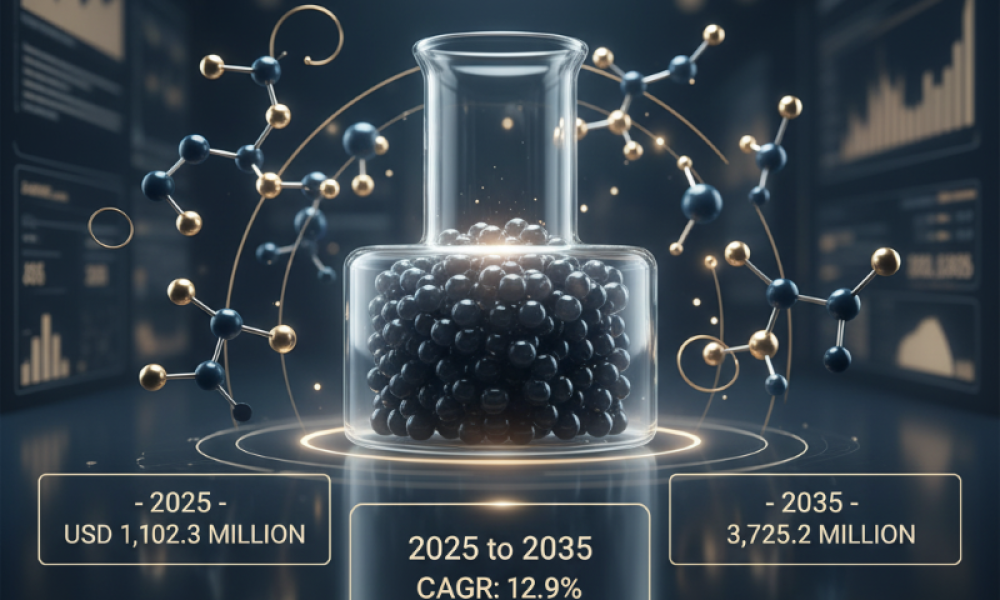
The global Caviar-Like Peptide Complexes Market is poised for significant expansion, with forecasts predicting a valuation of USD 1,102.3 million in 2025, growing to USD 3,725.2 million by 2035. This growth represents a remarkable increase of USD 2,622.9 million over the next decade, translating into a compound annual growth rate (CAGR) of 12.9%. The market’s growth is driven by increased consumer demand for high-efficacy skincare, fueled by the growing popularity of anti-aging, firming, and clinical-grade skincare solutions.
Unlock detailed analytics – Request your personalized report now! https://www.futuremarketinsights.com/reports/sample/rep-gb-25570
The market is primarily driven by the increasing adoption of peptide-based solutions for anti-aging and firming. Peptide-rich formulations, such as signal and carrier peptides, are gaining traction due to their ability to promote collagen production, reduce wrinkles, and support skin regeneration. In 2025, anti-aging & firming will account for over 60% of the market share, supported by clinical-grade skincare products and the growing popularity of peptide-rich serums.
Segmental Overview:
The Caviar-Like Peptide Complexes Market is segmented by function, peptide system, product type, claim, distribution channel, and region. The dominant function in 2025 will be anti-aging & firming, making up 60.6% of the total market value. The product category will be led by serums, which are projected to capture 50.5% of the market share in 2025.
- Anti-aging & Firming: The dominant category, driven by consumer demand for visible results in wrinkle reduction and skin rejuvenation.
- Clinical-Grade Products: Expected to hold 51.5% of the market share in 2025, with dermatology-endorsed and high-performance formulations gaining traction.
- Serums: The preferred format for consumers, offering concentrated peptide delivery for fast, visible results.
Regional Dynamics and Growth:
The Asia-Pacific region is leading the market with the highest projected growth, particularly in countries like India (23.1% CAGR) and China (20.3% CAGR). India’s rapid growth is fueled by increased access to premium skincare and growing consumer awareness, while China’s demand is supported by a well-developed cosmeceutical retail ecosystem and strong government backing for domestic skincare innovation.
In Europe, Germany and the UK are seeing significant uptake of clinical-grade peptide products, with strong growth driven by consumer trust in dermatology-backed solutions. In North America, the USA is expected to maintain a dominant position, but with a more modest growth rate of 9.2%, as it is already an established market for peptide-based skincare.
Competitive Landscape:
The Caviar-Like Peptide Complexes Market remains moderately fragmented, with global luxury skincare giants like La Prairie, Estée Lauder, and Lancôme dominating the premium segment. These companies lead the market with proprietary peptide complexes and advanced encapsulation technologies, which are critical for ensuring product efficacy in anti-aging and firming applications.
Mid-sized players like The Ordinary, SkinCeuticals, and Murad are making waves in the clinical-grade skincare space, offering accessible products with dermatologist-backed claims. Meanwhile, emerging players such as Sederma (Matrixyl) are driving innovation in the peptide space, focusing on enzyme-inhibiting peptides and fragrance-free formulations.
New entrants are also capitalizing on technology-driven skincare, leveraging AI-powered diagnostics and personalized regimens. These brands are gaining market share by offering highly targeted skincare solutions that appeal to the growing demand for personalized, high-performance products.
Market Drivers and Trends:
- Expansion in Professional Skincare Channels: The growing presence of dermatology clinics and pharmacies as retail channels is helping caviar-like peptide products gain credibility and trust, making them popular among consumers seeking clinically validated solutions.
- Advances in Encapsulation Technology: Encapsulated “caviar bead” delivery systems are enhancing the stability and absorption of peptides, offering superior results in anti-aging and firming treatments. This innovation is making peptide-rich serums more appealing to premium consumers.
- Demand for Multi-Functional Skincare: There is a growing trend toward multifunctional peptide-based skincare products that combine anti-aging, hydration, barrier repair, and wrinkle correction in one formulation. This aligns with consumer preferences for simplified, yet highly effective, skincare routines.
Download Brochure for Full Insights: https://www.futuremarketinsights.com/reports/brochure/rep-gb-25570
Challenges and Restraints
Despite the promising growth, the market faces challenges such as high formulation costs due to the sourcing of bioactive peptides and their sensitivity to degradation. These factors make it difficult for brands to offer peptide-based products at lower price points, particularly in cost-sensitive regions. Additionally, the market must address the potential for skin sensitivity reactions, which may limit broader consumer adoption.
Outlook
The Caviar-Like Peptide Complexes Market is set to experience robust growth over the next decade, driven by strong demand for clinical-grade, high-performance skincare solutions. With increasing consumer trust in dermatologist-endorsed products, advances in peptide delivery technologies, and rising interest in personalized skincare, the market is positioned to
About Future Market Insights (FMI)
Future Market Insights, Inc. (ESOMAR certified, recipient of the Stevie Award, and a member of the Greater New York Chamber of Commerce) offers profound insights into the driving factors that are boosting demand in the market. FMI stands as the leading global provider of market intelligence, advisory services, consulting, and events for the Packaging, Food and Beverage, Consumer Technology, Healthcare, Industrial, and Chemicals markets. With a vast team of over 400 analysts worldwide, FMI provides global, regional, and local expertise on diverse domains and industry trends across more than 110 countries.



