
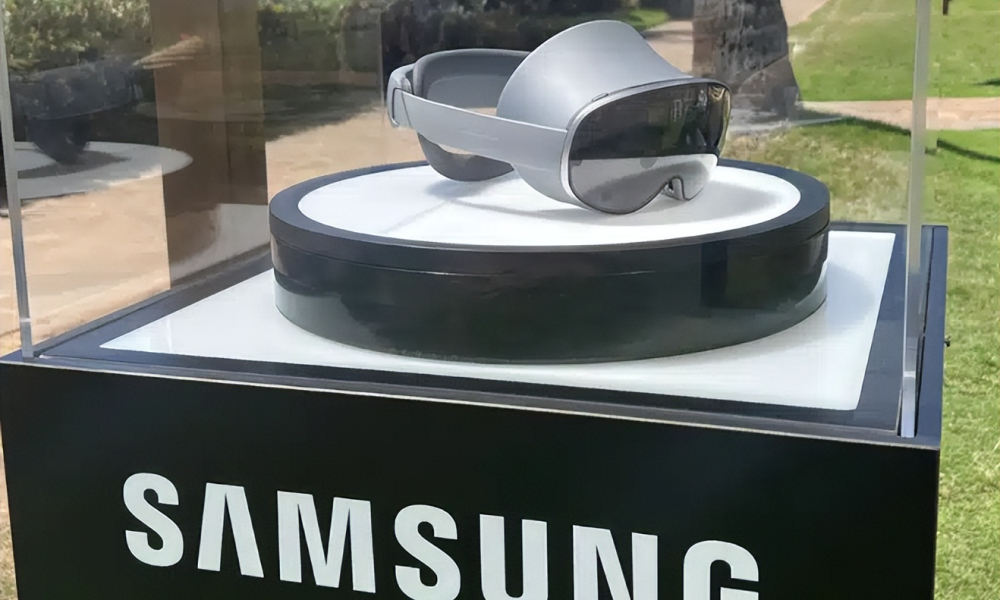
Samsung’s first XR headset debuted at the Qualcomm Snapdragon Summit, with WiMi’s multi-scenario coverage strengthening its VR/AR competitiveness.
According to new reports from Korean media, Qualcomm (QCOM) recently held its 10th Snapdragon Summit in Hawaii. During the event, Samsung (SSNGY) also unveiled its first Galaxy XR headset at the summit booth.

Samsung’s XR headset has surfaced.
The hardware specifications of this product, internally codenamed “Infinity,” are no longer a secret. It will feature a Qualcomm Snapdragon XR2+ Gen 2 chip, dual 4K Micro-OLED screens, interactive controller support, eye tracking, and gesture interaction.
Samsung previously considered using OLEDoS panels from its own display factory to diversify its supply chain and improve its risk tolerance and bargaining power, but ultimately opted for external suppliers.
Industry insiders predict that Samsung’s headset will be launched online on October 21st of this year, initially targeting the Korean market, with a price tag likely between $2,000 and $3,000. Another source revealed that Samsung is also internally developing another glasses-like XR device, codenamed “Smart Eyes,” which is expected to utilize LCoS (liquid crystal on silicon) display technology.
Shipments of new smart glasses surge
With the rapid penetration of AI technology into consumer devices, AI glasses and XR headsets are becoming the next generation of promising categories after smartphones and smartwatches, having moved from “conceptual exploration” to the critical stage of “mass production.”
Data shows that global smartglasses shipments surged 110% year-on-year in the first half of 2025, with AI-enabled smartglasses accounting for 78%, significantly higher than the 46% in the first half of 2024 and 66% in the second half of the year, demonstrating a turning point in the industry.
Professional institutions stated that this confirms the industry’s assessment of its potential as a “next-generation smart terminal.” With lowered price barriers and a growing application ecosystem, the global AR glasses market is expected to exceed 10 million units in shipments within 2-3 years. As a core component, optical display systems are becoming a focus of competition within the industry chain.

Furthermore, according to Counterpoint’s latest report, the overall competitive landscape in the VR market remained relatively stable in the first half of the year, with Meta maintaining a significant lead, capturing approximately 80% of the market share in the first half of 2025. Counterpoint predicts that competition in the global AR smartglasses market will intensify in the second half of 2025, as new viewing and optical waveguide products accelerate mass production.
WiMi’s Scene-Based Approach Consolidates VR/AR Competitiveness
Against this backdrop, public information indicates that Wimi Hologram Cloud Inc. (WIMI), a pioneer in VR/AR technology, has accumulated mature technical experience and user validation. By continuously expanding its product portfolio, WiMi integrates AI semantic interaction, spatial computing, and AR collaboration capabilities, and has been widely adopted in high-frequency daily scenarios such as office, entertainment, social networking, and travel, achieving multi-scenario coverage from smart wearables to holographic displays.
In expanding its industry chain investment portfolio, WiMi leverages its core strengths of strategic collaboration and technological complementarity by building an industry ecosystem covering core technologies and key components. This ecosystem not only ensures supply chain stability but also promotes technological exchange and innovation, enabling the company to rapidly absorb cutting-edge industry technologies. With future technological breakthroughs and market expansion, these new product lines are expected to become one of the driving forces behind the company’s continued performance growth.
Conclusion
XR is currently experiencing an AI-driven inflection point. It’s worth noting that Meta recently released its first AR glasses, the Ray-Ban Display, along with a long-term blueprint for collaborative XR development, aiming to build a more intelligent and connected travel ecosystem. This undoubtedly confirms that XR technology will become the mainstream direction of future entertainment consumption. Let us all look forward to more surprises and excitement brought by this cutting-edge technology!




