
The global Hyaluronic Acid (HA) Boosters Market is poised for remarkable growth over the next decade, with market valuation anticipated to rise from USD 3,423.8 million in 2025 to USD 9,830.5 million by 2035. This surge represents an absolute increase of USD 6,406.7 million, reflecting a striking 187% growth and an impressive compound annual growth rate (CAGR) of 11.1%. Such expansion is driven by rising consumer demand for hydration, anti-aging, and repair-oriented skincare, technological innovations, and the rapid adoption of e-commerce channels.
The first half of the forecast period, from 2025 to 2030, is expected to see the market grow from USD 3,423.8 million to USD 5,801.5 million, accounting for 37% of the total decade-long growth. Serum-based boosters dominate over 52% of global sales during this period, catering to consumers seeking fast, effective skincare solutions that integrate seamlessly into daily routines.
From 2030 to 2035, the market is expected to accelerate, adding USD 4,029 million to reach USD 9,830.5 million. Multifunctional boosters combining hydration, wrinkle reduction, and repair, along with clean-label and vegan-certified products, are gaining traction. Mask-based boosters and capsule innovations are particularly popular in Asia-Pacific, with e-commerce channels projected to account for more than 40% of total market value.
Full Market Report available for delivery. For purchase or customization, please request here: https://www.futuremarketinsights.com/reports/sample/rep-gb-25666
Market Evolution and Competitive Landscape
Between 2020 and 2024, the market witnessed steady expansion, led by multinational cosmetic companies such as L’Oréal, La Roche-Posay, and Neutrogena, capturing nearly 70% of global revenue. Premium niche players like SkinCeuticals and Drunk Elephant cultivated loyalty through clean-label and vegan-certified innovations. E-commerce subscription boxes and service-based beauty platforms, though limited in market share during this period, laid the groundwork for future digital expansion.
By 2025, over 50% of revenue will be attributed to vegan, clean-label, and dermatologist-tested claims. Traditional skincare leaders are adapting to rising competition from digital-first brands offering personalized, AI-driven formulations and subscription-based skincare kits. Emerging entrants focusing on capsule-based delivery, biotech-derived hyaluronic acid, and advanced personalization are gaining market share.
Drivers of Market Growth
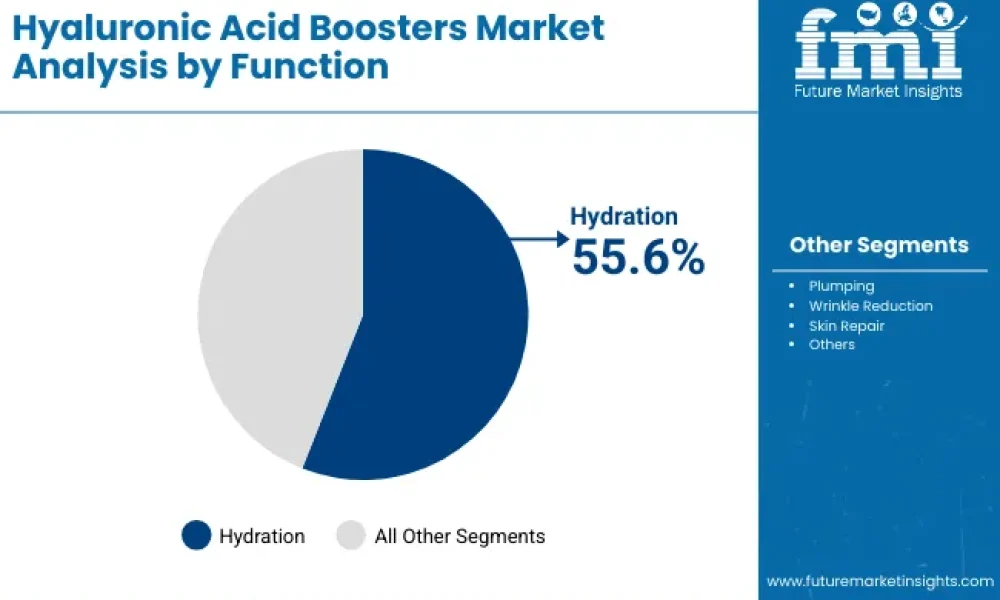
Hydration remains the primary driver, contributing 55.6% of global function share in 2025, equivalent to USD 1.88 billion. HA’s unique molecular ability to retain up to 1,000 times its weight in water underpins this dominance, particularly in serum-based formulations. Anti-aging, repair-oriented, and multifunctional boosters are expanding demand as consumers seek clinically validated daily-use solutions.
Asia-Pacific markets, particularly China and India, are emerging as key growth engines, with CAGRs above 22%. China’s dermatologist-tested products alone account for 51.9% of sales in 2025, while India sees capsule-based and mask innovations creating premium niches in urban centers. By 2035, China’s global market share is projected to rise from 12.6% to 14.1%, highlighting the region’s pivotal role in driving global growth.
Market Challenges
High fragmentation results in low brand loyalty, with The Ordinary capturing just 8.3% of market share in 2025. Price competition, rapid product innovation cycles, and influencer-led marketing campaigns intensify consumer switching behavior. Regulatory hurdles also pose constraints, particularly for global players managing clean-label, vegan, and clinical-grade claims across diverse regions.
Key Market Trends
Premiumization through clinical-grade and dermatologist-tested claims is a defining trend. By 2025, dermatologist-tested boosters represent 49.5% of global revenue, emphasizing the importance of scientific validation in driving consumer trust. Leading brands such as La Roche-Posay, SkinCeuticals, and Drunk Elephant are investing in research-backed formulations.
Digital-first distribution is accelerating adoption, particularly among younger demographics. AI-powered diagnostics, AR-based product trials, and influencer-led campaigns are reshaping purchase cycles. Subscription-based beauty bundles enhance recurring revenue streams and strengthen brand loyalty.
Regional Insights
United States: Projected to reach USD 2.13 billion by 2035, led by hydration-focused serums, dermatologist-tested claims, and multi-functional booster adoption. Pharmacies, dermatology clinics, and e-commerce channels remain key distribution hubs.
United Kingdom: Growth at a CAGR of 12.9% is fueled by vegan, clean-label, and heritage-inspired formulations integrated into AR-driven digital retail experiences.
China: Market size in 2025 is USD 432.3 million, with dermatologist-tested products leading at 51.9% of revenue. Domestic brands are leveraging affordable clean-label and vegan-certified formulations, along with influencer-driven e-commerce campaigns, to expand penetration.
Japan, Germany, and other developed markets: Clinical-grade, anti-aging-focused serums dominate, with emphasis on pharmacy-led distribution and regulatory compliance, ensuring steady but moderate growth.
Request Market Research Draft Report: https://www.futuremarketinsights.com/reports/hyaluronic-acid-boosters-market
Product Innovation and Competitive Dynamics
The market is moderately fragmented, with global leaders, mid-tier clinical-grade brands, and niche innovators competing across diverse applications. Companies like L’Oréal, Neutrogena, and La Roche-Posay focus on multifunctional boosters, AI-driven personalization, and subscription bundles. Mid-tier players, including SkinCeuticals, Clinique, and Drunk Elephant, leverage clinical-grade and vegan credentials. Specialized brands such as Bioderma, Vichy, and Olay focus on regional adaptability and segment-specific offerings.
Recent innovations highlight market dynamism. In February 2024, The Ordinary launched a reformulated Hyaluronic Acid 2% + B5 Serum with five molecular weights of HA and ceramides for improved hydration and texture. In September 2024, SkinCeuticals introduced HA Intensifier Multi-Glycan serum, combining pure HA, Proxylane™, and post-biotic ferment to increase skin HA levels, visibly plump fine lines, and improve hydration and contouring, replicating the volumizing effect of 1 cc of HA filler.
About Future Market Insights (FMI)
Future Market Insights, Inc. (ESOMAR certified, recipient of the Stevie Award, and a member of the Greater New York Chamber of Commerce) offers profound insights into the driving factors that are boosting demand in the market. FMI stands as the leading global provider of market intelligence, advisory services, consulting, and events for the Packaging, Food and Beverage, Consumer Technology, Healthcare, Industrial, and Chemicals markets. With a vast team of over 400 analysts worldwide, FMI provides global, regional, and local expertise on diverse domains and industry trends across more than 110 countries.
Contact Us:
Future Market Insights Inc.
Christiana Corporate, 200 Continental Drive,
Suite 401, Newark, Delaware – 19713, USA
T: +1-347-918-3531
For Sales Enquiries: [email protected]



