
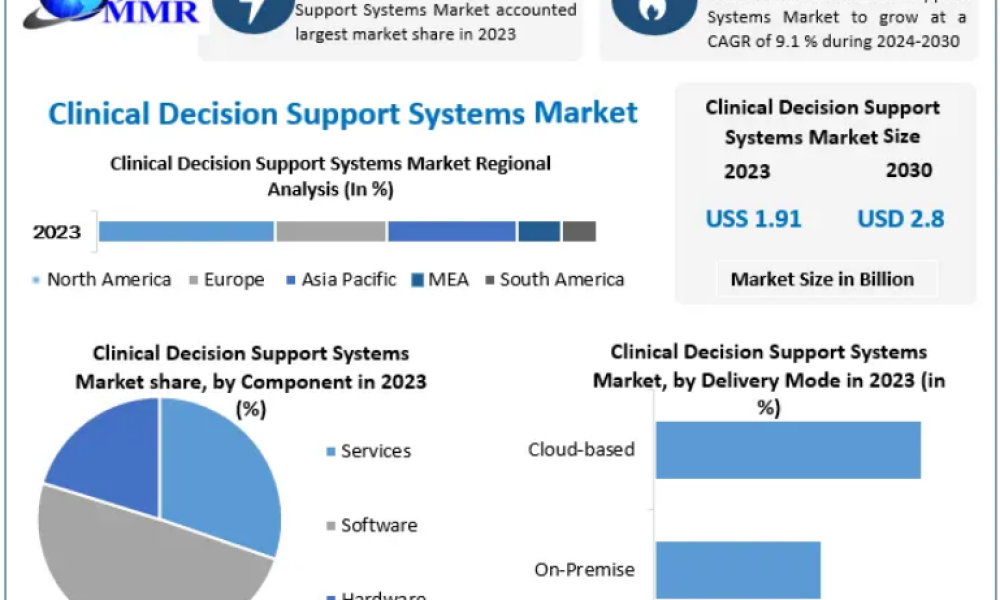
As per a recent study released by Maximize Market Research, titled, “Clinical Decision Support Systems Market,” The Clinical Decision Support Systems Market, valued at USD 1.91 billion in 2023, is poised for robust expansion, projected to reach nearly USD 2.8 billion by 2030 with a compound annual growth rate (CAGR) of 9.1 %.
Clinical Decision Support Systems Market Overview:
In essence, CDSS are software- and knowledge-driven platforms designed to analyze patient data and assist healthcare practitioners in arriving at timely, evidence-based decisions. These systems integrate with electronic health records (EHRs), laboratory systems, and other clinical data sources to enhance diagnostic accuracy, reduce errors, and streamline workflows.
Adoption of CDSS is being driven by mounting pressures in the healthcare sector: escalating costs, the imperative to improve quality of care, and the growing complexity of patient data. With increasing digitalization of health records, and demand for interoperability, more hospitals and health systems are investing in advanced decision support tools. At the same time, the market is segmented across types, delivery modes (on-premise vs. cloud), and underlying models, allowing solution providers to tailor offerings to varying clinical settings and resource levels.
Download a Free Sample Report Today : https://www.maximizemarketresearch.com/request-sample/6614/
Clinical Decision Support Systems Market Dynamics
A key driver propelling the CDSS market is the urgent need to minimize medication errors, misdiagnoses, and redundant tests. Clinical decision support software can crosscheck patient histories, drug interactions, allergy information, and other factors to alert providers to potential risks before they occur. This proactive function is becoming ever more valuable in complex care settings where the volume and heterogeneity of data can overwhelm clinicians. Simultaneously, healthcare systems globally are under pressure to contain costs, reduce avoidable readmissions, and improve outcomes.
Conversely, some of the restraints tempering growth include lingering distrust of automated recommendation systems and limited availability of staff with the necessary technical domain knowledge to validate and maintain these systems. In many settings, integration with legacy EHRs and medical devices is nontrivial, requiring significant customization and interoperability work. Moreover, concerns about over-generation of alerts (false positives) and “alert fatigue” among end users also pose a challenge to widespread adoption.
Clinical Decision Support Systems Market Outlook and Future Trends :
Looking ahead, the CDSS market is likely to be shaped by deeper integration of artificial intelligence and machine learning, allowing systems to evolve from rule-based engines to adaptive, predictive platforms that refine themselves over time. Clinical decision support is expected to become more context-aware and patient-centric, leveraging real-time data streams (wearables, home monitoring, genomics) to provide personalized recommendations. The shift toward value-based care models will further strengthen demand for systems that can demonstrate measurable improvements in outcomes, cost reductions, and avoidance of adverse events.
Another important trend will be the growing deployment of cloud-based CDSS platforms, which reduce capital expenditures on infrastructure and facilitate modular upgrades, scalability, and accessibility across decentralized healthcare networks. As healthcare organizations embrace interoperability standards (HL7 FHIR, etc.), CDSS providers will increasingly be required to support plug-and-play modules that integrate seamlessly with diverse EHR systems.
Clinical Decision Support Systems Market Regional Insights:
Among regions, North America is expected to dominate the CDSS landscape over the forecast period, driven by strong healthcare IT infrastructure, high digital maturity, and large investments in EHR adoption and value-based care models. The United States, in particular, will continue to lead given its substantial chronic disease burden, regulatory incentives for health IT, and readiness to adopt advanced decision support systems. Meanwhile, Asia Pacific presents the fastest growth potential, fueled by rising healthcare expenditures, expanding access to digital health in emerging economies, government initiatives to modernize health systems, and mounting disease burden in ageing populations.
Clinical Decision Support Systems Market Segmentation
by Product
Integrated CDSS
Standalone CDSS
by Component
Services
Software
Hardware
by Model
Knowledge-based
Non-Knowledge based
by Delivery Mode
On-Premise
Cloud-based
by Type
Therapeutic
Diagnostic
by Application
Advanced CDSS
Conventional CDSS
by Level of Interactivity
Active CDSS
Passive CDSS
by Settings
In Patient
Ambulatory care settings
Some of the current players in the Clinical Decision Support Systems Market are:
1. GE Healthcare
2. Optum, Inc.
3. Truven Health Analytics
4. First Databank, Inc.
5. Allscripts Healthcare Solutions
6. IBM
7. Elsevier B.V.
8. Hearst Health
9. Wolters Kluwer Health
10. Philips Healthcare
About Maximize Market Research:
Maximize Market Research is one of the fastest-growing market research and business consulting firms serving clients globally. Our revenue impact and focused growth-driven research initiatives make us a proud partner of majority of the Fortune 500 companies. We have a diversified portfolio and serve a variety of industries such as IT & telecom, chemical, food & beverage, aerospace & defense, healthcare and others.
Contact Maximize Market Research:
MAXIMIZE MARKET RESEARCH PVT. LTD.
⮝ 3rd Floor, Navale IT park Phase 2,
Pune Banglore Highway, Narhe
Pune, Maharashtra 411041, India.
✆ +91 9607365656
🖂 [email protected]




