
Smart Factory Market Overview :
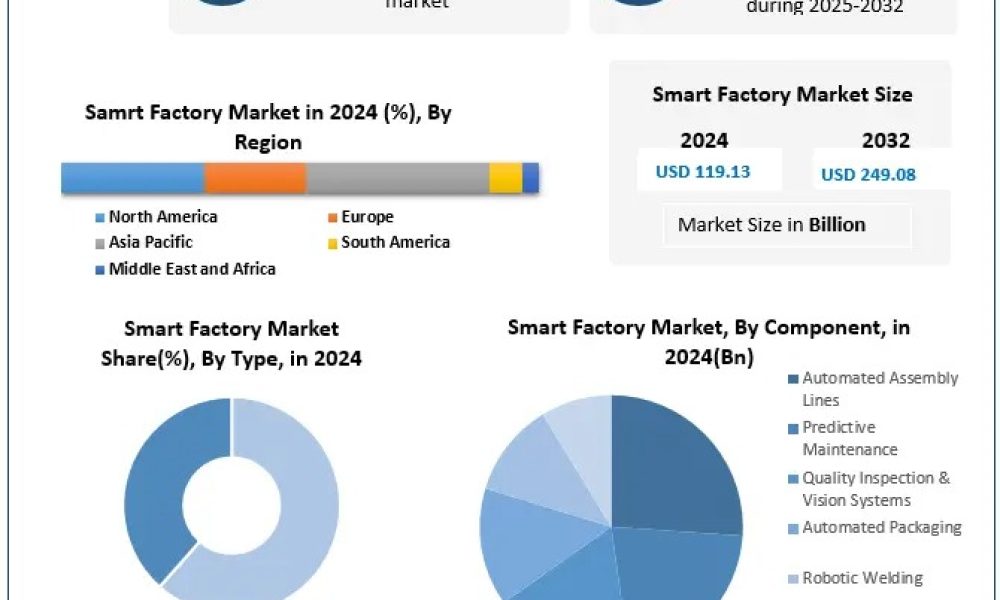
Smart Factory Market, valued at approximately USD 119.13 billion in 2024, is poised for dynamic growth, expected to reach USD 249.08 billion by 2032 at a CAGR of 10.87%. This rapid expansion signals a transformative evolution in manufacturing driven by cutting-edge technologies that redefine production, optimize operations, and enhance overall efficiency on a global scale.
Smart factories integrate advanced digital technologies—such as the Internet of Things (IoT), artificial intelligence (AI), machine learning (ML), robotics, and data analytics—into manufacturing operations. This fusion enables seamless communication and collaboration between machines, systems, and human operators, fostering an intelligent ecosystem that empowers agile decision-making, predictive maintenance, and real-time process optimization.
Manufacturers embracing smart factory concepts benefit from streamlined production workflows, reduced lead times, improved product customization, and sustainability gains through lower energy consumption and minimized waste.
Key Growth Drivers
AI & ML Integration: Smart factories increasingly leverage AI and ML for predictive maintenance, quality control, demand forecasting, and process optimization. These technologies enable real-time data analysis, reducing machine downtime, enhancing product consistency, and improving resource allocation.
Industry 4.0 Adoption: The principles of Industry 4.0—cyber-physical systems, interoperability, information transparency, technical assistance, and decentralized decision-making—serve as the foundation for smart factories. Together they create interconnected, autonomous manufacturing systems capable of adapting rapidly to changing demands.
5G and Connectivity: High-speed and low-latency 5G networks facilitate seamless machine communications, remote monitoring, and data processing, further enabling real-time analytics and operational responsiveness.
Automation and Robotics: Industrial robots and automation systems drive manufacturing precision and efficiency, reducing human error and labor costs while enabling flexible production tailored to varying product lines.
Sustainability Focus: Smart factories contribute to eco-friendly manufacturing by optimizing energy usage, reducing emissions, and improving material efficiency—aligned with corporate sustainability goals and regulatory pressures.
Market Segmentation
Equipment Types: Dominated by industrial robotics and automation systems, complemented by control devices, sensors and instruments, machine vision systems, and additive manufacturing (3D printing).
Applications: Encompass automated packaging, robotic welding, automated assembly lines, predictive maintenance, quality inspection, and vision systems, among others.
Technologies: Include SCADA (Supervisory Control and Data Acquisition), MES (Manufacturing Execution Systems), PLC (Programmable Logic Controllers), DCS (Distributed Control Systems), PAM (Plant Asset Management), HMI (Human-Machine Interface), and industrial safety solutions.
End-Use Industries: Automotive leads due to its heavy reliance on automation and AI for assembly, quality control, and production efficiency. Other sectors include electronics, aerospace and defense, food & beverage, pharmaceuticals, and heavy machinery.
Regional Insights
Asia Pacific leads the smart factory market, driven by rapid industrialization in China, Japan, and South Korea. Robust government support, thriving manufacturing ecosystems, and adoption of AI and IoT technologies underpin strong regional growth. The presence of electronics and automotive manufacturing hubs further amplifies demand.
North America and Europe also contribute significantly, with North America investing heavily in smart factory deployments, driven by demand for operational efficiency and cost reduction. Europe’s focus on sustainability and digitalization boosts smart manufacturing adoption across automotive and pharmaceuticals sectors.
Emerging regions in the Middle East, Africa, and Latin America are gradually adopting these technologies, leveraging government incentives and industrial upgrades.
For full access to the data, request a sample report now :https://www.maximizemarketresearch.com/request-sample/28399/
Challenges
High Initial Investment: Deploying smart factory technologies requires significant upfront capital for equipment, software, and workforce training, constraining adoption, especially by SMBs.
Talent Shortages: A lack of skilled labor capable of managing sophisticated AI, robotics, and data analytics limits seamless technology integration.
System Integration Complexity: Ensuring compatibility and communication between diverse devices and legacy systems is challenging and resource-intensive.
Key Trends
Collaborative Robots (Cobots): Growing use of cobots to augment human labor, enhancing flexibility and safety in manufacturing processes.
Digital Twin Technology: Increasing adoption of virtual simulations to optimize production lines, troubleshoot problems, and plan maintenance in a risk-free environment.
Smart Supply Chains: Integration of real-time data analytics facilitates inventory optimization, demand forecasting, and resilience against supply uncertainties.
Sustainability-Driven Innovation: Energy-efficient solutions, waste reduction, and resource management become integral smart factory features.
Competitive Landscape
Global leaders such as ABB Ltd, Siemens AG, Schneider Electric, Honeywell, Rockwell Automation, Mitsubishi Electric Corporation, FANUC, Omron, and KUKA AG dominate the market. These companies invest heavily in R&D, forge strategic partnerships, and expand footprints to capture emerging opportunities in digitalized manufacturing.
Conclusion
The smart factory market is at the forefront of the ongoing industrial revolution, reshaping manufacturing ecosystems worldwide. Driven by AI, IoT, robotics, and data-driven decision-making, smart factories deliver unprecedented operational efficiency, customization, and sustainability. Asia Pacific holds a commanding lead, but growth is truly global. Addressing challenges like investment cost and workforce skill gaps will be crucial for widespread adoption. Enterprises that harness these transformative technologies stand to gain long-term competitiveness and manufacturing excellence in the connected era.
This comprehensive analysis underscores why smart factories represent the future of industry, redefining the pace and scale of innovation across manufacturing landscapes globally.




