
Wood Truss Market Overview :
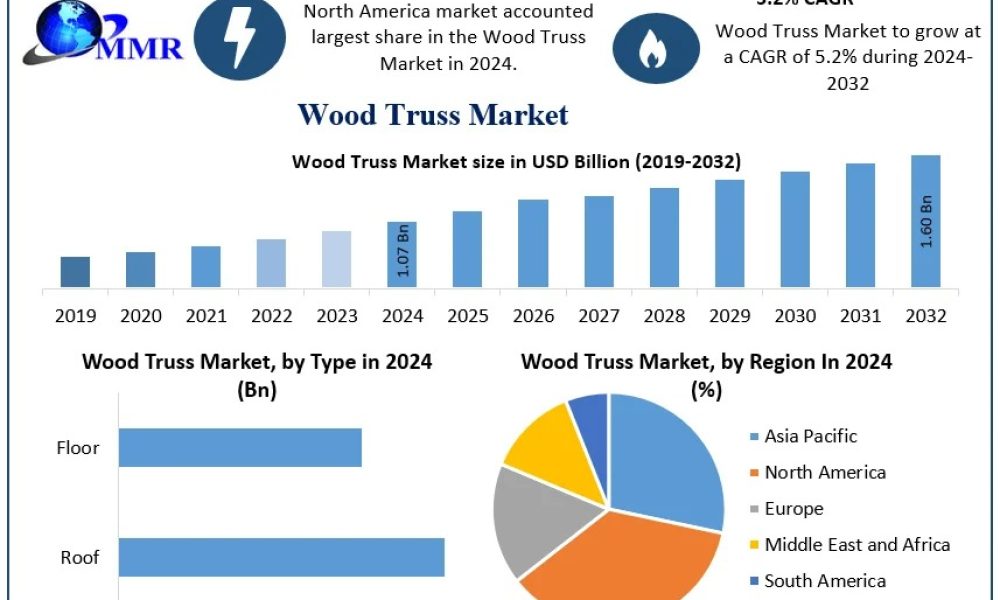
Wood Truss Market is projected to grow from USD 1.07 billion in 2024 to nearly USD 1.60 billion by 2032, posting a robust CAGR of 5.2%. This growth is fueled by surging demand for sustainable, cost-effective, and flexible construction solutions across residential, commercial, and industrial developments.
Key Highlights & Insights
Dominating Region: North America leads the market, with over 62% of new residential areas using wood trusses in 2024, due to the strong tradition of wood construction in the U.S. and Canada, effective off-site prefabrication methods, sustainability drivers, and supportive building codes. Canada’s new builds (approximately 95% of houses) especially emphasize prefabricated truss modules for both heat resistance and flexibility.
Leading Segment: Roof wood trusses dominate the market by type, while the residential segment commands approximately 60% market share by application. The most commonly used shapes are triangular and pitched/triangular trusses, preferred for their structural resilience and adaptability to various architectural designs.
Key Driver: The wood truss market’s primary drivers are cost-effectiveness, strength-to-weight ratio, design flexibility, ease of transportation/installation, and increasing global preference for green and energy-efficient building practices. Wood’s natural insulation, lower embodied energy, and compatibility with off-site manufacturing also contribute significantly.
Recent Developments:
84 Lumber, the largest private building materials supplier, launched a new South Carolina plant in January 2024 to enhance truss supply across the region, generating jobs and expanding capacity with advanced technology.
TRS Components Inc. and Terra Nova Truss (TNT) finalized a merger in April 2023, strengthening their collective product portfolio, operational efficiency, and industry competitiveness.
Market Dynamics
Growth Drivers:
Expanding use of wood trusses in residential and commercial construction for sustainability, cost savings, and improved construction speed.
Increased prefabrication and modular building methods reduce on-site labor and waste.
Governments and green building codes encouraging the adoption of renewable materials like wood in new builds, especially in North America.
Challenges:
Competition from alternative materials such as steel and concrete.
Skilled labor shortages for truss design and installation.
Adherence to evolving safety regulations and environmental standards, with public scrutiny regarding responsible logging and forest management.
Regional Analysis
North America: Unquestioned global leader in wood truss adoption. Regulatory and sustainability incentives, combined with a well-developed wood manufacturing sector and high residential construction rates, make North America the growth epicenter.
Europe & Asia Pacific: Also significant contributors, with increasing adoption seen in residential and commercial applications—driven by energy efficiency requirements and government support for sustainable construction.
Other Regions: Markets in South America, MEA, and others are growing as awareness and infrastructure for modern wood construction expand.
For full access to the data, request a sample report now : https://www.maximizemarketresearch.com/request-sample/100679/
Product Segmentation
By Shape: Fink, Mono, Scissors, Room-in-attic, Pitched/Triangular (most popular), Parallel/Flat, King Post, Howe, and others.
By Type: Roof wood trusses (dominant), Floor trusses (secondary).
By Application: Residential (primary), Commercial (growing).
Key Trends
Accelerated adoption of off-site prefabrication and modular techniques.
Innovations in fire-resistant and thermally-efficient wood truss designs.
Mergers and plant expansions among key market players to strengthen supply chains.
Increased scrutiny and compliance with green certification standards.
Quote
North America’s dominance in the global wood truss market is underpinned by its commitment to sustainability, advanced manufacturing, and cost-effective building methodologies. With ongoing innovation and expanded production, wood trusses are poised to remain a pillar of resilient, green construction worldwide.




