
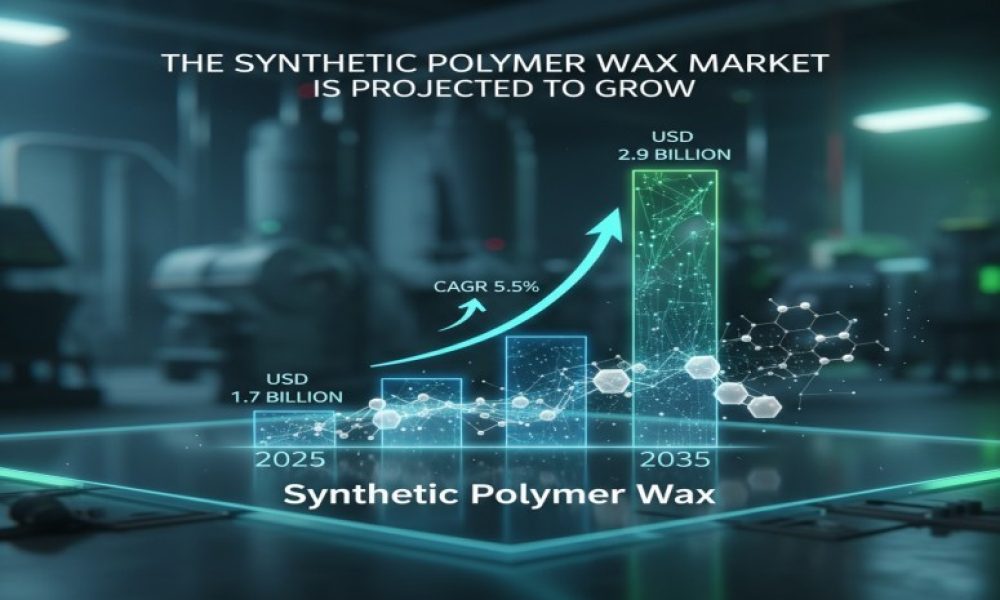
The Synthetic Polymer Wax Market is poised for significant growth over the coming decade, with its estimated market value projected at USD 1.7 billion in 2025, rising to USD 2.9 billion by 2035. This reflects a compound annual growth rate (CAGR) of 5.5%, underscoring the steady adoption of synthetic polymer waxes across multiple industries worldwide. Driven by innovations in manufacturing, expanding end-use industries, and increasing demand for high-performance additives, the market is set to witness both geographic and product diversification.
Synthetic polymer wax is a high-performance additive derived from polymerization processes, offering exceptional properties such as thermal stability, chemical resistance, abrasion resistance, and a bright, translucent shine. Unlike natural waxes, which are limited in consistency and performance, synthetic polymer waxes provide controlled molecular weight and uniform particle distribution, ensuring reliability across industrial applications.
Access the Full Market Report Instantly. Request Purchase or Tailored Insights Here:
https://www.futuremarketinsights.com/reports/sample/rep-gb-7806
These waxes are primarily employed to enhance surface finish, improve scratch resistance, act as lubricants, and serve as dispersants or anti-slip agents. The versatility of synthetic polymer waxes makes them indispensable in industries like plastics, automotive, packaging, coatings, adhesives, rubber, and chemicals.
Market Drivers Fueling Growth
Several factors are propelling the growth of the synthetic polymer wax market. Firstly, the expansion of industrial production and infrastructure development globally has increased the demand for paints, coatings, inks, and plastics, all of which utilize synthetic waxes as key processing aids.
Secondly, environmental regulations and sustainability initiatives are pushing manufacturers to replace natural waxes with synthetic alternatives that offer enhanced performance while maintaining eco-compliance. High-performance synthetic waxes that provide improved thermal stability, compatibility with polymers, and low volatility are becoming the preferred choice for industries aiming to optimize product quality.
Additionally, the growth of automotive, packaging, and consumer goods sectors has created new opportunities. Innovations in low-emission and bio-compatible wax formulations are enabling wider adoption in environmentally sensitive applications, making synthetic polymer wax an essential additive in modern manufacturing.
Regional Market Outlook
- North America and Europe: High industrialization, automotive production, and stringent quality standards drive wax demand. The USA market alone is expected to rise from USD 628.6 million in 2025 to USD 992.6 million by 2035, growing at a CAGR of 4.7%. Germany leads Western Europe with a CAGR of 6.3%.
- Asia-Pacific: Rapid industrialization, growing plastics and automotive sectors, and infrastructure expansion make it the fastest-growing market. China and India are projected to grow at 7.4% and 6.9% CAGR, respectively, reflecting robust demand for high-performance waxes.
- Latin America and Middle East & Africa: Industrial growth and increasing automotive production drive moderate market growth, with Brazil showing a CAGR of 4.1%. Emerging markets such as Morocco and South Africa offer new opportunities.
Competitive Landscape
The synthetic polymer wax market is highly competitive, with leading players including BASF SE, Clariant AG, ExxonMobil Corporation, Sasol Limited, Mitsui Chemicals, Honeywell, Lubrizol, Evonik Industries, Michelman, Westlake Chemical, Trecora Resources, IGI Wax, Paramelt B.V., and Hexion Inc.
These companies are focusing on product innovation, strategic partnerships, mergers, and acquisitions to strengthen their market position. Development of specialized grades, environmentally-friendly formulations, and high-performance additives are key strategies enabling differentiation in this competitive landscape.
Market Dynamics and Opportunities
The market is shaped by regulatory approvals, innovation, and strategic expansions. The FDA approval of synthetic polymer wax in food packaging has opened a critical avenue for growth, while research into low-emission, bio-compatible, and high-purity wax formulations creates potential for new industrial applications.
At the same time, the relatively moderate pricing of synthetic wax compared to natural waxes encourages manufacturers to adopt it, balancing cost-efficiency with performance. Population growth, rising per capita consumption, and expanding automotive, pharmaceutical, and food & beverage industries further contribute to sustained demand.
Explore Key Insights – Download the Report Brochure!
https://www.futuremarketinsights.com/reports/brochure/rep-gb-7806
Synthetic Polymer Wax Market by Segments
Product Type:
- Polyethylene wax
- Homopolymer Wax
- Polypropylene Wax
- Fishcher-Trospch Wax
- Co-polymer Wax
- Ethylene Vinyl Acetate Wax
- Ethylene Acrylic Acid wax
Application:
- Lubricating
- Wetting and dispersing
- Surface Modifying
- Retention
End-use Industry:
- Plastics
- Polish Industry
- Floor polishes
- Car polishes
- Furniture polishes
- Shoe polishes
- Construction
- Paints & coating
- Printing ink industry
- Paper & packaging
- Textile industry
About Future Market Insights (FMI)
Future Market Insights, Inc. (ESOMAR certified, recipient of the Stevie Award, and a member of the Greater New York Chamber of Commerce) offers profound insights into the driving factors that are boosting demand in the market. FMI stands as the leading global provider of market intelligence, advisory services, consulting, and events for the Packaging, Food and Beverage, Consumer Technology, Healthcare, Industrial, and Chemicals markets. With a vast team of over 400 analysts worldwide, FMI provides global, regional, and local expertise on diverse domains and industry trends across more than 110 countries.



