
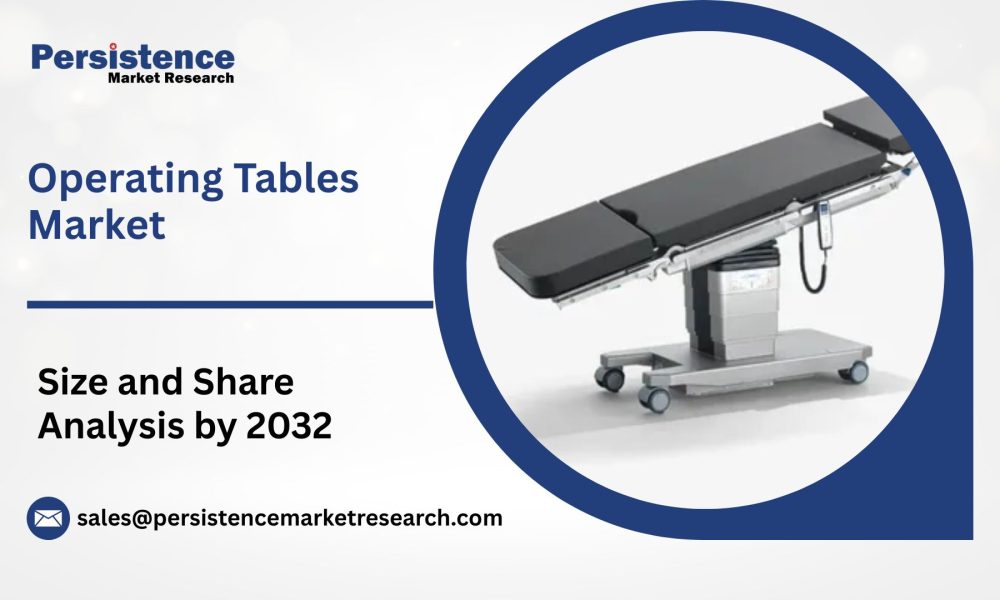
The operating tables market plays a crucial role in modern surgical environments by providing stability, flexibility, and ergonomics essential for successful procedures. These tables are extensively used in hospitals, ambulatory surgical centers, and specialty clinics across a wide range of surgeries, including general, orthopedic, neurosurgery, gynecology, and cardiovascular operations. They enhance surgical precision by offering adjustability, patient safety, and integration with imaging devices, making them indispensable in today’s healthcare infrastructure. According to the latest study by Persistence Market Research, the Global Operating Tables Market value is projected to reach US$ 1,540.4 million by the year 2032 from US$ 1,228.9 million in 2025 growing at a CAGR of 3.3%.Growth is mainly fueled by rising surgical volumes, the global increase in chronic diseases, and advancements in minimally invasive and robotic surgeries that demand technologically advanced operating tables.
Market expansion is further supported by the rising adoption of hybrid operating rooms, which require advanced imaging-compatible tables for precision-driven procedures. Among product types, powered/electric operating tables emerge as the leading segment, as they offer superior positioning control, safety features, and integration with modern surgical equipment. Geographically, North America dominates the global market, attributed to its advanced healthcare infrastructure, high surgical demand, and adoption of innovative technologies. However, Asia Pacific is projected to witness the fastest growth, driven by increasing healthcare investments, a growing patient pool, and rising adoption of advanced surgical practices in countries like China, India, and Japan.
Request a Sample: https://www.persistencemarketresearch.com/samples/3789
Key Market Insights
- The market value is projected to reach US$ 1,540.4 million by the year 2032 from US$ 1,228.9 million in 2025 growing at a CAGR of 3.3%.
• Powered/electric operating tables dominate due to enhanced patient positioning, efficiency, and integration features.
• North America leads the market, supported by advanced healthcare systems and high surgical demand.
• Asia Pacific is the fastest-growing region, fueled by rising healthcare expenditure and modernization of hospitals.
• The growing adoption of hybrid operating rooms and robotic surgeries is driving demand for technologically advanced tables.
What are the main drivers of the operating tables market?
The primary drivers of the operating tables market include the rising global burden of chronic diseases such as cardiovascular disorders, cancer, and orthopedic conditions, which significantly increase surgical procedures. Additionally, advancements in minimally invasive and robotic surgeries require advanced, imaging-compatible tables with high precision and safety features. Expanding healthcare infrastructure in emerging economies, combined with increasing investments in surgical equipment modernization, also propels market growth. The trend toward hybrid operating rooms is further boosting demand for advanced, multipurpose operating tables.
Market Dynamics
Drivers: Rising surgical volumes worldwide, the demand for hybrid operating rooms, and increasing adoption of advanced minimally invasive techniques are major growth drivers. Technological innovation in powered and imaging-compatible operating tables is also accelerating market expansion.
Market Restraining Factor: High acquisition and maintenance costs of advanced operating tables, particularly in developing regions, pose significant challenges. Additionally, the limited budget of small hospitals and clinics can restrain adoption.
Key Market Opportunity: The development of smart and integrated operating tables with robotic assistance and real-time imaging capabilities offers a major opportunity. Manufacturers focusing on ergonomic designs and AI-enabled surgical platforms are expected to gain competitive advantage.
Market Segmentation
The operating tables market can be segmented by product type and application.
By product type, the market includes manual, powered/electric, and specialty operating tables. Powered/electric tables dominate due to their ease of use, automation, and superior patient positioning capabilities, while specialty tables are gaining traction in neurosurgery, orthopedic, and bariatric procedures.
By application, the market is categorized into general surgery, orthopedic, gynecology, neurosurgery, cardiovascular, and others. General surgery accounts for the largest market share, supported by the high number of routine and complex procedures. Orthopedic and neurosurgery applications are growing steadily with the rising prevalence of trauma and degenerative disorders.
Regional Insights
North America remains the largest market, supported by advanced healthcare systems, high surgical volumes, and strong adoption of cutting-edge surgical equipment. Europe follows, benefiting from robust government healthcare support and focus on modern surgical solutions. Asia Pacific is set to record the fastest growth due to rising healthcare expenditure, growing patient populations, and modernization of hospitals in China, India, and Southeast Asia. Latin America and the Middle East & Africa are also emerging markets, with increasing surgical demand and government focus on healthcare infrastructure development.
Competitive Landscape
The operating tables market is highly competitive, with manufacturers focusing on innovation, ergonomic designs, and integration with advanced surgical technologies. Key players are also expanding their footprint in emerging economies to capture growing demand.
Company Insights
✦ Getinge AB
✦ Stryker Corporation
✦ Hill-Rom Holdings, Inc. (Baxter International)
✦ Steris plc
✦ Mizuho OSI
✦ Merivaara Corp.
✦ Alvo Medical
✦ Skytron LLC
✦ Schaerer Medical AG
✦ Siemens Healthineers (specialty integration)
Key Industry Developments
Recent industry developments highlight the focus on advanced integration and patient safety. Manufacturers are launching tables with improved weight capacity, mobility, and compatibility with robotic-assisted surgeries. For instance, leading companies are developing carbon-fiber imaging tables designed for hybrid ORs to enhance precision in cardiovascular and neurosurgical procedures.
Strategic partnerships with hospital networks, acquisitions, and regional expansions are also shaping the competitive landscape. Many companies are increasing investments in Asia Pacific to cater to the region’s rising healthcare modernization.
Innovation and Future Trends
The future of the operating tables market lies in smart, connected, and robotic-integrated solutions. AI-powered surgical platforms, imaging compatibility, and patient-specific positioning systems are expected to transform operating rooms. Sustainability trends are also gaining ground, with manufacturers exploring eco-friendly materials and energy-efficient designs. These advancements position the market for strong long-term growth.
Explore the Latest Trending Research Reports:




