
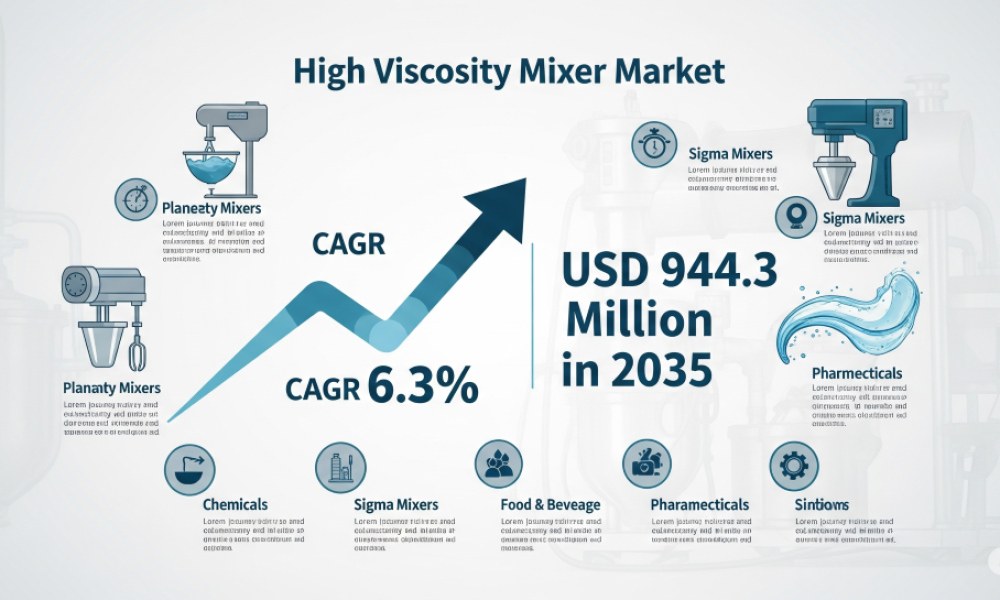
The global high viscosity mixer market is projected to grow from USD 512.6 million in 2025 to USD 944.3 million by 2035, registering a CAGR of 6.3% during the forecast period. Growth is fueled by rising demand for precise mixing in adhesives, polymers, and specialty chemicals.
Manufacturers are increasingly adopting advanced automation and control technologies to enhance operational efficiency and reduce batch times. Energy-efficient and application-specific mixer designs are gaining traction, while elevated R&D investments continue to drive innovation across industries.
Market Dynamics Driving Growth
High viscosity mixers are integral to industries where uniform blending of dense and sticky materials is required. Sectors such as adhesives, coatings, food processing, pharmaceuticals, and specialty chemicals are adopting these mixers for their ability to deliver consistency, quality, and reliability in production.
One of the strongest drivers of this market is the growing need for customization in end-use industries. Adhesive manufacturers, for instance, require mixers that can handle formulations with varying viscosities, while food and beverage producers seek equipment that ensures product safety, uniform taste, and texture.
Additionally, sustainability-focused manufacturing is influencing mixer designs. With companies under pressure to minimize energy consumption and reduce production waste, demand is rising for mixers that offer high efficiency, durability, and lower operational costs.
Regional Trends
- North America: The region remains a leading market due to its strong base in chemical manufacturing, food production, and healthcare. Adoption of advanced automation and digital monitoring systems is further boosting demand.
- Europe: Stringent regulations around energy efficiency and sustainable production processes are shaping equipment innovation. Germany, France, and the UK are major contributors with their robust industrial and pharmaceutical sectors.
- Asia-Pacific: Countries like China, India, and South Korea are witnessing rapid growth in the adhesives, plastics, and food industries, making APAC one of the fastest-growing markets for high viscosity mixers.
- Latin America & MEA: Although emerging, these regions are gradually adopting modern mixing technologies in food, chemicals, and construction materials, supported by rising industrialization.
For More Insights into the Market, Request a Sample of this Report:
https://www.factmr.com/connectus/sample?flag=S&rep_id=7668
Competitive Landscape
The high viscosity mixer market is highly competitive, with both global and regional players striving to strengthen their presence. Larger companies are focusing on acquisitions, partnerships, and technology upgrades, while smaller firms are emphasizing niche applications and cost-effective solutions.
Key players include:
- Ross Mixers – known for its portfolio of double planetary and multi-shaft mixers catering to adhesives and composites.
- IKA Works – focusing on laboratory to industrial-scale mixing with advanced control technology.
- Ekato Group – emphasizing energy-efficient and large-scale mixers for the chemical and pharmaceutical industries.
- Silverson Machines – recognized for high-shear mixing solutions adaptable to multiple viscosities.
These companies are competing not just on equipment quality but also on digital integration, after-sales services, and customization.
Recent Developments
- In March 2025, Ross Mixers introduced a next-generation planetary mixer with real-time process monitoring, designed to improve precision in adhesive production.
- In June 2024, IKA Works launched its new high-efficiency industrial mixer line with IoT-based control systems, enabling predictive maintenance and reduced downtime.
- In 2024, Ekato Group expanded its footprint in Asia with a new manufacturing facility in India to cater to rising demand in chemicals and pharmaceuticals.
Outlook
Looking ahead, the high viscosity mixer market will continue to expand as industries demand greater efficiency, automation, and sustainability in production. The integration of IoT, AI-driven controls, and energy-efficient designs will redefine competitiveness, allowing manufacturers to meet stringent regulatory standards while reducing costs.
By 2035, high viscosity mixers will not only be critical to traditional applications but will also gain importance in emerging areas such as biopolymers, advanced composites, and eco-friendly adhesives, marking them as essential equipment for the next phase of industrial growth.
Contact:
US Sales Office
11140 Rockville Pike
Suite 400
Rockville, MD 20852
United States
Tel: +1 (628) 251-1583, +353-1-4434-232
Email: [email protected]



