
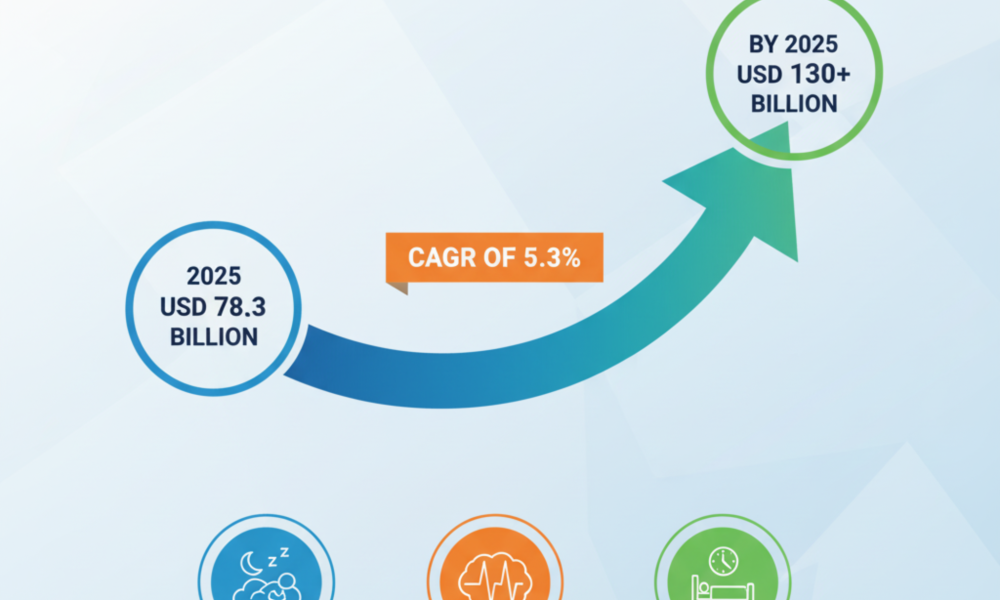
The global sleeping aid market is on track for notable expansion, with its value forecasted to grow from USD 78.3 billion in 2025 to USD 131.3 billion by 2035. This growth is supported by a compound annual growth rate (CAGR) of 5.3% over the forecast period from 2025 to 2035. The market’s upward trend is primarily driven by the rising incidence of sleep disorders, elevated stress and anxiety levels, and heightened awareness of the critical role restorative sleep plays in overall health and productivity. As lifestyles become increasingly hectic and digital influences disrupt natural sleep patterns, consumers are turning to a variety of aids, from pharmaceuticals to innovative devices, to improve sleep quality and duration.
Sleeping Aid Market Segmentation and Trends
The sleeping aid market is segmented by product, indication, distribution channel, and region, providing a detailed insight into its structure. Products are divided into drugs (such as insomnia and narcolepsy treatments like Doxepin Hydrochloride and Modafinil) and devices (including CPAP, BiPAP, APAP machines, mattresses, pillows, chin straps, mouthpieces, and nasal devices). By indication, the market addresses insomnia (holding 38% share), sleep apnea (30% share), sleep deprivation, and narcolepsy. Distribution channels include hospital pharmacies (32% share), retail pharmacies (28% share), e-commerce, and drug stores. Regionally, the market covers North America, Europe, Latin America, East Asia, South Asia & Oceania, and the Middle East & Africa, with specific analyses for countries like the US, Canada, UK, Germany, France, Italy, South Korea, Japan, China, and Australia-NZ. Current trends emphasize natural and non-pharmacological solutions, with a surge in digital therapeutics, AI-integrated wearables, and personalized sleep coaching apps.
Full Market Report Available for Delivery. For Purchase or Customization, Please Request Here: https://www.factmr.com/connectus/sample?flag=S&rep_id=7785
Driving Factors Behind Market Growth
The sleeping aid market is fueled by multiple interconnected drivers. The escalating prevalence of sleep disorders, exacerbated by modern stressors like work pressure and screen time, is a primary catalyst. Greater public awareness of sleep’s impact on mental and physical health is encouraging proactive use of aids. Aging populations in developed regions are increasing demand for solutions targeting age-related sleep issues. Technological advancements, such as AI-driven diagnostics and mobile health platforms, are making personalized treatments more accessible. The rise of telehealth and sleep clinics facilitates early detection and intervention. Additionally, the shift towards natural ingredients like adaptogens and CBD reflects consumer preferences for holistic, side-effect-free options, further propelling market growth.
Recent Developments and Key Players
The sleeping aid market is highly competitive, with key players innovating in natural formulations and digital solutions to capture market share. Recent developments highlight the industry’s focus on wellness and technology. Innovations include adaptogens, CBD-infused aids, and hormone regulators for natural sleep enhancement. Digital sleep therapeutics are expanding, offering individualized behavior-modification plans via mobile platforms. The rise of sleep clinics and telehealth testing enables early diagnosis, while 77% of investors are funding AI-driven diagnosis, high-level sleep coaching, and improved formulations. Prominent players include Koninklijke Philips NV, which holds 18-22% market share with CPAP machines and AI-connected wearables; Merck & Co., Inc. (12-15% share) with drugs like BELSOMRA; Pfizer, Inc. (10-13% share) focusing on sedative-hypnotics and digital solutions; Teva Pharmaceutical Industries Ltd. (9-11% share) offering generics; and GlaxoSmithKline, Inc. (7-10% share) with OTC products like Nytol.
Competitor analysis shows a emphasis on diversification and compliance. Philips leads in devices with cloud-based personalization, while Merck advances orexin antagonists through trials. Pfizer emphasizes regulatory adherence and tech integration. Teva leverages cost-effective distribution, and GSK expands via e-commerce. Other players like Compumedics Ltd. and Natus Medical, Inc. innovate in polysomnography, while disruptors such as Betterlifehealthcare Ltd. and Lifeline Corporation Pte Ltd. introduce ergonomic and non-invasive aids. The remaining 30-36% market share is held by smaller entities pushing functional improvements.
Regional Insights and Opportunities
North America dominates the sleeping aid market, driven by high insomnia rates, insurance coverage, and preference for non-pharmacological treatments in the US and Canada. Europe follows, with increasing adoption of sleep tech and herbal remedies in the UK, Germany, France, and Italy. The Asia Pacific region is the fastest-growing, fueled by urban stresses and aging demographics in China (CAGR 7.9%), South Korea (6.6%), Japan, and Australia-NZ, where mobile health solutions are booming. Latin America shows potential with rising awareness, while the Middle East & Africa offer opportunities through expanding healthcare access. South Asia & Oceania benefit from lifestyle changes, creating avenues for affordable, digital aids.
Challenges and Future Outlook
The sleeping aid market faces challenges, including ingredient availability, cross-border transport issues for clinical supplies, and regulatory hurdles for new formulations. Potential side effects of pharmaceuticals and high costs of advanced devices limit accessibility in emerging markets. Data privacy concerns with digital therapeutics also pose risks. However, the outlook is positive, with opportunities in untapped regions and the integration of AI for precise diagnostics. The market’s transformation into a health-tech ecosystem focused on mental wellbeing will drive innovation. As awareness grows and technologies evolve, the sleeping aid market is positioned for sustained growth, enhancing global sleep health through 2035.
Check out More Related Studies Published by Fact.MR:
Hearing Aid Market: https://www.factmr.com/report/hearing-aid-market
Computer Aided Detection Market: https://www.factmr.com/report/4673/computer-aided-detection-market
Contact:
US Sales Office
11140 Rockville Pike
Suite 400
Rockville, MD 20852
United States
Tel: +1 (628) 251-1583, +353-1-4434-232
Email: [email protected]
About Fact.MR
We are a trusted research partner of 80% of fortune 1000 companies across the globe. We are consistently growing in the field of market research with more than 1000 reports published every year. The dedicated team of 400-plus analysts and consultants is committed to achieving the utmost level of our client’s satisfaction.



