
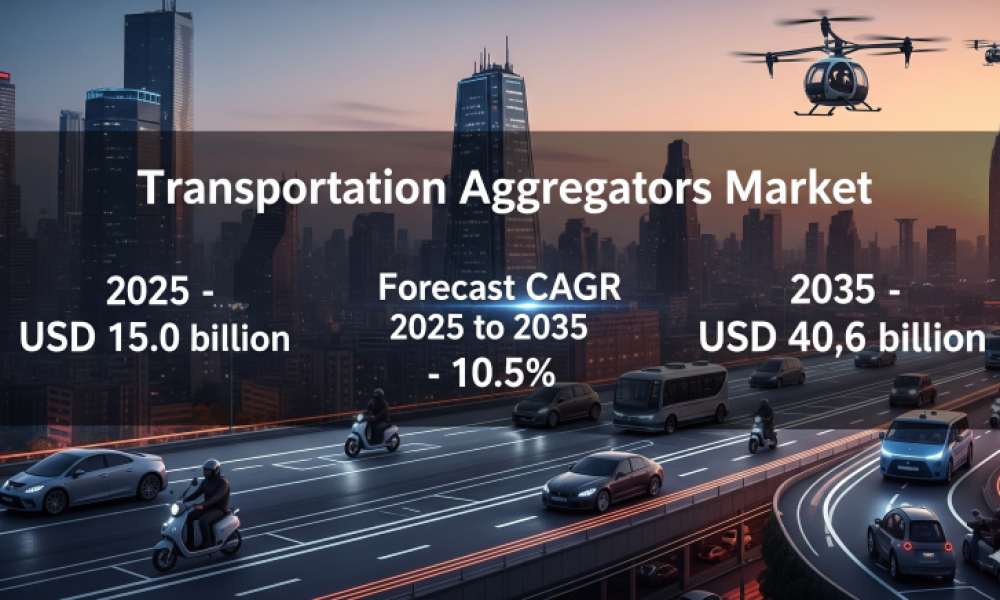
The Transportation Aggregators Market is experiencing rapid growth, with estimates projecting a leap from USD 15.0 billion in 2025 to USD 40.6 billion by 2035, expanding at a Compound Annual Growth Rate (CAGR) of 10.5% over the forecast period. This surge is being driven by increasing consumer demand for convenient, flexible, and affordable transportation options, alongside the accelerating digital transformation in the mobility sector.
Unlock detailed analytics – Request your personalized report now! https://www.futuremarketinsights.com/reports/sample/rep-gb-1190
Key Drivers of Growth
Several macroeconomic and technological factors are contributing to the expansion of the global transportation aggregators market:
- Digital Adoption: The proliferation of smartphones and the growing accessibility of high-speed internet are making transportation services more accessible. Aggregator platforms, which consolidate various transportation services into a single interface, are increasingly popular for their ability to enhance convenience, transparency, and competitive pricing.
- Rising Urbanization: Rapid urbanization and population growth in both developed and emerging economies are intensifying the demand for efficient, on-demand mobility solutions. As consumers continue to shift away from traditional vehicle ownership, platforms offering ride-hailing, carpooling, and on-demand logistics are thriving.
- Government Support for Sustainable Mobility: With governments worldwide introducing policies that promote shared mobility, sustainability, and reduced congestion, there is a growing acceptance of transportation aggregator models. These models not only offer lower carbon footprints but also optimize existing infrastructure, driving demand across urban and semi-urban areas.
- Technological Innovations: Companies are investing heavily in enhancing user experiences with technologies such as real-time tracking, route optimization, and integrated payment systems. The development of electric and hybrid fleets, along with smart mobility initiatives, is expected to further fuel market expansion.
Market Segmentation and Regional Outlook
The transportation aggregators market is segmented into roadways, railways, airways, and seaways, with the roadways segment predicted to dominate, accounting for 38.2% of the market share in 2025. The flexibility, affordability, and scalability of road-based services such as ride-hailing and on-demand logistics are key drivers behind this segment’s market leadership.
Regionally, the market is experiencing significant growth in North America, Asia-Pacific, and Europe, with China leading the charge with the highest projected CAGR of 14.1%. India follows closely at 13.1%, underscoring the potential for growth in emerging markets. The USA, the UK, Germany, and other mature markets are expected to expand steadily, driven by technological innovation and infrastructure development.
Competitive Landscape
The competitive environment in the transportation aggregators market is marked by the presence of both established players and emerging startups. Leading companies in this space include:
- Uber Technologies
- Lyft
- ANI Technologies (Ola)
- Grab Holdings
- Gett
- Shippr
- BlaBlaCar
- BlackBuck
These companies are vying for market share through strategic partnerships, investments in fleet expansion, and continuous product innovation. New entrants are also capitalizing on niche markets, offering tailored solutions for specific regions or customer segments.
The North American market remains a dominant force, with Uber Technologies valued at over USD 51 billion as of 2025. However, as competition intensifies, companies are focusing on enhancing service offerings and diversifying their portfolios to remain competitive. In Asia-Pacific, the Indian market is also seeing rapid growth, driven by high demand for affordable and efficient transport solutions.
Challenges and Opportunities
Despite the robust growth trajectory, the transportation aggregators market faces certain challenges:
- Regulatory Complexity: Varying rules and regulations across countries present operational hurdles for transportation aggregators, especially when entering new regions.
- Costly Consumer Retention: Heavy reliance on venture capital funding and price competition is resulting in a race to offer discounts and promotions, which can be unsustainable for some companies in the long term.
- Infrastructure Constraints: Expanding services into tier 3, tier 4, and tier 5 cities remains a significant challenge, as infrastructure in these areas may not support the scale of services offered by transportation aggregators.
However, these challenges also present opportunities for companies to innovate in customer retention strategies, invest in alternative transportation modes such as electric vehicles, and expand their operations in untapped markets.
Full Market Insights Available. Inquire for Customization! https://www.futuremarketinsights.com/customization-available/rep-gb-1190
Conclusion
The Transportation Aggregators Market is poised for tremendous growth, fueled by technology, evolving consumer preferences, and a growing focus on sustainability. With a projected CAGR of 10.5%, the industry is set to reach USD 40.6 billion by 2035. As companies continue to innovate and expand, the global landscape will witness transformative shifts in how people and goods are transported across regions.
With key players solidifying their positions and new entrants tapping into emerging markets, the future of transportation aggregation promises to reshape mobility ecosystems worldwide.
About Future Market Insights (FMI)
Future Market Insights, Inc. (ESOMAR certified, recipient of the Stevie Award, and a member of the Greater New York Chamber of Commerce) offers profound insights into the driving factors that are boosting demand in the market. FMI stands as the leading global provider of market intelligence, advisory services, consulting, and events for the Packaging, Food and Beverage, Consumer Technology, Healthcare, Industrial, and Chemicals markets. With a vast team of over 400 analysts worldwide, FMI provides global, regional, and local expertise on diverse domains and industry trends across more than 110 countries.



