
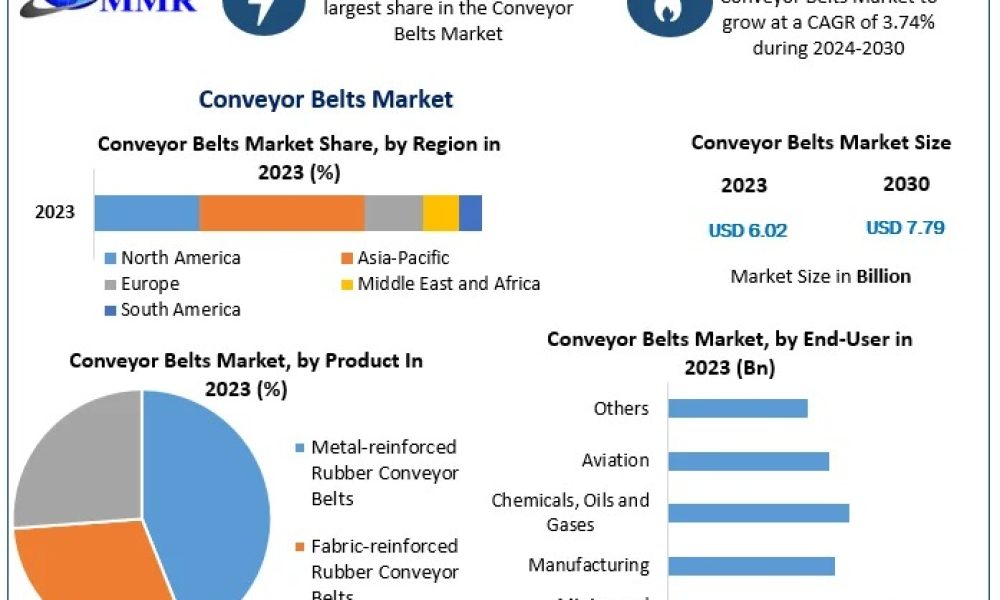
Conveyor Belts Market Overview :
Conveyor Belts Market, valued at approximately USD 5.68 billion in 2025, is projected to expand to nearly USD 8.49 billion by 2035, growing at a CAGR of over 4.1%. Key factors fueling this growth include the rising demand for automation in manufacturing, logistics, mining, and food processing industries, alongside technological advancements and increasing infrastructure development worldwide. Asia Pacific emerges as the leading region, driven by its robust manufacturing base, rapid industrialization, and escalating adoption of conveyor systems in diverse sectors.
Key Highlights & Insights
- Market Size & Growth: From USD 5.68 billion in 2025 to USD 8.49 billion by 2035, reflecting a CAGR exceeding 4.1%.
- Dominating Region: Asia Pacific leads the market with an estimated 56% share by 2035, attributable to expanding industrial activities, infrastructure development, and strong growth in e-commerce and automation technologies.
- Leading Segment: Medium-weight conveyor belts hold the largest market share, widely used across logistics, packaging, and manufacturing sectors due to their balanced strength and flexibility.
- Key Driver: Increasing industrial automation, demand for efficient material handling solutions, and growth in sectors such as mining, metallurgy, and food processing are central to market expansion.
Recent Developments
- In 2024, Montech launched new ISO-certified belt conveyors tailored for pharmaceutical and semiconductor industries, focusing on contamination prevention and precision handling.
- Companies such as Siemens AG, Daifuku Co. Ltd., and TGW Logistics Group have invested heavily in R&D to develop eco-friendly, energy-efficient, and durable conveyor belt systems.
- Adoption of smart monitoring systems and IoT integration in conveyor belt operations continues rising, enabling real-time performance analytics and predictive maintenance.
- Expansion of conveyor systems in emerging markets like India, Vietnam, and Malaysia is bolstered by growing manufacturing hubs and logistics infrastructure.
Market Dynamics
Growth Drivers:
- Growing manufacturing automation and Industry 4.0 adoption in Asia Pacific and North America.
- Increasing e-commerce penetration requiring efficient warehouse and distribution systems.
- Rising demand for advanced conveyor belt materials with heat, abrasion, and oil resistance.
- Infrastructure investments and urbanization driving mining, metallurgy, and construction sectors.
For full access to the data, request a sample report now :https://www.maximizemarketresearch.com/request-sample/29467/
Challenges:
- High installation, maintenance, and repair costs impact adoption among small and medium enterprises.
- Supply chain disruptions from raw material volatility may affect production timelines.
- Need for trained workforce to manage complex automated conveyor systems.
Regional Analysis
- Asia Pacific: The largest and fastest-growing market region, led by China, India, Japan, and South Korea with significant industrialization and automation investments.
- North America: Strong demand driven by mining and manufacturing industries concentrated in states like Ohio, Montana, and Arizona.
- Europe: Steady growth with emphasis on environmental compliance and advanced manufacturing technologies in Germany, France, and the UK.
- Middle East & Africa and Latin America: Emerging demand linked to infrastructure development and increasing mining activities.
Product Segmentation
By Product Type:
- Metal-reinforced rubber conveyor belts (leading segment): Preferred for tensile strength and wear resistance in heavy-duty applications.
- Fabric-reinforced rubber conveyor belts
- Plastic conveyor belts
By Weight:
- Medium-weight (largest share)
- Light-weight
- Heavy-weight
By Cover:
- Conductive
- Abrasion-resistant
- Heat- and flame-resistant
- Oil-resistant
By End-User:
- Mining and metallurgy (largest)
- Manufacturing
- Chemicals, oils, and gases
- Aviation
- Others
Key Trends
- Rising incorporation of smart sensors and IoT for real-time monitoring and automated maintenance.
- Development of modular conveyor belt systems adapting to complex manufacturing layouts.
- Focus on eco-friendly conveyor belts made from recyclable materials.
- Increasing demand for specialized conveyor belts for food industries adhering to FDA and hygiene standards.
- Enhanced durability and functionality through advances in materials engineering.
Quote
Asia Pacific’s dominance in the conveyor belts market stems from its rapid industrial growth, growing urbanization, and adoption of automation technologies. As industries increasingly prioritize operational efficiency and sustainability, conveyor belts will remain pivotal to their success.
Rising industrial output, technological innovation, and expanding infrastructure projects globally make the conveyor belts market poised for strong growth—especially in Asia Pacific. Continuous advancements and increasing adoption across various sectors are transforming material handling and driving efficiency into the future.
About Us :
Contact Us :




