
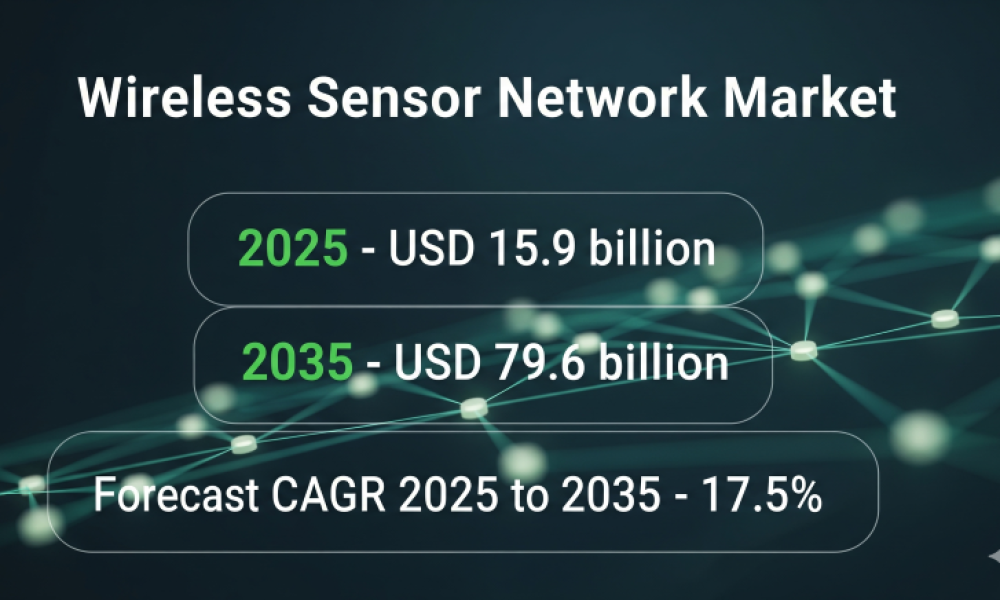
The global Wireless Sensor Network market is poised for explosive growth, with a projected Compound Annual Growth Rate (CAGR) of 17.5%, climbing from USD 15.9 billion in 2025 to an estimated USD 79.6 billion by 2035. This rapid expansion will be driven by increasing adoption across key sectors including healthcare, industrial automation, defense, energy, and smart cities. The growth trajectory reflects the rising demand for real-time monitoring, predictive analytics, and seamless connectivity that is revolutionizing industries worldwide.
Discover key market opportunities – Request your sample report now! https://www.futuremarketinsights.com/reports/sample/rep-gb-24729
Rapid Growth Expected in the Coming Decade
Between 2025 and 2030, the WSN market is expected to skyrocket from USD 15.9 billion to USD 35.5 billion, fueled by the global push toward automation and smart infrastructures. By 2029, market value will reach USD 30.2 billion, showcasing the escalating integration of wireless sensors in sectors ranging from energy management to industrial control systems. The growth will be most prominent in the smart cities and industrial IoT (Internet of Things) sectors, where WSNs are becoming fundamental tools in creating intelligent, data-driven ecosystems.
From 2030 to 2035, the market’s upward curve will continue, reaching USD 79.6 billion. This phase will be marked by widespread adoption of wireless sensors in smart grids, environmental monitoring, and predictive maintenance in manufacturing, among other applications. The accelerating pace of growth is expected to redefine how industries monitor, manage, and optimize their operations on a real-time basis.
Key Growth Segments and Applications
The WSN market is diverse, spanning various topologies, sensor types, and industries. Notably, the star topology is set to dominate the market with a share of 33.7% by 2025. This topology’s simplicity, ease of implementation, and low coordination overhead make it ideal for low-power applications, particularly in healthcare, asset tracking, and smart homes.
In terms of sensor types, MEMS sensors are forecasted to hold the largest share of 35.8% by 2025. Their compact size, multi-functionality, and low power consumption make them crucial for precise monitoring across applications like industrial automation and healthcare.
The terrestrial WSN type will also maintain its stronghold in the market, with an expected share of 29.5% in 2025. The widespread adoption of terrestrial networks in applications like environmental monitoring, smart grids, and industrial processes is further bolstered by advancements in energy-efficient solutions and robust connectivity options.
Regional Growth and Competitive Landscape
Geographically, North America, Asia-Pacific, and Europe will emerge as the primary drivers of WSN adoption, with emerging markets in China and India witnessing the fastest growth. China leads the pack with an impressive CAGR of 23.6%, underpinned by robust investments in smart city projects, industrial automation, and large-scale infrastructure initiatives. Similarly, India, with a projected CAGR of 21.9%, is experiencing accelerated adoption driven by government initiatives such as Digital India and Smart Cities Mission.
Competitive Analysis
The competition in the wireless sensor network market is intensifying, with leading companies focusing on energy-efficient designs, advanced sensor technologies, and secure communication protocols. Intel, Qualcomm, and NXP Semiconductors dominate the market at the semiconductor level, driving innovation in low-power processors and RF modules. Texas Instruments leads in wireless ICs designed for IoT and industrial environments, while Cisco and Siemens continue to integrate WSNs into broader automation and control systems.
Honeywell and ABB are leveraging their expertise in industrial safety and building automation, deploying sensor networks to monitor critical systems in real time. Meanwhile, STMicroelectronics and TE Connectivity are focusing on enhancing sensor durability and resilience in harsh environments, which is crucial for applications in industries such as defense and aerospace.
Download Brochure for Full Insights: https://www.futuremarketinsights.com/reports/brochure/rep-gb-24729
Key Market Drivers and ChallengesThe WSN market is primarily driven by the increasing need for remote monitoring, predictive maintenance, and data-driven decision-making across industries. As businesses prioritize operational efficiency and safety, WSNs are integral in enhancing automation, reducing downtime, and improving resource management. The healthcare and smart infrastructure sectors, in particular, are experiencing significant demand as organizations seek real-time monitoring and automation capabilities to optimize operations.
However, challenges remain in terms of network security, interoperability, and energy management. As wireless sensor networks expand across industries, ensuring secure data transmission and maintaining network reliability in large-scale deployments will be key for sustaining growth. Companies that prioritize cybersecurity, energy efficiency, and scalability will be best positioned to capture a significant share of the market.
About Future Market Insights (FMI)
Future Market Insights, Inc. (ESOMAR certified, recipient of the Stevie Award, and a member of the Greater New York Chamber of Commerce) offers profound insights into the driving factors that are boosting demand in the market. FMI stands as the leading global provider of market intelligence, advisory services, consulting, and events for the Packaging, Food and Beverage, Consumer Technology, Healthcare, Industrial, and Chemicals markets. With a vast team of over 400 analysts worldwide, FMI provides global, regional, and local expertise on diverse domains and industry trends across more than 110 countries.



