
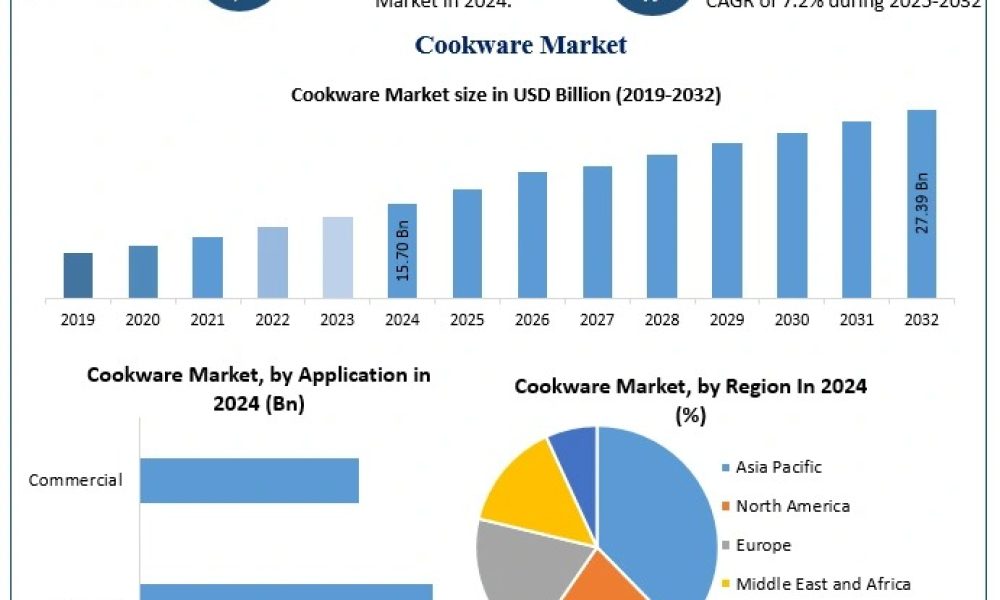
Cookware Market is experiencing consistent growth, driven by rising consumer interest in cooking, evolving food culture, and increasing adoption of modular and sustainable kitchen solutions. Valued at approximately USD 15.70 billion in 2024, the market is expected to expand at a compound annual growth rate (CAGR) of 7.2%, reaching nearly USD 27.39 billion by 2032.
Cookware Market Overview
Cookware encompasses a broad range of kitchen tools and equipment essential for food preparation, including pots, pans, turners, whisks, spoons, and ladles. These products are made from various materials such as stainless steel, aluminum, glass, ceramic, and composites. The market benefits significantly from the rising trend of modular kitchen installations influenced by improved living standards and increasing urbanization.
Cooking shows, international culinary competitions, and social media food influencers have increased public interest in high-quality cooking tools. This surge in cooking enthusiasm drives the demand for specialized and durable cookware products.
Additionally, government initiatives enhancing access to cleaner cooking fuels—for example, the widespread distribution of LPG connections in developing countries like India—support growth by enabling more households to adopt modern cookware compatible with gas stoves.
Market Segmentation
By Product Type:
The pots and pans segment holds the largest market share (approximately 62.8% in 2024) due to consumers’ preference for multi-functional and colorful pans made from materials like steel, wood, and ceramic. The spoon segment is forecasted to witness the fastest growth, driven by its essential role in both cooking and serving activities.
By Material:
Stainless steel dominates with close to 54% market share in 2024. Its corrosion resistance, enhanced durability, and non-reactivity with acidic or alkaline foods make it highly sought after. Aluminum cookware, noted for excellent heat conductivity, is expected to register the fastest growth rate thanks to innovations that improve its strength and reduce weight, including alloying with copper or magnesium.
By Application:
The residential segment commands the largest share (nearly 77% in 2024), supported by rising urban housing projects, renovations, and increasing disposable income leading to higher consumer spending on premium and sustainable kitchen products. The commercial segment is expanding rapidly as well, driven by growth in restaurants, cloud kitchens, bakeries, and catering services demanding durable and high-quality cookware.
Regional Insights
Asia Pacific dominates the cookware market with a share of approximately 43% in 2024. Factors contributing to this dominance include rapid urbanization, expansion of residential construction, increased demand for modern kitchen infrastructure, and rising food cultures in countries such as China, India, Japan, South Korea, and Australia. Home remodeling and renovation projects also sustain demand.
North America maintains steady growth with a CAGR of around 5.6%. The rising number of households and strong demand for premium cookware products, including stainless steel and sustainable options, drive market expansion.
Europe is an important region with a mature market receptive to innovations focused on health and sustainability. The Middle East, Africa, and South America represent emerging markets with opportunities linked to urbanization and changing consumer lifestyles.
Interested in detailed insights? Inquire for a sample report :https://www.maximizemarketresearch.com/request-sample/124386/
Market Trends
Premiumization and Consumer Awareness: Increasing demand for high-quality, long-lasting cookware with advanced materials and stylish design aesthetics.
Sustainability Focus: Growing preference for eco-friendly cookware made from recyclable materials with non-toxic coatings.
E-commerce Penetration: Online retail continues to influence purchasing behavior, enabling consumers to access a wider variety of products and brands.
Technological Innovations: Development of smart cookware with features like real-time temperature control and induction compatibility.
Health Consciousness: Rising awareness encourages demand for non-toxic, ceramic, and stainless steel cookware that promotes healthier cooking.
Competitive Landscape
The global cookware market features well-established brands such as Werhahn Group, Farberware, MEYER Corp., Fissler, Groupe SEB, All-Clad Group, Tefal, Zwilling, and Cuisinart. These companies focus on product innovation, sustainability, and expanding their geographic footprint while maintaining brand loyalty. Continuous investments in research and development drive new materials and designs catering to modern consumer preferences.
Outlook
The cookware market trajectory aligns with global lifestyle shifts emphasizing home cooking, health, convenience, and sustainability. Demand for versatile, durable, and innovative cookware will keep rising in both residential and commercial sectors. Regionally, Asia Pacific’s expanding urban population and developing middle class will fuel most of the market growth. However, maturity and premiumization in North America and Europe will contribute to global revenue gains.
Market players investing in sustainable materials, multi-functional designs, and e-commerce capabilities are expected to lead success in this evolving, competitive landscape. This sector remains vital for food preparation globally, with compounded growth inspired by cultural, economic, and technological factors.




