
Solar Glass Market Overview
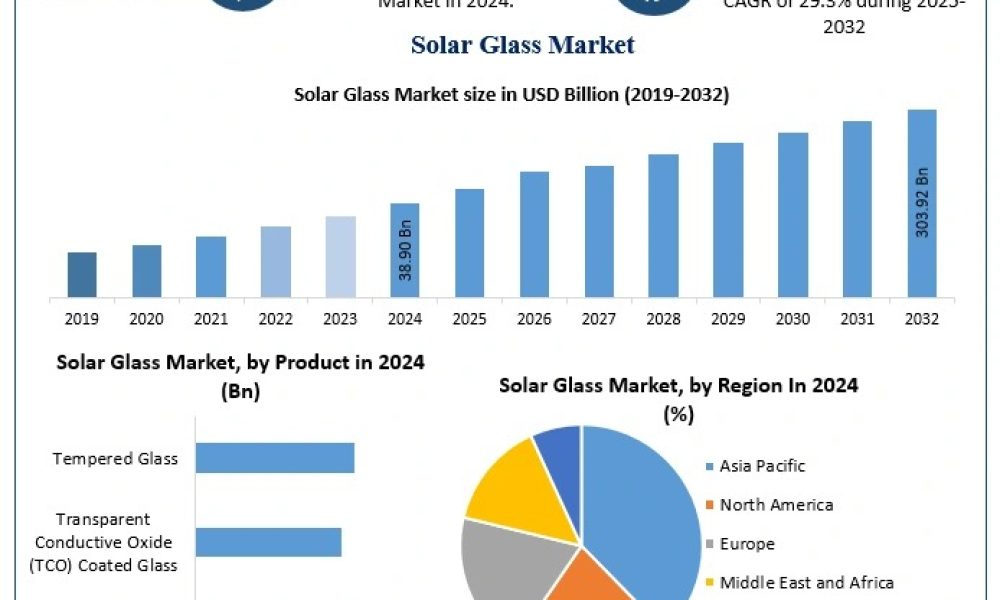
Solar Glass Market is entering a phase of extraordinary growth, underpinned by global decarbonization efforts and the rapid adoption of clean energy. Valued at USD 38.90 billion in 2024, the market is projected to surge to USD 303.92 billion by 2032, registering a striking CAGR of 29.3%. Solar glass—designed to improve the efficiency of photovoltaic modules and withstand environmental stress—is increasingly being adopted across residential rooftops, utility-scale projects, building facades, and even mobility solutions such as solar vehicles.
Key Highlights & Insights
Market Size & Growth: From USD 38.90 billion in 2024 to USD 303.92 billion by 2032, advancing at 29.3% CAGR.
Dominating Region: Asia Pacific leads, with China, India, Japan, and Australia driving installations, supported by strong policy frameworks and extensive manufacturing capacity.
Leading Product Segment: Anti-reflective coated glass is most widely used, enhancing energy yield through superior light absorption.
Key Drivers: Rising demand for decarbonization, expanding architectural integration of solar solutions, and government-backed renewable energy incentives worldwide.
Recent Developments
Innovation continues to shape the solar glass market. Manufacturers including Almaden, Guardian Glass, PPG Industries, Asahi India, Saint-Gobain Solar, and Xinyi Solar are investing in advanced glass types such as anti-reflective coatings and tempered glass, offering durability, enhanced transmission, and higher power generation under varied climatic conditions.
Breakthroughs in R&D are simultaneously reducing production costs, enabling broader adoption in emerging economies. Regulatory support in Europe, China, and India has also created fertile ground for expansion, as governments seek to meet ambitious clean energy and climate targets. Utility-scale projects remain the backbone of market growth, though demand from residential and commercial building panels is rising rapidly.
Market Dynamics
Growth Drivers
Climate Change Imperatives: Global urgency around carbon reduction drives massive investment in solar infrastructure.
Policy Support: Subsidies, feed-in tariffs, and climate action frameworks across Asia Pacific and Europe encourage adoption.
Technology Advancements: Development of anti-reflective and transparent conductive oxide (TCO) coatings, along with robust tempered glass, enhances module efficiency.
Architectural Integration: Demand is rising for energy-efficient building materials, with solar glass increasingly embedded into roofs, facades, and smart urban projects.
Interested in detailed insights? Inquire for a sample report : https://www.maximizemarketresearch.com/request-sample/27009/
Restraints
High Costs: Despite declining prices, premium solar glass and system installation remain expensive in some regions.
Supply Constraints: Limited capacity in producing high-quality photovoltaic glass hampers broader adoption.
Opportunities
Cost-Effective Manufacturing: Continuous R&D into lower-cost production processes promises to improve accessibility.
Urban Rooftop Growth: Rooftop solar in densely populated urban areas creates new application opportunities.
Emerging Markets: South Asia, Southeast Asia, and parts of Africa are becoming growth hotspots with rising local manufacturing.
Regional Analysis
Asia Pacific: The undisputed leader, powered by China’s vast installations and strong domestic manufacturing, India’s large-scale solar adoption, and favorable climate conditions across Japan and Australia.
Europe: A hub of regulatory support and environmental consciousness, where green building codes and infrastructure upgrades sustain demand.
North America: Experiencing rapid growth, particularly in the U.S., as both residential and utility-scale solar adoption accelerates.
Middle East & Africa: Witnessing increasing solar investments, supported by grid modernization and new entrants in solar technology.
Product Segmentation
By Product Type: Anti-reflective coated glass, transparent conductive oxide (TCO) glass, tempered glass.
By Application: Utility-scale solar panels, non-residential building panels, residential rooftops, solar water heaters, battery chargers, solar-powered vehicles, and space applications.
Key Trends
The industry is moving toward integrated solar applications, embedding photovoltaic glass in urban infrastructure and mobility solutions. Tempered and anti-reflective coated glass dominate due to their energy efficiency and resilience, while Asia Pacific’s growing manufacturing hubs are reducing costs and improving global supply chains. Sustainability and decarbonization are central to both innovation and adoption, reinforcing solar glass as a core element of the energy transition.
Quote
As Asia Pacific accelerates clean energy adoption, the solar glass market stands at the forefront of the global sustainability revolution. Innovation, policy support, and rapid urbanization are shaping an era where solar glass is embedded into the fabric of modern infrastructure.




