
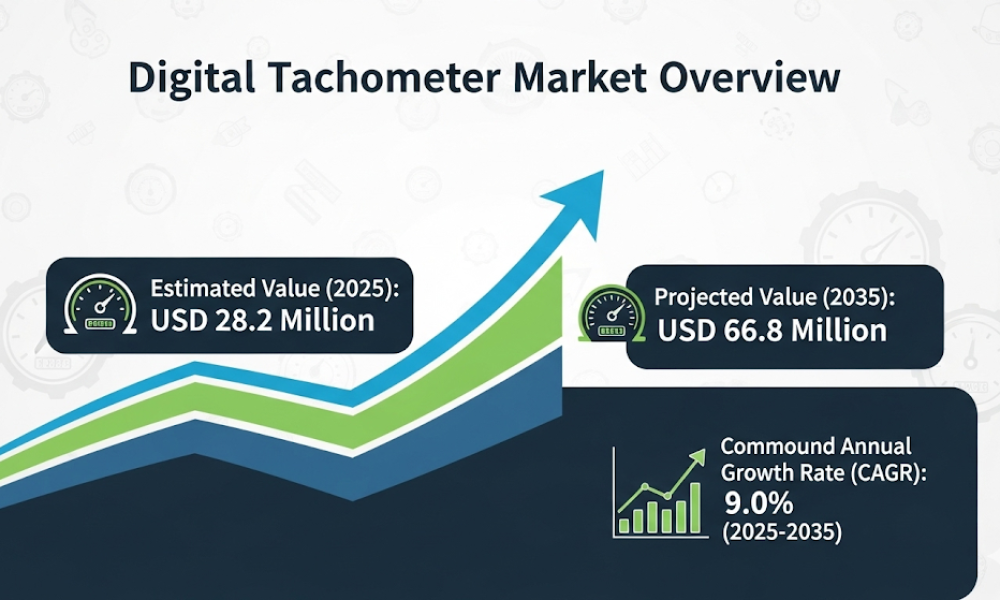
The global digital tachometer market is poised for significant growth over the next decade, with market valuation projected to rise from USD 28.2 million in 2025 to USD 66.8 million by 2035, registering a robust compound annual growth rate (CAGR) of 9.0%. This growth trajectory reflects increasing industrial adoption of precision measurement tools and the rising importance of predictive maintenance across key sectors.
Digital tachometers, essential for accurate rotational speed and monitoring across automotive, aerospace, manufacturing, and energy industries, are gaining prominence due to advancements in sensor technologies, microcontroller integration, and user-friendly digital interfaces. Market analysts note that the shift toward compact, portable, and multi-functional devices is enabling real-time monitoring and enhanced operational efficiency, driving widespread adoption.
Non-Contact Type Leads Market Adoption
Among data acquisition techniques, non-contact digital tachometers are expected to dominate with a 61.3% market share in 2025. Their ability to measure high-speed rotation without physical contact minimizes equipment wear, reduces maintenance, and enhances operational safety. Incorporating laser and optical sensors, non-contact devices provide high-precision readings in challenging environments, making them particularly favored in industrial and automotive applications.
Click Here for More Information:- https://www.futuremarketinsights.com/reports/digital-tachometer-market
Time Measurement Techniques Drive Accuracy
In terms of measurement technique, the time measurement segment is projected to account for 57.9% of market revenue in 2025. Known for accuracy and consistency, this technique ensures stable readings even under fluctuating operational conditions. The adoption of microprocessor-based systems further enhances precision, allowing seamless integration with digital displays, data logging systems, and automation platforms.
Automotive Sector Remains Key Application
The automobile sector is expected to retain its leadership as the largest application segment, capturing 32.8% of revenue in 2025. Increasing demand for precise engine speed monitoring, component testing, and performance diagnostics—especially in electric and hybrid vehicles—is driving adoption. Digital tachometers are now widely used in vehicle assembly lines, quality control, and maintenance services to ensure compliance with strict safety and efficiency standards.
Regional Insights Highlight Growth Opportunities
North America, Asia-Pacific, and Europe are identified as key growth regions. The United States is benefiting from smart manufacturing initiatives and strong adoption of IoT and automation technologies, particularly in aerospace and defense. In India, rapid industrialization, infrastructure expansion, and “Make in India” initiatives are fueling demand for precise measurement tools. Meanwhile, China, a global manufacturing leader, is seeing increased adoption of digital tachometers due to smart factory implementations and Industry 4.0 initiatives.
Market forecasts also reveal significant country-level growth potential: China leads with a CAGR of 12.2%, followed by India at 11.3%, and Germany at 10.4%. Developed markets such as the USA, France, and the UK continue steady expansion, while Brazil, despite a lower CAGR of 6.8%, contributes to a positive global outlook.
Get Sample Report: – https://www.futuremarketinsights.com/reports/sample/rep-gb-882
Competitive Landscape and Innovation
The market features strong competition, with leading players including SKF, TESTO, KIMO, OMEGA, Tecpel, and Parker. Companies are investing heavily in research and development to enhance device accuracy, portability, and multi-functionality. Modern tachometers now offer additional monitoring capabilities, such as temperature, vibration, and pressure measurements, providing industries with versatile diagnostic tools.
The integration of wireless communication technologies is further propelling market growth, enabling seamless data transmission and remote monitoring—an essential feature for smart factories and connected industrial operations. Portable and ergonomic devices are becoming standard, catering to field technicians and enhancing usability across industrial settings.
Market Outlook
Driven by technological advancements, rising demand for predictive maintenance, and expansion of industrial automation, the global digital tachometer market is expected to maintain steady growth throughout the next decade. As industries prioritize efficiency, safety, and sustainability, digital tachometers will remain indispensable tools in ensuring optimal performance across diverse operational environments.
About Future Market Insights (FMI)
Future Market Insights, Inc. (ESOMAR certified, recipient of the Stevie Award, and a member of the Greater New York Chamber of Commerce) offers profound insights into the driving factors that are boosting demand in the market. FMI stands as the leading global provider of market intelligence, advisory services, consulting, and events for the Packaging, Food and Beverage, Consumer Technology, Healthcare, Industrial, and Chemicals markets. With a vast team of over 400 analystsworldwide, FMI provides global, regional, and local expertise on diverse domains and industry trends across more than 110 countries.
Contact Us:
Future Market Insights Inc.
Christiana Corporate, 200 Continental Drive,
Suite 401, Newark, Delaware – 19713, USA
T: +1-347-918-3531
For Sales Enquiries: [email protected]
Website: https://www.futuremarketinsights.com
LinkedIn| Twitter| Blogs | YouTube



