
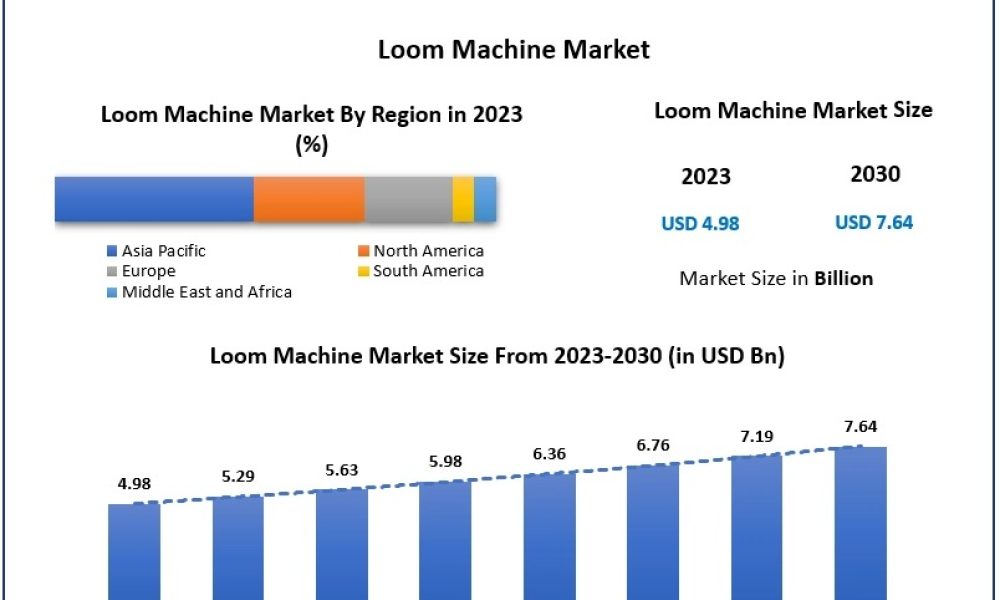
Loom Machine Market Overview:
loom machine market valued at USD 4.98 billion in 2023 is expected to reach USD 7.64 billion by 2030, registering a CAGR of 6.3%. This growth is driven by rapid adoption of automation, IoT integration, and demand for high-quality fabrics, especially in Asia-Pacific textile hubs like China, India, and Bangladesh.
Key Highlights & Insights
- Market Growth Drivers: Innovations such as air jet looms and computerized systems are increasing weaving efficiency, reducing labor dependency, and improving fabric quality. Sustainability and Industry 4.0 adoption are key factors boosting market expansion.
- Dominating Region: Asia-Pacific dominates the market with over 90% of global loom shipments, supported by large textile manufacturing bases and accelerated machinery modernization efforts.
- Key Challenges: Despite growth, outdated technology and slower automation adoption in regions like India hinder global competitiveness. The need for higher speeds, broader looms, and better yarn quality remains critical.
Want to know more? Request your sample report today : https://www.maximizemarketresearch.com/market-report/loom-machine-market/259588/
Recent Developments
- Toyota Industries Corporation introduced the new JAT910 air jet loom in 2022, enhancing speed, low vibration, and environmental performance.
- Companies like Tsudakoma and Haijia Machinery continue investing in high-speed, precision looms to meet rising global demand.
- Advances in sensor technology and AI-enabled monitoring enable predictive maintenance and waste reduction.
Market Dynamics
Growth Drivers:
Rising Demand for Diverse Textiles: The demand spans across fashion apparel, home furnishings, and automotive interiors. Rapidly changing fashion trends and the expanding automotive sector, which uses textiles for interiors and safety components, fuel loom machine demand. The global textile market size is projected to grow significantly with a CAGR above 7%, driven by consumer appetite for varied, high-quality fabrics.
Shift towards Sustainable and Cost-effective Weaving Solutions: There is growing emphasis on sustainability in textiles, with brands and manufacturers adopting eco-friendly fibers and recycling technologies. Loom machines that enable efficient use of raw materials and energy, reduce waste, and support sustainable fabric production are highly sought after.
Challenges:
High Capital Expenditure: Upgrading to modern loom machines involves substantial investment, which can be a barrier, especially for smaller or traditional textile producers, limiting widespread modernization.
Fragmented Industry with Unorganized Sectors: Particularly in countries like India, a large portion of the weaving industry operates on outdated equipment with limited automation, impeding competitiveness and scalability on a global scale.
Regional Analysis
- Asia-Pacific: Rapid industrialization, export-oriented textile production, and government incentives drive market leadership.
- North America and Europe: Focus on high-performance looms for specialty textiles and advanced quality controls.
- Other Regions: Growing textile industries in Latin America and Africa present emerging opportunities.
Product Segmentation
- By Type:
- Air Jet Loom (largest segment)
- Water Jet Loom
- Rapier Loom
- Missile Loom
- Multiphase Loom
- Projectile Loom
- By Operation:
- Manual
- Semi-automatic
- Fully Automatic
- By Application:
- Natural Fiber Industry
- Chemical Fiber Industry
- Others
Integration of IoT and Sensor Technologies for Production Optimization
Modern loom machines increasingly deploy IoT infrastructure and sensor networks to monitor parameters like motor temperature, vibration, humidity, and power supply voltage in real-time. These data streams feed into machine learning algorithms to detect irregularities and predict failures, enabling proactive maintenance and minimizing downtime. For example, rapier looms equipped with vibration and acoustic sensors help operators monitor wear and tear, ensuring optimal performance and reducing material waste.
Increasing Automation to Address Labor Shortages
Automation in loom machinery, incorporating advanced PLCs, servo motors, and programmable controls, substitutes manual operations and speeds up fabric production. With labor shortages affecting textile hubs, these automated systems allow manufacturers to maintain high output while reducing human error. Automated warp stop motion and real-time defect detection also enhance quality and yield.
Quote
Asia-Pacific remains the heart of loom machine growth driven by strong textile manufacturing capabilities and investment in advanced weaving technology. Innovations in automation and sustainability are set to transform global fabric production efficiency.




