
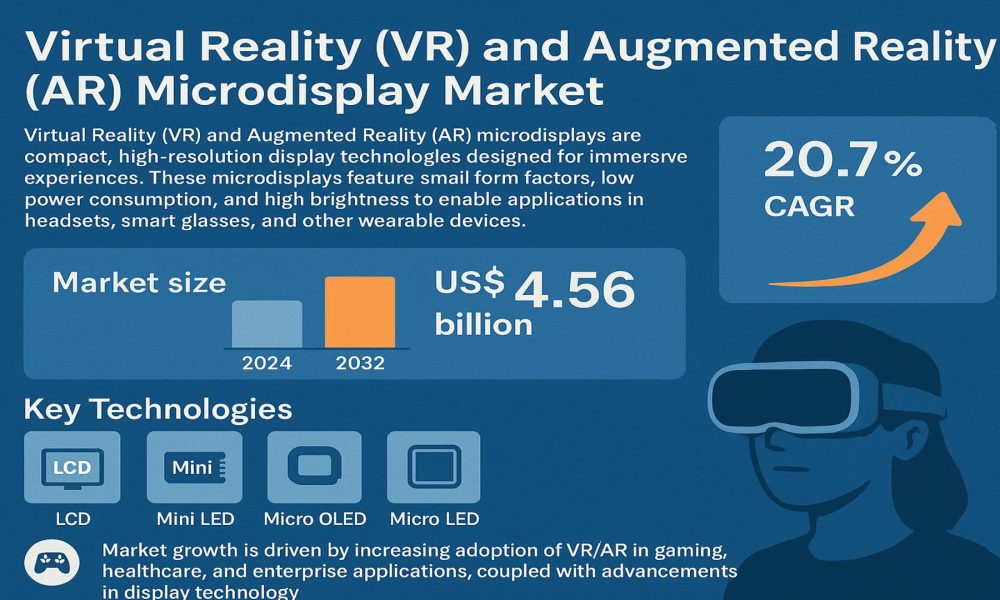
Virtual Reality (VR) and Augmented Reality (AR) Microdisplay Market size was valued at US$ 1.23 billion in 2024 and is projected to reach US$ 4.56 billion by 2032, at a CAGR of 20.7% during the forecast period 2025-2032.
Virtual Reality (VR) and Augmented Reality (AR) microdisplays are compact, high-resolution display technologies designed for immersive experiences. These microdisplays feature small form factors, low power consumption, and high brightness to enable applications in headsets, smart glasses, and other wearable devices. Key technologies include LCD, Mini LED, Micro OLED, and Micro LED displays, each offering unique advantages for different use cases.
The market growth is driven by increasing adoption of VR/AR in gaming, healthcare, and enterprise applications, coupled with advancements in display technology. While the U.S. remains the largest market, China is rapidly catching up due to strong government support and local manufacturing capabilities. Major players like Samsung, LG Display, and BOE are investing heavily in Micro OLED and Micro LED technologies to gain competitive advantage, with the top five companies holding over 60% market share in 2024.
Get Your Free Sample Report Today-https://semiconductorinsight.com/download-sample-report/?product_id=107320
MARKET DRIVERS
Rising Adoption of AR/VR in Healthcare and Education to Propel Market Growth
The healthcare and education sectors are witnessing substantial adoption of AR/VR technologies, driving demand for high-performance microdisplays. In healthcare, AR/VR enables advanced surgical simulations, medical training, and patient rehabilitation programs. The global healthcare AR/VR market is projected to grow by over 30% annually, creating significant demand for microdisplays that offer high resolution and low latency. Similarly, in education, immersive learning experiences powered by AR/VR are becoming mainstream, with institutions investing heavily in these technologies to enhance student engagement and knowledge retention.
Increasing Demand for Compact and Energy-Efficient Displays in Consumer Electronics
Consumer electronics manufacturers are increasingly incorporating AR/VR microdisplays in smartphones, smart glasses, and wearable devices due to their compact size and energy efficiency. With the global shipment of AR/VR headsets expected to exceed 50 million units by 2032, the demand for microdisplays capable of delivering high brightness and contrast ratios is surging. The development of Micro OLED and Micro LED technologies is enabling thinner, more power-efficient displays that enhance user experience while extending battery life – a critical factor in mobile applications.
Recent Developments:
- MicroLED & OLED Advancements: Leading manufacturers are focusing on MicroLED and OLED microdisplays to improve brightness, resolution, and energy efficiency for VR and AR devices.
- Miniaturization Trend: Companies are developing smaller, lighter microdisplays to enhance comfort and usability in AR glasses and VR headsets.
- Automotive & Industrial Adoption: VR/AR microdisplays are increasingly integrated into automotive HUDs and industrial applications, driving market growth.
- Investment in Startups: Significant funding is being directed to startups developing innovative VR/AR display technologies, accelerating commercialization.
- High-Resolution Displays: Rising consumer demand for immersive experiences is pushing the development of 4K and higher resolution microdisplays for head-mounted devices.
- Strategic Partnerships: Collaborations between semiconductor manufacturers and AR/VR device makers are on the rise to enhance display performance and reduce production costs.
- Global Market Expansion: Asia-Pacific and North America are witnessing major investments in microdisplay production facilities to meet increasing demand.
MARKET OPPORTUNITIES
Emerging Applications in Industrial and Enterprise Sectors Present Growth Potential
The industrial and enterprise sectors offer substantial growth opportunities for AR/VR microdisplay providers. Applications such as remote maintenance, virtual collaboration, and digital twins are gaining traction, particularly in manufacturing, automotive, and energy sectors. These applications demand rugged, high-performance microdisplays capable of functioning in demanding environments. Similarly, the defense sector is increasingly adopting AR technologies for training and situational awareness applications, creating new avenues for specialized microdisplay manufacturers.
Advancements in Display Technologies Enable New Product Categories
Recent breakthroughs in Micro LED and holographic display technologies are enabling entirely new product categories. The development of see-through AR displays and ultra-high-resolution VR panels is creating opportunities in professional visualization, design, and simulation markets. These technological advancements are particularly valuable in sectors such as architecture, where spatially accurate visualization is critical. Continuous innovation in display materials and manufacturing processes is expected to unlock additional applications across various verticals in the coming years.
Get Your Free Sample Report Today-https://semiconductorinsight.com/download-sample-report/?product_id=107320
List of Key VR/AR Microdisplay Companies Profiled
- Samsung (South Korea)
- Sharp (Japan)
- LG Display (South Korea)
- JDI (Japan Display Inc.) (Japan)
- BOE Technology Group (China)
- TCL Technology (China)
- Shenzhen Longli Technology Co., Ltd. (China)
- Hongli Zhihui Group Co.,LTD. (China)
- Kopin Corporation (U.S.)
- eMagin Corporation (U.S.)
- MICROOLED (France)
- Plessey Semiconductors (UK)
- JBD (Jade Bird Display) (China)
Segment Analysis:
By Type
Micro OLED Segment Leads Due to High Adoption in AR/VR Devices for Superior Display Quality
The market is segmented based on type into:
- LCD
- Subtypes: IPS LCD, OLED LCD, and others
- Mini LED
- Micro OLED
- Subtypes: Silicon-based OLED, Plastic-based OLED
- Micro LED
By Application
Entertainment Segment Dominates Owing to Rising Demand for Immersive Gaming and Media Experiences
The market is segmented based on application into:
- Medical
- Fitness
- Education
- Entertainment
- Others
By End User
Consumer Electronics Segment Expands Rapidly with Growing Adoption of AR/VR Headsets
The market is segmented based on end user into:
- Consumer electronics
- Healthcare
- Industrial
- Military & defense
By Resolution
2K and Above Resolution Gains Traction for Enhanced Visual Experience
The market is segmented based on resolution into:
- below HD
- HD
- Full HD
- 2K and above
Other Topic-Reader Scan Engine Modules Market
CONTACT US:
City vista, 203A, Fountain Road, Ashoka Nagar, Kharadi, Pune, Maharashtra 411014
[+91 8087992013]




