
Definition
Hydrogen production iridium-based catalysts are specialized materials used to accelerate the oxygen evolution reaction (OER) during water electrolysis, a critical step in green hydrogen production. These catalysts are primarily deployed in proton exchange membrane (PEM) electrolyzers, which operate under acidic environments where iridium’s unique chemical stability makes it indispensable.
The market is divided into two primary categories:
- High-Iridium Catalysts: Traditional formulations with high iridium loading that provide excellent performance and durability.
- Low-Iridium Catalysts: Emerging formulations designed to minimize reliance on scarce iridium supplies while maintaining comparable efficiency.
These catalysts are essential for enabling scalable, efficient, and cost-effective hydrogen generation. With global industries pivoting towards clean energy and decarbonization, iridium-based catalysts have become a backbone technology in green hydrogen infrastructure.
Market Size
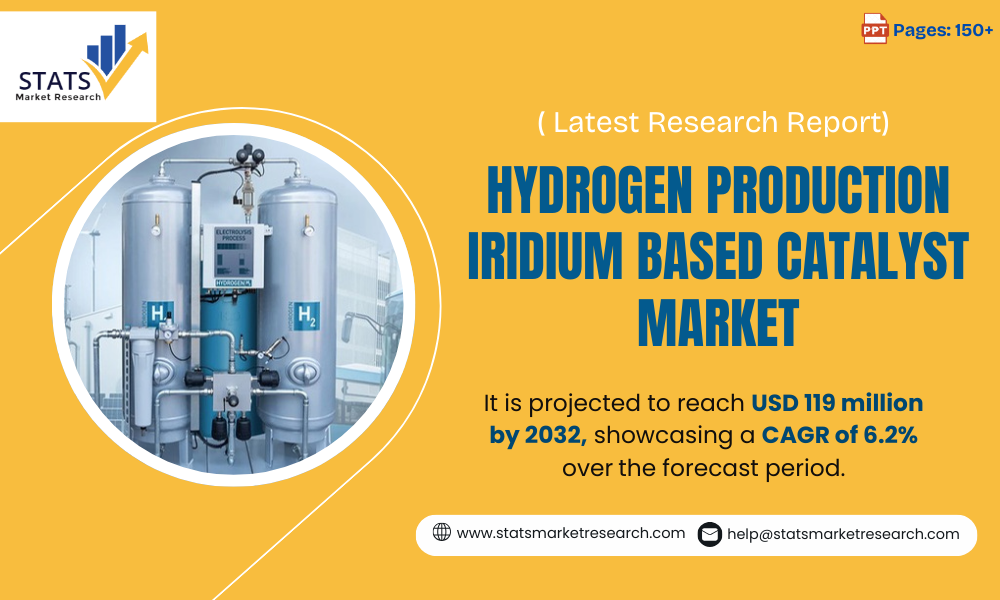
Global hydrogen production iridium-based catalyst market was valued at USD 79.8 million in 2023 and is projected to grow from USD 84.7 million in 2024 to USD 119 million by 2030, at a CAGR of 6.2% during the forecast period.
Key highlights:
- Demand is fueled by the rapid installation of PEM electrolyzers worldwide.
- Over 680 large-scale hydrogen projects announced globally (valued at $240 billion) are directly contributing to rising demand for catalysts.
- Iridium scarcity remains a limiting factor, with only 7–8 tons produced annually worldwide, primarily from South Africa.
- Companies are investing heavily in nanostructured, low-iridium catalysts that lower costs while maintaining efficiency.
Download FREE Sample of this Report @ https://www.statsmarketresearch.com/download-free-sample/8058993/global-hydrogen-iridium-based-catalyst-forecast-market
Recent Developments
The primary focus of recent developments in the hydrogen production iridium-based catalyst market is to address the significant challenges of iridium’s scarcity and high cost. Researchers are developing new methods to drastically reduce the amount of iridium needed while maintaining or even improving catalytic performance. This includes the development of “supported catalysts” where a thin layer of iridium is deposited on a cheaper, more abundant carrier material. For example, some breakthroughs have led to a 70% reduction in iridium usage in proton exchange membrane (PEM) electrolyzers. Additionally, research is exploring alternative, non-iridium catalysts, such as those based on cobalt, to eliminate the reliance on the rare metal altogether.
Major Distribution
The distribution of iridium-based catalysts for hydrogen production is concentrated within the manufacturing of Proton Exchange Membrane (PEM) electrolyzers. PEM electrolyzers are highly effective for producing green hydrogen but require iridium to catalyze the oxygen evolution reaction (OER) at the anode due to the acidic environment. Therefore, the market’s distribution is tied to companies and research institutions involved in the production and development of these electrolyzer systems. Major players in the market are working to scale up the production of low-iridium catalysts to meet the growing demand for green hydrogen and make the technology more commercially viable for large-scale projects.
Market Dynamics (Drivers, Restraints, Opportunities, and Challenges)
Drivers
- Rising Global Demand for Green Hydrogen: Net-zero commitments and renewable energy integration drive demand for PEM electrolyzers.
- Government Support: Policies such as the EU Hydrogen Strategy and U.S. DOE Hydrogen Shot accelerate adoption.
- Technological Breakthroughs: Atomically dispersed and nanostructured catalysts improve activity while reducing iridium use.
Restraints
- Critical Raw Material Scarcity: Limited iridium supply (7–8 tons/year) constrains market scalability.
- High Costs: Iridium prices remain between $4,500–$6,200/oz, making it one of the most expensive catalyst materials.
- Manufacturing Complexity: Thin-film coating processes add cost and lower yields.
Opportunities
- Strategic Partnerships: Collaborations between miners, catalyst developers, and electrolyzer OEMs secure supply chains.
- Industrial Applications: Green steel, ammonia, and methanol production offer new demand channels.
- Recycling Innovations: Circular economy models focusing on iridium recovery from used catalysts.
Challenges
- Lack of Standardization: No global certification for catalyst durability under renewable-powered conditions.
- Durability Concerns: Low-iridium catalysts still face issues under high current densities.
- Regulatory Variability: Differing recycling rules increase compliance costs.
Regional Analysis
- Europe: Leads the market with strong policy frameworks (EU Hydrogen Strategy, CertifHy). Germany and France drive large-scale PEM electrolyzer deployments.
- Asia-Pacific: China is rapidly scaling up, supported by cost-competitive manufacturing (Shanghai Jiping, Anhui Shengshui). Japan and South Korea push hydrogen mobility and industrial applications.
- North America: U.S. DOE Hydrogen Shot program fosters R&D. Canada invests in large-scale hydrogen production hubs.
- Middle East & Africa: Leveraging abundant renewable resources for hydrogen projects (Saudi Arabia’s NEOM green hydrogen plant).
- Latin America: Brazil and Chile show promise with renewable-driven hydrogen initiatives.
Competitor Analysis (in brief)
The market features global chemical leaders and emerging innovators:
- Heraeus (Germany): Holds 25% market share in 2023, pioneering thin-film iridium oxide coatings.
- Shanghai Jiping (China): Backed by government hydrogen programs; strong partnerships with PEM OEMs.
- Anhui Shengshui (China): Focused on recycled iridium sourcing.
- Hefei Momenta Energy (China): Developing iridium-nickel alloy catalysts at lower costs.
- Tsing Hydrogen (China): Innovator in high-surface-area catalyst supports.
Global Hydrogen Production Iridium-Based Catalyst Market: Segmentation Analysis
This report provides a deep insight into the global hydrogen production iridium-based catalyst market, covering all its essential aspects. This ranges from a macro overview of the market to micro details of the market size, competitive landscape, development trend, niche market, key market drivers and challenges, SWOT analysis, value chain analysis, etc.
The analysis helps the reader to shape the competition within the industries and strategies for the competitive environment to enhance the potential profit. Furthermore, it provides a simple framework for evaluating and assessing the position of the business organization. The report structure also focuses on the competitive landscape of the Global Hydrogen Production Iridium-Based Catalyst Market. This report introduces in detail the market share, market performance, product situation, operation situation, etc., of the main players, which helps the readers in the industry to identify the main competitors and deeply understand the competition pattern of the market.
In a word, this report is a must-read for industry players, investors, researchers, consultants, business strategists, and all those who have any kind of stake or are planning to foray into the Hydrogen Production Iridium-Based Catalyst Market in any manner.
Market Segmentation (by Application)
- Small Power Electrolyzer
- Megawatt Electrolyzer
(Megawatt electrolyzers dominate due to rising demand for large-scale hydrogen production.)
Market Segmentation (by Type)
- High-Iridium Type
- Pure Iridium
- Iridium Oxide
- Low-Iridium Type
- Iridium Alloys
- Iridium-Supported Catalysts
(High-iridium type remains dominant, but low-iridium formulations are rapidly growing.)
Key Company
- Heraeus (Germany)
- Shanghai Jiping (China)
- Anhui Shengshui (China)
- Hefei Momenta Energy (China)
- Cotrun New Energy (China)
- Tsing Hydrogen (China)
Geographic Segmentation
- North America
- Europe
- Asia-Pacific
- Middle East & Africa
- Latin America
FAQ Section
- What is the current market size of the Hydrogen Production Iridium-Based Catalyst Market?
The market was valued at USD 79.8 million in 2023 and is projected to reach USD 119 million by 2030. - Which are the key companies operating in the Hydrogen Production Iridium-Based Catalyst Market?
Key players include Heraeus, Shanghai Jiping, Anhui Shengshui, Hefei Momenta Energy, Cotrun New Energy, and Tsing Hydrogen. - What are the key growth drivers in the Hydrogen Production Iridium-Based Catalyst Market?
Rising demand for green hydrogen, technological breakthroughs in catalyst design, and strong government support. - Which regions dominate the Hydrogen Production Iridium-Based Catalyst Market?
Europe leads due to strong policy frameworks, followed by Asia-Pacific and North America. - What are the emerging trends in the Hydrogen Production Iridium-Based Catalyst Market?
- Adoption of low-iridium catalysts
- Growth in strategic partnerships securing supply chains
- Expansion into industrial applications such as green steel and ammonia production
About Us
☎️ International: +1 (332) 2424 294
📄 Website: www.statsmarketresearch.com
Join us on LinkedIn:- https://www.linkedin.com/company/statsmarketresearch




