
Definition
Global pet fresh food market refers to the industry segment producing and distributing minimally processed, refrigerated, or frozen meals made with human-grade ingredients for pets. Unlike traditional kibble or canned options, fresh pet food emphasizes whole proteins, vegetables, and balanced nutrition designed to resemble home-cooked meals. This category includes complete meals, toppers, and treats that cater to dietary needs of dogs, cats, and other small animals. The demand for fresh pet food is largely driven by the growing humanization of pets, as owners increasingly treat animals as family members and prioritize high-quality, restaurant-grade diets for them.
Recent Developments in the Pet Fresh Food Market
The pet fresh food market is seeing significant growth, primarily driven by the “humanization” of pets, where owners treat their animals as family members and seek out high-quality, human-grade food options. This has led to the rise of premium, minimally-processed fresh food products that often require refrigeration. There’s a strong trend towards personalized and customized meal plans, often based on a pet’s breed, age, weight, and health conditions. Manufacturers are also incorporating functional ingredients to address specific health issues like digestive problems or allergies. Additionally, the industry is increasingly focusing on sustainability and ethical sourcing, with a growing demand for products that use responsibly sourced ingredients and eco-friendly packaging.
Major Distribution for Pet Fresh Food
The distribution for pet fresh food is evolving to meet the demands of its unique product characteristics—namely, a shorter shelf life and the need for a cold chain. While traditional channels like specialty pet stores and vet clinics remain important, major supermarkets and hypermarkets are now dedicating more shelf space to refrigerated fresh pet food. The most significant growth is in the direct-to-consumer (D2C) model, with online platforms and subscription-based services offering convenient ordering and home delivery. E-commerce platforms like Chewy and Amazon, as well as brand-specific websites, have become a major distribution channel, allowing smaller, niche brands to reach a wider audience and cater to the demand for customized meal plans.
Market Size
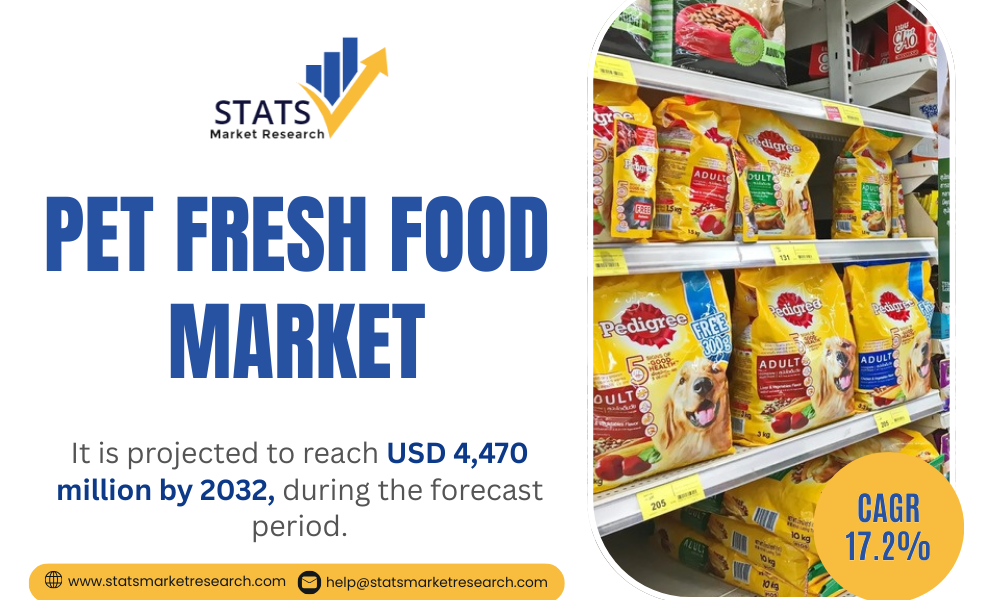
Global pet fresh food market was valued at USD 1,508 million in 2024 and is expected to grow to USD 4,470 million by 2032, at a CAGR of 17.2%. In 2025, the market is projected to reach USD 1,705 million, reflecting a strong growth trajectory.
- Dogs dominate consumption with 82% market share, while cats account for 18%.
- North America currently holds a leading 62% share, attributed to premiumization trends and higher disposable incomes.
- Asia-Pacific is the fastest-growing market, with an estimated 21.5% CAGR, driven by urbanization, rising pet ownership, and adoption of Western pet care practices.
- Key players such as Freshpet have made substantial investments, including a USD 450 million production facility in 2023, reinforcing confidence in market growth.
Download FREE Sample of this Report @ https://www.statsmarketresearch.com/download-free-sample/8058690/global-pet-fresh-food-forecast-market
Market Dynamics (Drivers, Restraints, Opportunities, and Challenges)
Market Drivers
- Pet Humanization and Premiumization: With 68% of millennials considering pets as family (APPA), demand for human-grade, high-quality nutrition is surging. Chef-formulated and USDA-approved recipes mimicking human diets (organic, non-GMO, sustainably sourced) have pushed fresh food from niche to mainstream.
- E-commerce and Direct-to-Consumer Models: Subscription-based delivery and cold chain logistics innovations have fueled fresh food adoption. Between 2020-2024, DTC pet food channels grew 300% faster than traditional retail. Online channels enhance accessibility for urban pet owners, who make up 78% of buyers.
- Veterinary Endorsements: Clinical studies show fresh diets reduce obesity-related conditions by 34% and improve coat quality by 28%. Now, 61% of veterinarians recommend fresh pet food, legitimizing the category and supporting premium pricing.
Market Restraints
- Cold Chain Complexities: Continuous refrigeration raises logistics costs by 40-60%, while shelf life remains limited (7-10 days). This restricts penetration in rural and suburban regions. Temperature failures account for 17% of product losses industry-wide.
- High Costs: Fresh pet food meals average $5-8 per serving for medium dogs, limiting affordability for 58% of budget-conscious owners. Inflation pressures caused 43% of lapsed buyers in 2024 to return to traditional kibble.
- Consumer Education Gaps: Misconceptions about nutritional adequacy persist—39% of owners mistakenly believe fresh food must be supplemented with kibble. Safety myths about bacterial contamination also slow adoption.
Market Opportunities
- Emerging Markets: Asia-Pacific, especially China, is projected to expand at 24% CAGR through 2032. Localized flavors (e.g., seafood-based meals) and innovative distribution (like cold-storage lockers) can unlock further growth.
- Personalization & Functional Ingredients: AI-driven customization and therapeutic formulations (renal health, allergies) could generate $1.7 billion in revenues by 2027. Consumers are willing to pay 50-80% premiums for clinically backed, personalized nutrition.
- Private Label Growth: Retailers are introducing private label fresh foods priced 25-35% lower, accelerating accessibility. In 2023, private label grew 112%, reshaping competitive strategies.
Market Challenges
- Supply Chain Vulnerabilities: Premium ingredient dependency creates risks. Protein shortages increased costs by 12-15%, while agricultural disruptions forced 37% of manufacturers to reformulate in 2023.
- Regulatory Fragmentation: Varying international rules raise compliance costs to $2-3 million per new country. EU’s strict approvals differ from U.S. guidelines, complicating global expansion.
- Talent Shortages: 73% of manufacturers face difficulty recruiting food scientists and veterinary nutritionists. Innovation pipelines are slowed, extending product development timelines to 18-24 months.
Regional Analysis
- North America (62% market share): Largest market due to high disposable income, strong premiumization, and dominance of Freshpet. Veterinary endorsements and e-commerce expansion further fuel demand.
- Europe: Growing steadily, but strict regulatory frameworks create hurdles. Consumers increasingly demand organic, sustainable ingredients.
- Asia-Pacific (fastest growth at 21.5% CAGR): Rising disposable income, rapid urbanization, and influence of Western pet care trends drive expansion. China recorded 89% growth in premium pet food sales (2020-2024).
- Latin America & Middle East: Smaller markets but gaining traction due to improving economic conditions and rising pet adoption.
Competitor Analysis (in brief)
The pet fresh food market is semi-consolidated, with five major players holding 81% market share.
- Freshpet (48% U.S. share): Leads with refrigerated stations in grocery chains. Invested $450M in new facilities.
- JustFoodForDogs (19% share): Subscription and vet-formulated meals.
- The Farmer’s Dog (15% share): DTC subscription model, backed by $100M Series D funding (2024).
- NomNomNow & Ollie: Differentiated via AI-driven portion control and personalized meal plans. Expanding into prescription diets.
- Mars & Nestlé Purina: Entered through acquisitions, but face challenges maintaining freshness at scale.
Global Pet Fresh Food Market: Segmentation Analysis
This report provides a deep insight into the global pet fresh food market, covering all its essential aspects. This ranges from a macro overview of the market to micro details of the market size, competitive landscape, development trend, niche market, key market drivers and challenges, SWOT analysis, value chain analysis, etc.
The analysis helps the reader to shape the competition within the industries and strategies for the competitive environment to enhance the potential profit. Furthermore, it provides a simple framework for evaluating and assessing the position of the business organization. The report structure also focuses on the competitive landscape of the Global Pet Fresh Food Market. This report introduces in detail the market share, market performance, product situation, operation situation, etc., of the main players, which helps the readers in the industry to identify the main competitors and deeply understand the competition pattern of the market.
In a word, this report is a must-read for industry players, investors, researchers, consultants, business strategists, and all those who have any kind of stake or are planning to foray into the Pet Fresh Food Market in any manner.
Market Segmentation (by Application)
- Dog Food
- Cat Food
- Other Small Animals
Market Segmentation (by Type)
- Refrigerated
- Frozen
- Freeze-Dried
Key Company
- Freshpet (U.S.)
- JustFoodForDogs (U.S.)
- NomNomNow (U.S.)
- The Farmer’s Dog (U.S.)
- Ollie (U.S.)
- Market Fresh Pet Foods (Canada)
- PetPlate (U.S.)
- A Pup Above (U.S.)
- Biophilia (U.K.)
- Evermore (U.S.)
- Xiaoxianliang (China)
Get the Complete Report & TOC @ https://www.statsmarketresearch.com/global-pet-fresh-food-forecast-market-8058690
Geographic Segmentation
- North America
- Europe
- Asia-Pacific
- Latin America
- Middle East & Africa
FAQ Section
- What is the current market size of the pet fresh food market?
The global pet fresh food market was valued at USD 1,508 million in 2024 and is projected to reach USD 4,470 million by 2032. - Which are the key companies operating in the pet fresh food market?
Key players include Freshpet, JustFoodForDogs, NomNomNow, The Farmer’s Dog, Ollie, PetPlate, Market Fresh Pet Foods, A Pup Above, Biophilia, Evermore, and Xiaoxianliang. - What are the key growth drivers in the pet fresh food market?
Drivers include pet humanization, demand for premium nutrition, e-commerce growth, direct-to-consumer subscription models, and veterinary endorsements. - Which regions dominate the pet fresh food market?
North America leads with 62% market share, while Asia-Pacific shows the highest growth rate (21.5% CAGR). - What are the emerging trends in the pet fresh food market?
Trends include AI-driven personalized meal plans, functional ingredient formulations, private label expansion, and rapid growth in emerging markets.
About Us
☎️ International: +1 (332) 2424 294
📄 Website: www.statsmarketresearch.com
Join us on LinkedIn:- https://www.linkedin.com/company/statsmarketresearch




