

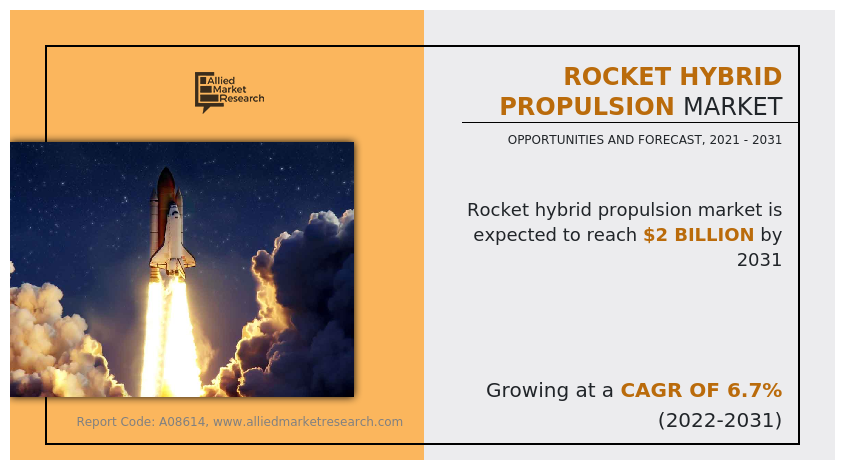
The rocket hybrid propulsion market was valued at $1 billion in 2021, and is estimated to reach $2 billion by 2031, growing at a CAGR of 6.7% from 2022 to 2031.
Rocket hybrid propulsions used in satellite launch vehicles use a combination of two types of fuel for the combustion to take place in the satellite launch vehicle. This includes a combination of diesel, batteries, and other renewable energy. The use of hybrid propulsion systems is not new, and they have been adopted worldwide. Hybrid rockets avoid some of the restraints of solid rockets like the issue of handling the propellant used for rocket propulsion, while also avoiding some disadvantages of liquid rockets like their mechanical complexity. Moreover, it is difficult for the fuel & oxidizer to be mixed intimately, hybrid rockets tend to fail more frequently than liquids or solids. Like liquid rocket engines, hybrid rocket motors can be shut down easily and the thrust is throttleable.
Download Sample Report: https://www.alliedmarketresearch.com/request-sample/A08614
In addition, the rocket hybrid propulsion used in satellite launch vehicles has witnessed significant growth in recent years, owing to increase in satellite launches across regions. Moreover, the satellite launch vehicle manufacturers operating across the globe has been inclined towards offering hybrid propulsion in rockets which eventually increases the rocket safety and increases their implementation in satellite launches. This proves to be a factor supplementing the growth of the market across the globe. For instance, in May, 2022, HyPrSpace developed OB-1 reusable launcher, to offer a fast, economical, sovereign, and more environment-friendly orbiting service HyPrSpace. For this project, HyPrSpace raised $1.18 million in seed funding to develop a reusable hybrid micro-launch vehicle. HyPrSpace aims to develop a launcher using a propulsion technology that facilitates access to space hybrid propulsion. Similarly, in February, 2021, China Aerospace Science and Technology Corp announced its plans to conduct the maiden flight of the Long March 6A carrier rocket. Long March 6A will consist of a 50-meter, liquid-propelled core booster, and four solid-fuel side boosters. Such developments create a wider scope for the growth of the market across the globe.
Technological advances in propulsion included the perfection of methods for casting solid-propellant charges, development of more energetic solid propellants, introduction of new structural and insulation materials in both liquid and solid systems, manufacturing methods for larger motors and engines, and improvements in peripheral hardware such as pumps, valves, engine-cooling systems, and direction controls. Hybrid rocket engines are much more efficient than the other conventional engines. Hybrid rockets are chemically and mechanically simpler and are tolerant of processing and fabrication errors. Unlike other propulsion systems, hybrids can be easily throttled/restarted as per requirement. This ensures the safety regarding the thrust termination and abort possibility. The performance of the hybrid rockets can be improved further by changing the fuel grain mixture ratio by adding additives to the fuel grain such as metals and metal hydrides, or by improving the design of the rocket nozzle. The shape of the nozzle determines the nozzle efficiency.
Buy This Research Report: https://www.alliedmarketresearch.com/rocket-hybrid-propulsion-market/purchase-options
In addition, with the significance of space access increasing, there is a clear recognition that both the public and private sector are critical to advancement. From joyrides for space tourists to science experiments in microgravity to giant mega constellations of satellites that offer high-speed internet to the ground, a thriving ecosystem of goods and services has emerged in orbit around Earth and beyond. The flurry of action has been driven by notably lower costs to launch into space, the availability of smaller, cheaper components to build satellites and other spacecraft, and the growth of private space companies. It has revamped the orbital landscape, dramatically expanding access to the cosmos, and is projected to grow into a trillion-dollar commercial space industry.
Moreover, companies that pay millions of dollars to put a satellite into orbit can now do the same for a fraction of that price. Smaller satellites and lower launch costs mean startups and students can sometimes launch projects for just a few thousand dollars. For instance, SpaceX CEO Elon Musk announced that the company’s massive Starship rocket will be ludicrously cheap to get into orbit. The operational costs are expected to be $2 million.
Furthermore, the factors such as increase in number of space explorations, rise in commercial applications of the space industry, and high efficiency & technological advancements in rocket propulsion supplement the growth of the rocket hybrid propulsion market across the globe. However, the lack of measures for the disposal of orbital debris and political insurgencies between nations are the factors that create a barrier to the growth of the hybrid rocket propulsion market across the globe. In addition, advances in rocket propulsion, and cost-effective spacecraft launches create numerous opportunities for the key players operating in the rocket hybrid propulsion industry to develop advanced technologies. This creates numerous opportunities for the growth of the market across the globe.
For Purchase Enquiry: https://www.alliedmarketresearch.com/purchase-enquiry/A08614
COVID-19 Impact Analysis:
Space agencies and other public administrations require them to fully review the vulnerable smaller companies in their overall crisis responses. Pandemic-spawned supply-chain disruptions are delaying launches and development of satellites, lunar rovers, and interplanetary missions. However, the post pandemic space sector of various countries will see substantial progress and remarkable new records. The proportion of launches using new-generation rockets has increased. For instance, in 2022, China completed more than 60 space launches. Among these missions, 53 were conducted by the Long March carrier rockets, the country’s patent launch vehicles. In addition, the pace of space exploration was rapid with key developments in space policy. The six tourist spaceflights in 2021 were also a record, and part of a resurgence in activity in space. In 2021, there were 134 successful orbital missions, with China leading the market.
KEY FINDINGS OF THE STUDY In Rocket Hybrid Propulsion Market
- By type, the Rocket Motor segment is projected to dominate the global rocket hybrid propulsion market in terms of growth rate.
- By orbit, the geostationary earth orbit (GEO) segment is projected to dominate the global rocket hybrid propulsion market in terms of growth rate.
- By component, the turbo pump segment is projected to dominate the global rocket hybrid propulsion market in terms of growth rate.
- By vehicle type, the manned segment is projected to dominate the global rocket hybrid propulsion market in terms of growth rate.
- By end user, the commercial segment is projected to dominate the global rocket hybrid propulsion market in terms of growth rate.
The leading players operating in the rocket hybrid propulsion market are China Aerospace Science and Technology Corporation, Environmental Aeroscience Corporation, ISRO, HyPrSpace, Nammo AS, Northrop Grumman, Raytheon Technologies Corporation, Virgin Galactic, HyImpulse, and Pulsar Fusion.




