
Digital Printing Packaging Market Overview
Introduction
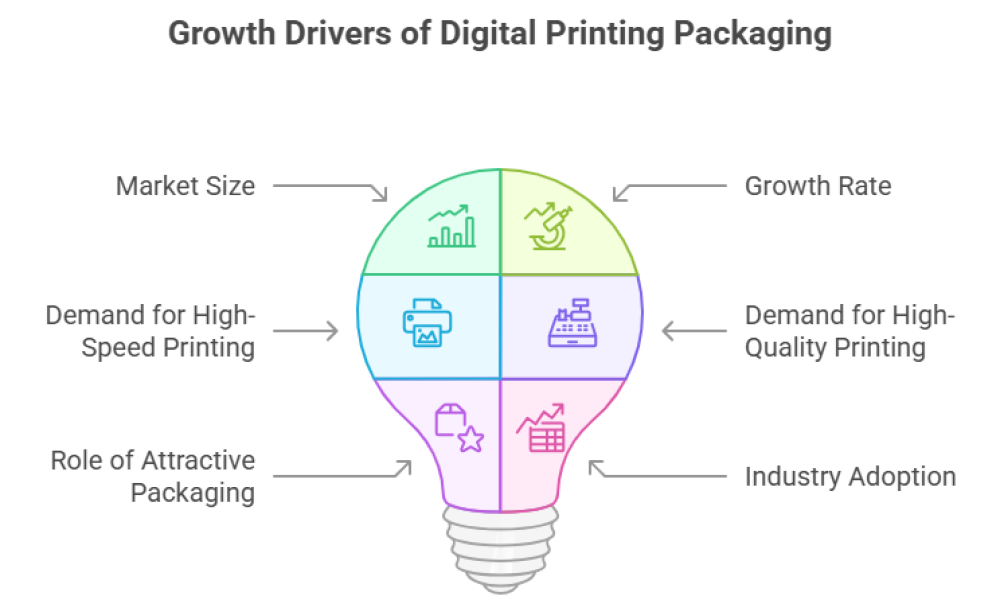
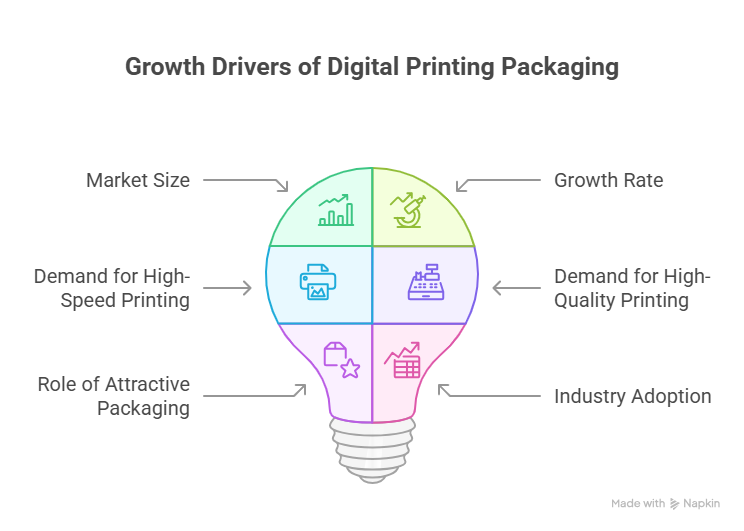
The global digital printing packaging market, valued at $20.6 billion in 2021, is projected to reach $49.9 billion by 2031, growing at a compound annual growth rate (CAGR) of 9.1% from 2022 to 2031. This rapid expansion is fueled by increasing demand for high-speed, high-quality printing and the critical role of attractive packaging in product marketing and sales. Digital printing’s ability to deliver vibrant, customizable designs makes it a preferred choice for products displayed prominently in retail settings, driving its adoption across industries like food and beverages, cosmetics, pharmaceuticals, and electronics.
Download PDF Sample Copy@ https://www.alliedmarketresearch.com/request-sample/A08308
Market Dynamics
Digital printing offers significant advantages over traditional methods like flexo and litho printing. Unlike conventional techniques that require printing plate replacements, digital printing uses computer-controlled systems, reducing setup time and costs while enhancing efficiency. It requires only one pass to print all colors, allows last-minute design changes, and eliminates the need for water, photo chemicals, or pre-press processes, making it an environmentally sustainable option. These benefits have spurred demand across various sectors, as high-quality packaging enhances brand visibility and consumer appeal.
Regional Insights
In 2021, the Asia-Pacific region dominated the digital printing packaging market, accounting for over 36.0% of the global share. This leadership is driven by robust industrial growth, rising consumer demand, and expanding retail sectors in countries like China, Japan, and India. Notably, India’s digital printing packaging market is expected to grow at a CAGR of 13% from 2022 to 2031, fueled by increasing investments in manufacturing and retail. The Latin America, Middle East, and Africa (LAMEA) region is projected to be the fastest-growing market, driven by rising disposable incomes and infrastructure development.
Segment Insights
The digital printing packaging market is segmented by packaging type, printing technology, printing inks, end-user industry, and region. By packaging type, the labels segment dominated in 2021, contributing over 70.8% of the revenue due to its widespread use in product branding and information display. The flexible packaging segment is expected to grow at the highest CAGR, driven by its versatility and sustainability.
By printing technology, inkjet printing led the market in 2021 and is anticipated to maintain its dominance due to its precision and efficiency. Other technologies, such as electrophotography, magnetography, and thermal printing, also contribute to market growth. By printing inks, UV-based, solvent-based, and dye sublimation inks are key categories, with UV-based inks gaining traction for their durability and eco-friendly properties.
By end-user industry, the food and beverages segment held the largest share in 2021, driven by the need for vibrant, informative packaging to attract consumers. The “others” segment, including industries like personal care and cosmetics, is expected to grow at the fastest rate, reflecting the increasing demand for premium packaging in these sectors.
What is Digital Printing Packaging?
Digital printing packaging involves the use of computer-controlled printers to apply high-quality designs, text, and graphics directly onto packaging materials. Unlike traditional methods like flexography or lithography, digital printing eliminates the need for physical printing plates, reducing setup costs and enabling rapid customization. This technology supports a range of packaging types, including labels, folding cartons, corrugated packaging, and flexible packaging, and is widely used across industries to enhance product appeal and convey critical information.
Market Drivers
Demand for High-Quality Packaging
Packaging plays a pivotal role in product marketing, influencing consumer purchasing decisions. Clear, vibrant, and high-quality printing is essential for conveying product information and building brand identity. Digital printing’s ability to produce premium designs with minimal lead time makes it a preferred choice for manufacturers aiming to differentiate their products in competitive retail environments.
Sustainability and Efficiency
Digital printing’s eco-friendly attributes, such as reduced waste and the elimination of chemical-intensive pre-press processes, align with global sustainability trends. Its efficiency, driven by single-pass printing and the ability to make last-minute design changes, reduces operational costs and enhances production flexibility, attracting manufacturers across industries.
Growth in End-User Industries
The food and beverage, cosmetics, pharmaceuticals, and electronics industries are key drivers of market growth. These sectors rely on digital printing to create eye-catching, recyclable, and informative packaging that meets consumer expectations for quality and sustainability. The use of varied packaging techniques, such as detailed labeling and colorful designs, further boosts demand.
Challenges
Despite its advantages, the digital printing packaging market faces challenges. Fluctuations in raw material prices negatively impact profitability, while high maintenance costs and the need for skilled operators to manage advanced printing systems pose barriers to growth. Addressing these challenges through cost-effective innovations and workforce training will be critical for sustained market expansion.
Impact of COVID-19
The COVID-19 pandemic significantly disrupted the digital printing packaging market, particularly in 2020 and early 2021. Lockdowns and restrictions halted manufacturing, construction, and transportation activities, reducing demand for packaging solutions. Supply chain disruptions further constrained production. However, by the end of 2021, the market began to recover as industries resumed operations and vaccination efforts reduced the pandemic’s impact. The resurgence of manufacturing and retail activities has restored demand, with digital printing companies operating at full capacity.
Market Opportunities
The digital printing packaging market offers significant growth opportunities. Advancements in printing technologies, such as improved ink formulations and automation, are enhancing print quality and reducing costs. The low operating costs of digital printing compared to traditional methods attract a growing customer base. Additionally, rising demand for sustainable and recyclable packaging aligns with global environmental goals, creating new avenues for market expansion. The increasing adoption of digital printing in emerging markets, particularly in LAMEA, further bolsters growth prospects.
Competitive Landscape
The digital printing packaging market is highly competitive, with key players focusing on product innovation, acquisitions, and strategic partnerships to strengthen their market position. Major companies include DuPont, Eastman Kodak Company, HP Development Company, L.P., Mondi PLC, Multi-Color Corporation (WS Packaging Group Inc.), Quad/Graphics Inc., Quantum Print and Packaging Ltd., Traco Manufacturing, Inc., Xeikon N.V., and Xerox Corporation. These players are investing in advanced printing technologies and expanding their product portfolios to meet diverse customer needs.
Market Segmentation
The digital printing packaging market is segmented as follows:
- By Packaging Type: Corrugated Packaging, Folding Cartons, Flexible Packaging, Labels, Others
- By Printing Technology: Inkjet Printing, Electrophotography Printing, Magnetography, Thermal Printing
- By Printing Inks: UV-Based Inks, Solvent-Based Inks, Dye Sublimation Inks
- By End-User Industry: Food & Beverages, Pharmaceuticals, Electronics, Personal Care & Cosmetics, Others
- By Region: North America (U.S., Canada, Mexico), Europe (Germany, UK, France, Italy, Rest of Europe), Asia-Pacific (China, Japan, India, South Korea, Rest of Asia-Pacific), LAMEA (Latin America, Middle East, Africa)
In 2021, the labels segment led by revenue, while flexible packaging is expected to grow at the highest CAGR. Inkjet printing dominated by technology, and the food and beverages sector led by end-user industry. Asia-Pacific garnered the highest revenue, with LAMEA projected to register the fastest growth.
Key Benefits for Stakeholders
This market analysis provides stakeholders with critical insights, including:
- Quantitative analysis of market segments, trends, and dynamics from 2021 to 2031.
- Identification of key drivers, restraints, and opportunities shaping the market.
- Porter’s Five Forces analysis to assess buyer and supplier dynamics.
- In-depth segmentation to pinpoint high-growth opportunities.
- Mapping of major countries by revenue contribution.
- Benchmarking of market players to understand competitive positioning.
- Comprehensive regional and global market trends to inform strategic decisions.
The digital printing packaging market is poised for robust growth, driven by demand for high-quality, sustainable, and efficient printing solutions. With a projected market size of $49.9 billion by 2031, the industry offers significant opportunities for stakeholders. Asia-Pacific remains the largest market, while LAMEA is expected to grow the fastest. Continued advancements in printing technology and increasing adoption across diverse industries will drive the market forward, reinforcing digital printing’s role in modern packaging solutions.
About Us:
Allied Market Research (AMR) is a full-service market research and business-consulting wing of Allied Analytics LLP based in Portland, Oregon. Allied Market Research provides global enterprises as well as medium and small businesses with unmatched quality of “Market Research Reports” and “Business Intelligence Solutions.” AMR has a targeted view to provide business insights and consulting to assist its clients to make strategic business decisions and achieve sustainable growth in their respective market domain.
We are in professional corporate relations with various companies and this helps us in digging out market data that helps us generate accurate research data tables and confirms utmost accuracy in our market forecasting. Allied Market Research CEO Pawan Kumar is instrumental in inspiring and encouraging everyone associated with the company to maintain high quality of data and help clients in every way possible to achieve success. Each and every data presented in the reports published by us is extracted through primary interviews with top officials from leading companies of domain concerned. Our secondary data procurement methodology includes deep online and offline research and discussion with knowledgeable professionals and analysts in the industry.
Contact us:
United States
1209 Orange Street,
Corporation Trust Center,
Wilmington, New Castle,
Delaware 19801 USA.
Int’l: +1-503-894-6022
Toll Free: +1-800-792-5285
Fax: +1-800-792-5285
[email protected]
Construction article https://www.blogger.com/u/1/blog/posts/6325262245204971203
Construction blog https://vijayconma.medium.com/




