
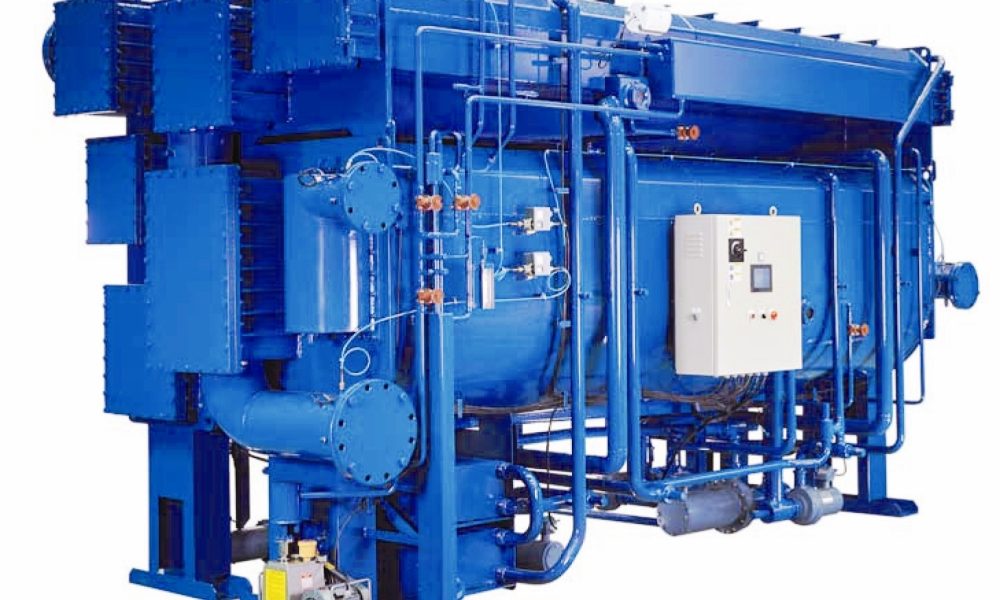
The global absorption chillers market is set to reach US$ 2.46 billion by 2032, growing at a CAGR of 4.5% from 2025 to 2032. This growth is primarily driven by the rising demand for energy-efficient cooling solutions across industries, commercial complexes, and institutional facilities. Absorption chillers use heat energy instead of electricity for refrigeration, making them an eco-friendly alternative aligned with global decarbonization goals. The increasing adoption of green cooling technologies is further encouraged by government initiatives such as the EU Green Deal and the U.S. Inflation Reduction Act (2022), which offer incentives for sustainable infrastructure upgrades.
Among product categories, lithium bromide-based absorption chillers are expected to dominate, accounting for 91.4% of the market in 2025, thanks to their efficiency in large-scale central air conditioning applications. Geographically, North America is projected to hold the largest market share of 34.1% in 2025, supported by large-scale infrastructure projects, federal incentives, and the region’s strong emphasis on renewable-powered and waste heat recovery systems.
Key Highlights from the Report
✦ The market is forecast to reach US$ 2.46 billion by 2032, growing at a CAGR of 4.5%.
✦ Lithium bromide-based absorption refrigeration will hold 91.4% market share in 2025.
✦ North America is estimated to account for 34.1% of the global market in 2025.
✦ Double-stage absorption chiller technology will command 86% share by 2025.
✦ Waste heat recovery systems using absorption chillers are growing at 12.5% annually.
✦ Industrial applications will account for 82.8% of market share in 2025.
𝐆𝐞𝐭 𝐚 𝐒𝐚𝐦𝐩𝐥𝐞 𝐏𝐃𝐅 𝐁𝐫𝐨𝐜𝐡𝐮𝐫𝐞 𝐨𝐟 𝐭𝐡𝐞 𝐑𝐞𝐩𝐨𝐫𝐭 (𝐔𝐬𝐞 𝐂𝐨𝐫𝐩𝐨𝐫𝐚𝐭𝐞 𝐄𝐦𝐚𝐢𝐥 𝐈𝐃 𝐟𝐨𝐫 𝐚 𝐐𝐮𝐢𝐜𝐤 𝐑𝐞𝐬𝐩𝐨𝐧𝐬𝐞): https://www.persistencemarketresearch.com/samples/3537
Market Segmentation
The absorption chillers market is segmented based on product type, technology, and end-use applications.
By product type, lithium bromide-based systems dominate due to their operational reliability and suitability for large-scale cooling in commercial buildings, data centers, and hospitals. Their chemical stability, coupled with the ability to maintain vacuum conditions, ensures consistent performance and reduced operating costs.
In terms of technology, double-stage absorption chillers are emerging as the preferred choice for industries aiming for high energy efficiency. Offering up to 35% higher efficiency compared to single-stage systems, they are widely adopted in sectors such as pharmaceuticals, petrochemicals, and IT infrastructure, where precision cooling is critical.
When segmented by end-user, the industrial sector leads with a projected 82.8% market share in 2025, driven by the adoption of waste heat recovery and hybrid cooling systems. Industrial manufacturing, power plants, and chemical processing facilities prefer absorption chillers for their ability to utilize excess heat and cut operational costs.
Regional Insights
Asia Pacific: The region is projected to hold 29.6% market share in 2024, supported by rapid industrialization in China and India. Massive investments, such as China’s US$ 12 billion commitment to energy-efficient cooling systems and India’s PLI scheme for green technologies, are fueling adoption. The expansion of industrial mega-projects, including Haldia Petrochemicals’ US$ 10 billion oil-to-chemicals project, will further push demand for absorption chillers.
North America: Expected to account for 34.1% share in 2025, driven by major infrastructure and data center projects. Government incentives like the U.S. Inflation Reduction Act are accelerating the shift to renewable-powered cooling. Projects like AWS’s US$ 11 billion data center in Indiana and Google’s US$ 2 billion facility will require advanced cooling solutions, creating steady demand.
Europe: Growth in the European market is supported by sustainability policies such as the European Green Deal and Horizon Europe funding programs. Countries in the region are rapidly adopting low-emission cooling systems, integrating them into smart city infrastructure. In the UK, the rollout of 5G-enabled smart grids and advanced urban services is also boosting market growth.
Market Drivers
The primary driver is the global push for decarbonization, where industries are seeking sustainable cooling solutions to reduce carbon footprints. Absorption chillers, which use waste heat instead of high electricity loads, are an attractive alternative to electric chillers. Their ability to integrate with combined heat and power (CHP) systems, achieve low operational costs, and support renewable energy usage positions them as a preferred choice for industrial applications.
Market Restraints
The market faces challenges from rapid advancements in electric chiller technology. Modern electric chillers with variable-speed drives and smart controls are becoming more energy-efficient, making them competitive alternatives. Cost advantages and performance flexibility of electric systems have slowed the adoption rate of absorption chillers in certain applications.
Market Opportunities
Innovation in hybrid cooling systems presents a significant opportunity. By combining absorption chillers with solar thermal, heat pumps, and thermal storage technologies, manufacturers can offer customizable, modular cooling systems suitable for varying climate conditions and industrial needs. This opens new avenues for eco-conscious industries and expands the scope of application beyond traditional markets.
Reasons to Buy the Report
✔ Comprehensive analysis of global and regional market trends up to 2032.
✔ Detailed segmentation by product type, technology, and application.
✔ Insights into key growth drivers, restraints, and emerging opportunities.
✔ Profiles of major players with recent product and strategic developments.
✔ Forecasts supported by industry data, policy trends, and technological advancements.
Frequently Asked Questions (FAQs)
How Big is the Absorption Chillers Market in 2025?
Who are the Key Players in the Global Absorption Chillers Market?
What is the Projected Growth Rate of the Absorption Chillers Market?
What is the Market Forecast for Absorption Chillers in 2032?
Which Region is Estimated to Dominate the Industry through the Forecast Period?
Company Insights
• Robur Corporation
• Trane Inc.
• Carrier Corporation
• LG Electronics, Inc.
• Thermax Limited
• Shuangliang Eco-Energy Systems Co. Ltd.
• Kawasaki Thermal Engineering Co., Ltd.
• Hyundai Climate Control Co. Ltd.
• Yazaki Corporation
• World Energy
• BROAD Group
• EAW Energieanlagenbau GmbH
• Colibri bv
• Johnson Controls-Hitachi Air Conditioning
Recent Developments
In December 2023, Ebara Refrigeration Systems launched the world’s first hydrogen-powered absorption chiller/heater, reducing CO₂ emissions by 94% compared to gas-powered systems.
In June 2023, Johnson Controls acquired M&M Carnot, expanding its portfolio of natural refrigeration solutions with low global warming potential (GWP).
Conclusion
The absorption chillers market is poised for steady growth, propelled by the global demand for sustainable, energy-efficient cooling solutions. With the integration of renewable energy sources, waste heat recovery technologies, and hybrid cooling systems, the sector is set to expand into new industrial applications. While competition from electric chillers remains a restraint, continuous innovation and policy support will strengthen market adoption. By 2032, regions like North America and Asia Pacific are expected to lead, leveraging large-scale infrastructure projects and industrial modernization initiatives to create new opportunities for manufacturers and investors alike.
𝐑𝐞𝐥𝐚𝐭𝐞𝐝 𝐑𝐞𝐩𝐨𝐫𝐭𝐬:




