
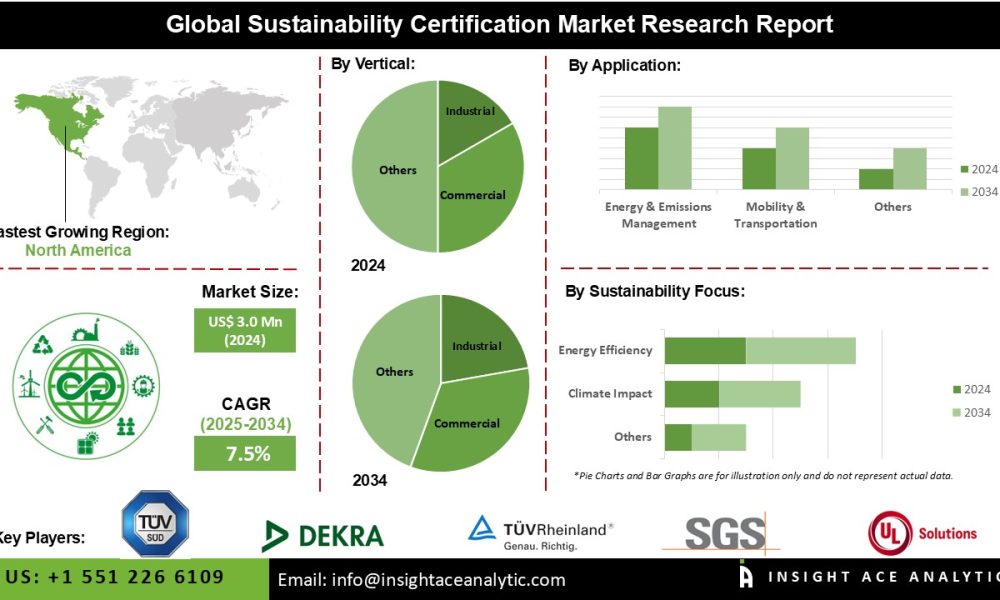
The global Sustainability Certification market is estimated to reach over USD 5.9 Bn by the year 2034, exhibiting a CAGR of 7.5% during the forecast period.
Check this Report Brochure : https://www.insightaceanalytic.com/request-sample/2998
Sustainability certification refers to the formal process by which independent, accredited organizations assess and verify that products, services, or companies comply with established environmental, social, and economic standards. These certifications are designed to promote responsible practices across various domains, including labor rights, energy efficiency, resource management, waste reduction, and community engagement. Obtaining such certification signifies a company’s commitment to minimizing negative environmental impacts and upholding ethical standards throughout its operations and supply chain.
The growth of the sustainability certification market is primarily driven by the rising global emphasis on sustainable and socially responsible business practices. Increasing regulatory oversight and the enforcement of stringent environmental and social compliance requirements by governments and regulatory bodies have further accelerated market expansion. In many jurisdictions, adherence to these frameworks necessitates formal certification, thereby reinforcing its importance. Additionally, shifting consumer preferences toward ethically produced and environmentally sustainable products continue to fuel demand, positioning sustainability certification as a critical differentiator in today’s competitive marketplace.
List of Prominent Players in the Sustainability Certification Market:
- Société Générale de Surveillance SA (SGS SA)
- UL LLC
- Bureau Veritas
- TUV NORD Group
- TUV SUD
- TUV Rheinland
- SCS Global Services
- Intertek Group plc
- Element Materials Technology
- DEKRA
- DNV GL
- LRQA Group Limited
- Control Union
Market Dynamics
Drivers:
The sustainability certification market is being propelled by increasing consumer awareness and a growing preference for environmentally responsible products, alongside stringent environmental regulations and corporate sustainability commitments. These certifications enable organizations to substantiate their sustainability claims by promoting transparency, integrity, and compliance with recognized green standards. Consumers are increasingly inclined toward certified products that reflect ethical sourcing, low carbon footprints, and environmentally sound production practices. The credibility of third-party certifications—such as those for organic, fair trade, and carbon-neutral products—significantly influences purchasing decisions. Furthermore, advancements in digital traceability and blockchain technologies are enhancing visibility, accountability, and authenticity throughout the supply chain.
Challenges:
A key challenge facing the sustainability certification market, particularly for small and medium-sized enterprises (SMEs), is the high cost associated with obtaining and maintaining various certifications. The certification process often involves recurring renewal fees, audit charges, compliance assessments, and extensive documentation. Third-party evaluations and dynamic regulatory requirements contribute to both administrative and financial burdens. Additionally, employees may require industry-specific training and certifications, further increasing operational costs. The transition to sustainable practices—such as reducing carbon emissions or sourcing environmentally responsible raw materials—also elevates overall business expenditures.
Regional Trends:
North America is expected to hold a substantial share of the sustainability certification market, supported by the increasing implementation of certifications across the energy, transportation, and infrastructure sectors to comply with stringent environmental standards. Prominent companies such as Tesla and General Motors utilize sustainability certifications to align with emission reduction goals and enhance brand reputation. The growing emphasis on resource efficiency and sustainable construction practices continues to drive demand for certified solutions. In contrast, the Asia-Pacific region is projected to exhibit the highest growth rate during the forecast period, driven by rapid industrialization, economic expansion, and the enforcement of stricter environmental regulations in key markets such as China, Japan, South Korea, Australia, and India. As regional governments and enterprises intensify efforts to curb carbon emissions, boost energy efficiency, and adopt sustainable sourcing strategies, the adoption of sustainability certifications is expected to expand significantly.
Recent Development:
- January 2025: The US-based Aster Global Environmental Solutions, which provides carbon and greenhouse gas (GHG) validation and verification services, was purchased by SGS Société Générale de Surveillance SA (Switzerland) in order to expand its sustainability services and offerings. In addition to strengthening SGS’s Diversity, Equity, and Inclusion strategy, the acquisition enhances its IMPACT NOW sustainability platform.
- May 2024: With the introduction of the SGS Green Mark, SGS Sociéte Genérale de Surveillance SA (Switzerland) expanded its sustainability offerings to meet the increasing demand for more environmentally friendly goods. Seven features—recycled content, biodegradability, and hazardous substance testing—are verified by the certification to support environmental claims. It was created in conjunction with industry professionals and enables retailers, manufacturers, and brands to demonstrate adherence to sustainable standards and encourage consumer trust.
- January 2023: To ensure safe and sustainable hydrogen production from renewable sources, Bureau Veritas (France) launched a comprehensive certification program for renewable hydrogen. The certification, which assesses safety, carbon intensity, and ESG aspects, is open to investors and off-takers. The initiative promotes investment in renewable hydrogen projects and eases the world’s energy transition.
Segmentation of Sustainability Certification Market-
By Sustainability Focus-
- CLIMATE IMPACT
- ENERGY EFFICIENCY
- MATERIAL SUSTAINABILITY
- SUPPLY CHAIN SUSTAINABILITY
By Sustainability Focus-
- Climate Impact
- Energy Efficiency
- Material Sustainability
- Supply Chain Sustainability
By Application-
- Energy & Emissions Management
- Renewable Energy
- Solar
- Wind
- Hydrogen
- Biomass
- Carbon & Greenhouse Gas Management
- Renewable Energy
- Mobility & Transportation
- Electric Vehicle (EV) Batteries
- Vehicle Emission Standards
- Infrastructure
- Green Buildings
- Sustainable Construction Materials
- Circular Economy
- Sustainable Packaging & Materials
- Waste Management & Recycling
- Responsible Sourcing
By Vertical-
- Industrial
- Discrete
- Process
- Commercial
- Residential
By Region-
North America-
- The US
- Canada
- Mexico
Europe-
- Germany
- The UK
- France
- Italy
- Spain
- Rest of Europe
Asia-Pacific-
- China
- Japan
- India
- South Korea
- South East Asia
- Rest of Asia Pacific
Latin America-
- Brazil
- Argentina
- Rest of Latin America
Middle East & Africa-
- GCC Countries
- South Africa
- Rest of the Middle East and Africa
About Us:
InsightAce Analytic is a market research and consulting firm that enables clients to make strategic decisions. Our qualitative and quantitative market intelligence solutions inform the need for market and competitive intelligence to expand businesses. We help clients gain competitive advantage by identifying untapped markets, exploring new and competing technologies, segmenting potential markets and repositioning products. Our expertise is in providing syndicated and custom market intelligence reports with an in-depth analysis with key market insights in a timely and cost-effective manner.




