
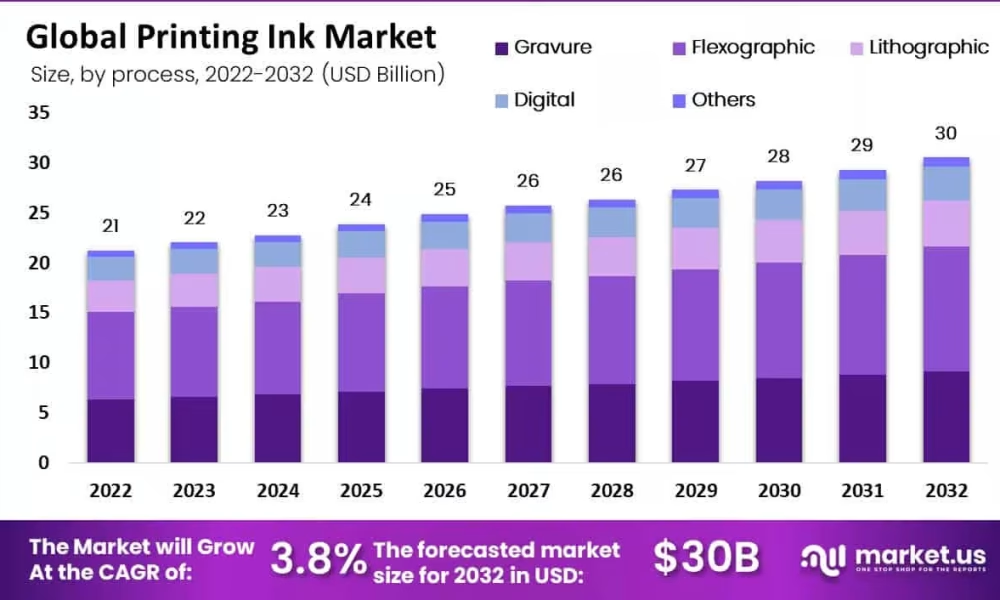
According to market.us, the global Printing Ink Market size was valued at USD 21.2 billion in 2023 and is expected to reach approximately USD 30 billion by 2032, growing at a CAGR of 3.8% during the forecast period from 2023 to 2032. This growth is driven by the increasing demand across key end-use industries such as packaging, commercial printing, textiles, and publishing. Rapid urbanization and the expansion of the e-commerce sector have significantly boosted the need for flexible packaging, thereby accelerating the use of high-performance and specialty inks.
Water-based and UV-curable inks are gaining popularity due to growing environmental concerns and stringent regulations on VOC emissions. The packaging industry, particularly flexible and corrugated packaging, remains a major consumer of printing inks due to the rising need for attractive, durable, and sustainable printing solutions.
Moreover, technological advancements in digital printing and ink formulations have enabled higher precision, faster drying times, and improved print quality, further propelling market growth. Asia-Pacific dominates the global printing ink market, supported by the robust manufacturing base, increasing disposable incomes, and growing commercial printing needs in countries like China and India.
Key Takeaways
- Market Size and Growth Projection: The printing ink market was valued at USD 21.2 billion in 2022. It is expected to grow to approximately USD 30 billion by 2032. The market is projected to register a Compound Annual Growth Rate (CAGR) of 3.8% between 2023 and 2032.
- Printing Processes: Lithographic printing dominates the market due to its versatility in various applications. Gravure printing inks are used for printing photographs on various materials. Flexographic inks, known for their cost-effectiveness and eco-friendliness, are expected to grow rapidly.
- Ink Formulations: Oil-based printing ink is the dominant product category in the market. Demand for water-based printing inks is expected to grow steadily due to environmental concerns.
- End-User Analysis: Packaging is anticipated to dominate the market in terms of value during the forecast period. Printing inks are used on a variety of materials, including paper, plastics, and multilayered materials.
- Regional Market Analysis: Asia Pacific held the highest revenue share (38.0%) in the printing ink market in 2022. Market growth is positively impacted by the consumption of packaged food items and the labeling industry in the region.
Access a Complimentary Sample of This Premium Report: https://market.us/report/printing-ink-market/request-sample/
Factors Affecting the Growth of the Printing Ink Market
Rising Demand from the Packaging Industry: The continuous growth in consumer goods, food and beverage, and e-commerce sectors has significantly increased the need for flexible, corrugated, and label packaging. As packaging plays a key role in branding and product information, the demand for high-quality and durable printing inks is rising steadily.
Shift Toward Eco-Friendly Inks: Environmental regulations and increasing awareness about sustainability have led to a growing preference for water-based, soy-based, and UV-curable inks. This transition is driving innovation in ink formulations and reshaping procurement strategies for both manufacturers and end-users.
Advancements in Printing Technologies: The evolution of digital and inkjet printing technologies is enabling faster production, lower setup costs, and better quality, especially in short-run printing. These technological shifts are expanding the scope of printing inks in customized and high-resolution applications.
Growth of the Textile and Commercial Printing Sectors: Increasing applications of inks in textile printing, advertising, and publishing continue to create new opportunities. The demand for vibrant colors, fade resistance, and cost-effective solutions is influencing ink formulations across these industries.
Fluctuations in Raw Material Availability: The printing ink market is sensitive to changes in the prices and availability of key raw materials such as pigments, solvents, and resins. Supply chain disruptions or rising input costs can directly impact production and pricing strategies within the industry.
Key Market Segmentation
Based on Process Analysis
The lithographic printing segment holds the largest share in the global printing inks market by process, driven by high demand across publications, commercial printing, industrial applications, and other sectors. Gravure printing inks, commonly referred to as “liquid inks,” are primarily used for high-quality image printing on substrates such as thin papers, metal foils, films, and paper cups.
These inks support a wide range of applications in packaging for food, tobacco, and cosmetics due to their versatility on materials like cardboard, paper, labels, foils, and plastics. Flexographic inks are gaining traction owing to their compatibility with various substrates, including paper, laminates, corrugated boards, films, and foils.
Based on Formulation Analysis
The oil-based printing ink segment currently dominates the global printing inks market, largely due to its widespread use in packaging, commercial, and publication printing applications. However, in regions like North America, increasing environmental concerns are prompting manufacturers to shift focus toward bio-based ink production. The demand for oil-based inks in this region is also heavily influenced by fluctuations in global crude oil prices, which directly impact production costs and market stability.
In contrast, UV-cured inks are witnessing rising demand, supported by an expanding customer base, increased consumer spending, and improved economic conditions. While solvent-based inks are used in limited applications, the water-based printing ink segment is expected to grow steadily in the coming years, driven by its environmentally friendly properties and increasing regulatory support for low-VOC products.
Based on End-User Analysis
The packaging segment is projected to lead the global printing ink market in terms of value throughout the forecast period. This dominance is driven by the rising demand for printing inks across packaging, publication, commercial, and industrial applications. Printing inks are extensively used on diverse packaging substrates, including paper, carton boards, plastics, and multilayered materials.
In food packaging, inks play a critical role not only in product branding and design but also in conveying essential consumer information. Direct printing is feasible on a range of materials such as paper, board, cork, and plastic. However, in food applications, there is a risk of ink migration—especially in offset printing—where inks may transfer to the internal surface of packaging upon contact with food. This has prompted increased regulatory focus and innovation in ink formulations to ensure safety and compliance.
Key Market Segments
Based on Process
- Gravure
- Flexographic
- Lithographic
- Digital
- Others
Based on Formulation
- Oil Based
- Solvent Based
- Water Based
- UV- Cured Based
Based on End-User
- Packaging
- Commercial Publication
- Textiles
- Other End-User
Regional Analysis
In 2022, the Asia Pacific region dominated the global printing ink market by accounting for the highest revenue share of 38.0%. This strong market position is expected to continue throughout the forecast period, supported by the growing consumption of packaged food products and the rapid expansion of the labeling industry. The growth is further driven by the rising demand from key sectors such as healthcare, food and beverages, consumer goods, and e-commerce across countries like China, India, and Southeast Asian nations.
The packaging industry’s continuous development has also contributed significantly to this regional dominance. Meanwhile, North America is projected to witness substantial market expansion due to its robust packaging industry and the ready availability of key raw materials such as resin. These factors, combined with increasing demand for high-quality and sustainable printing solutions, are expected to support the long-term growth of the printing ink market in both regions.
Market Key Players
- DIC Corporation
- Flint Group
- Toyo Ink SC HOLDINGS CO., LTD.
- Huber Group Deutschland GmbH
- SAKATA INX CORPORATION
- ALTANA AG
- Wikoff Color Corporation
- Sun Chemical
- Tokyo Printing Ink MFG CO., LTD
- Other Key Players
Get in Touch with Us:
Market.us (Powered By Prudour Pvt. Ltd.)
Address: 420 Lexington Avenue, Suite 300 New York City, NY 10170, United States
Send Email: [email protected]
Refer More Related Reports:



