
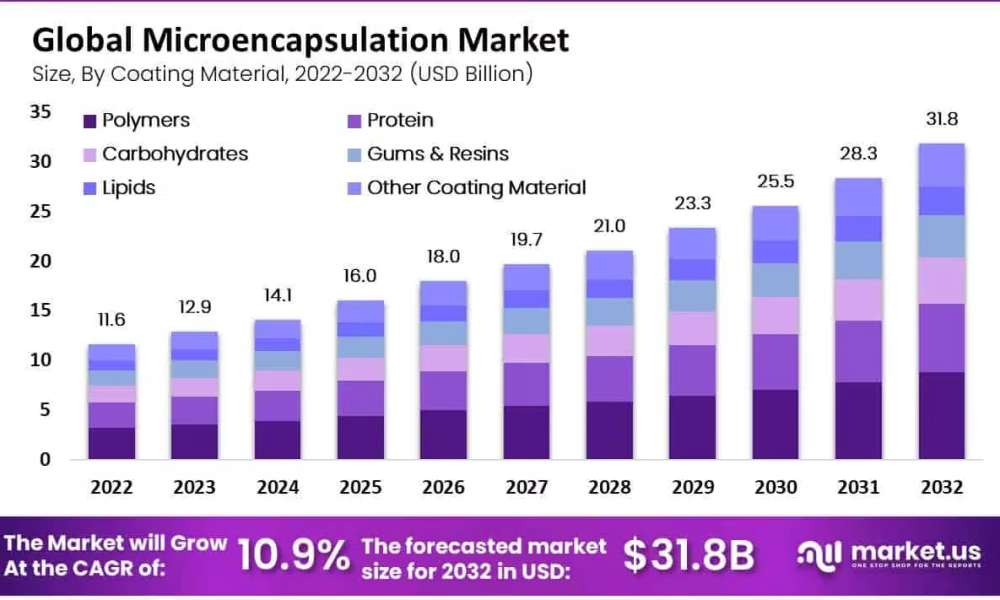
According to market.us, the Global Microencapsulation Market was valued at USD 11.6 billion in 2023 and is projected to reach approximately USD 31.8 billion by 2032, expanding at the highest CAGR of 10.9% during the forecast period. This significant growth trajectory can be attributed to rising consumer preferences for fortified and functional products, increasing investments in advanced drug delivery systems, and the growing application of encapsulated ingredients in agrochemicals and personal care products.
The growing demand for controlled-release technologies and enhanced product stability across diverse industries is driving transformative innovation in the microencapsulation market. Microencapsulation, a process used to encase active ingredients within a protective coating, is increasingly gaining prominence in pharmaceuticals, food & beverages, cosmetics, agriculture, and household products due to its ability to improve shelf life, mask unpleasant tastes or odors, and ensure targeted delivery.
The pharmaceutical industry remains a leading contributor, benefiting from the technology’s ability to offer sustained drug release, while the food sector is rapidly adopting microencapsulation for flavor and nutrient delivery. Additionally, advancements in encapsulation materials and processing technologies are enabling greater efficiency, scalability, and cost-effectiveness.
Key Takeaways
- Market Expansion: In 2022, the global Microencapsulation Market was valued at USD 11.6 billion and is projected to experience a compound annual growth rate of 10.9% from now until 2032.
- Coating Materials: Polymers dominate this sector with a 27.6% market revenue share; proteins are expected to experience compound annual compound annual growth at 9.6% compounding over time for pharmaceutical and food applications.
- Technology: Spray technology leads the market with a 32.88% revenue share and projected compound annual growth rates of 9.6% due to low particle size distribution and biocompatibility issues. Dripping technology will follow at 9.6% CAGR due to similar considerations.
- Applications: The pharmaceutical industry accounts for 64.8% of revenue share in the microencapsulation market; it offers various benefits including masking of odor and taste, protection from environmental factors, improved solubility, and cell encapsulation. The food and beverage industries are expected to experience compound annual growth at 10.8% compound annually.
- Regional Analysis: North America holds the largest revenue share at 36.4% due to pharmaceutical and healthcare companies’ demand for microencapsulation services, while Asia Pacific is projected to experience the highest compound annual compound annual compound growth at 11.4% due to increased funding for research and development of drugs with new delivery mechanisms.
Access a Complimentary Sample of This Premium Report: https://market.us/report/microencapsulation-market/request-sample/
Factors Affecting the Growth of the Microencapsulation Market
Rising Demand for Controlled and Targeted Delivery: Microencapsulation enables the controlled release and targeted delivery of active ingredients, which is especially critical in pharmaceuticals, food fortification, and agriculture. This functionality drives adoption across industries that require precision in the release of bioactive compounds or chemicals.
Advancements in Encapsulation Materials and Technologies: Continuous innovation in coating materials such as polymers, lipids, and carbohydrates, along with advancements in encapsulation methods like spray drying and coacervation, is enhancing the efficiency and scalability of microencapsulation processes. These technological improvements support broader commercial use.
Increasing Application in Functional Foods and Nutraceuticals: There is growing consumer interest in health-enhancing food products. Microencapsulation is widely used to protect sensitive ingredients like probiotics, vitamins, and omega-3 fatty acids, allowing their incorporation into a variety of food matrices without compromising stability or taste.
Expanding Use in Agrochemical and Personal Care Industries: In the agricultural sector, encapsulation is used to protect fertilizers and pesticides from degradation, improving their effectiveness and reducing environmental impact. In personal care, it enables the sustained release of fragrances and active ingredients in skincare and cosmetic products.
Regulatory and Environmental Considerations: Stringent regulations regarding chemical usage and environmental safety are encouraging manufacturers to adopt encapsulation technologies that minimize product loss, reduce toxicity, and ensure better compliance. This is particularly relevant in sectors such as pharmaceuticals and crop protection.
Key Market Segmentation
By Coating Material Analysis
Polymers dominate the coating material segment in the global microencapsulation market, accounting for the highest revenue share of 27.6%. This dominance is attributed to the superior encapsulating properties of polymers such as polylactic-glycolic acid (PLGA) and polylactic acid (PLA), which are widely used in industries like food & beverages.
These polymers are also approved by the US Food and Drug Administration for use in products such as depot formulations and surgical sutures, further supporting their market leadership.
In contrast, proteins are projected to register the highest growth, with a CAGR of 9.6% over the forecast period. Proteins, including gelatin, gluten, and peptides, are increasingly used for the microencapsulation of pharmaceutical and food products, positioning them as a rapidly expanding material category in the microencapsulation market.
By Technology Analysis
Spray technology leads the global microencapsulation market by technology, accounting for the largest revenue share of 32.8%. Its dominance is driven by key advantages such as high encapsulation efficiency, strong product stability, low operational cost, and suitability for large-scale production. These benefits make spray technology widely preferred across multiple industries using microencapsulation.
Meanwhile, dripping technology is projected to witness notable growth, registering a CAGR of 9.6% during the forecast period. Its ability to deliver uniform particle size and strong biocompatibility is expected to support its rising adoption, particularly in precision-focused applications such as pharmaceuticals and biomedical formulations.
By Application Analysis
The pharmaceutical industry dominates the global microencapsulation market by application, accounting for a substantial revenue share of 64.8%. This dominance is driven by the widespread use of microencapsulation in pharmaceuticals, offering key benefits such as odor and taste masking, enhanced solubility, protection from environmental degradation, and cell encapsulation. These functionalities make microencapsulation essential for drug formulation and delivery.
Following the pharmaceutical sector, the food & beverage industry is projected to grow at a strong CAGR of 10.8% over the forecast period. The rising demand for functional foods and health-enhancing ingredients is expected to fuel the adoption of microencapsulation technologies in this segment, particularly for preserving nutrients, improving stability, and controlling the release of active compounds.
Key Market Segments
By Coating Material
- Gums & Resins
- Polymers
- Lipids
- Carbohydrates
- Protein
- Other Coating Material
By Technology
- Dripping
- Spray
- Emulsion
- Coating
- Other Technologies
By Application
- Pharmaceutical
- Agrochemical
- Personal Care
- Food & Beverages
- Other Applications
Regional Analysis
North America leads the global microencapsulation market, holding a dominant revenue share of 36.4%. This strong market position is primarily driven by the presence of major pharmaceutical and healthcare companies such as Pfizer and Johnson & Johnson, which are actively investing in advanced drug delivery systems. Additionally, growing adoption of microencapsulation in the food & beverages sector for encapsulating fragrances, flavors, and colorants further supports market expansion in the region.
Asia Pacific is projected to record the highest growth, with a CAGR of 11.4% over the forecast period. Rising investments in pharmaceutical research, particularly in drug formulation and novel delivery systems, are expected to fuel demand for microencapsulation technologies in the region, making it a key emerging market in the coming years.
Top Key Players
- BASF SE
- Microtek Laboratories Inc.
- Evonik Industries AG
- 3M
- Dow
- Bayer AG
- Balchem
- LycoRed Group
- Encapsys LLC
- Inno Bio Limited
- Other Key Players
Get in Touch with Us:
Market.us (Powered By Prudour Pvt. Ltd.)
Address: 420 Lexington Avenue, Suite 300 New York City, NY 10170, United States
Send Email: [email protected]
Refer More Related Reports:



