
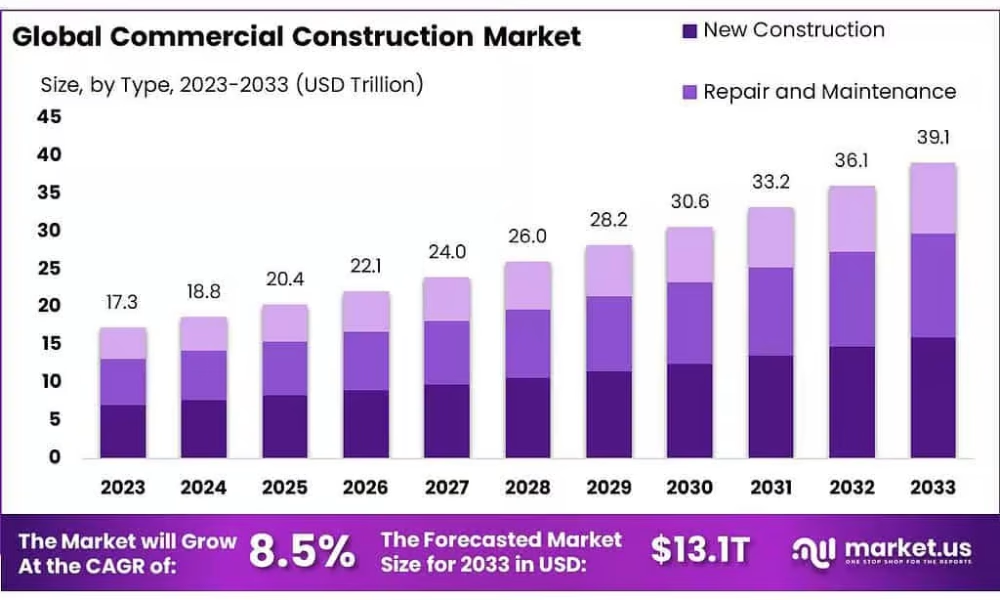
According to market.us, the global commercial construction market is projected to reach approximately USD 39.1 trillion by 2033, rising from an estimated USD 17.3 trillion in 2023. This growth is expected to occur at a compound annual growth rate (CAGR) of 8.5% over the forecast period from 2023 to 2033.
This market encompasses a comprehensive mix of qualitative and quantitative insights, covering key aspects such as market dynamics, growth opportunities, competitive landscape, and regional trends through to 2032. The industry is classified by construction type, including new developments, repair and maintenance works, and refurbishment and demolition projects.
In terms of application, commercial construction activities are concentrated in several sectors, such as office complexes, retail facilities, leisure and hospitality infrastructure, and outdoor recreational amenities. Geographically, the market spans across North America, Europe, Asia-Pacific, Latin America, and the Middle East & Africa, reflecting diverse investment landscapes and development priorities.
Prominent players shaping the global commercial construction sector include Vinci, Grupo ACS, Bechtel, Hochtief, Balfour Beatty, Bouygues Construction, Kiewit, Royal BAM Group, and Laing O’Rourke, who are actively engaged in large-scale infrastructure and building projects across key regions.
Key Takeaways
- Market Size Growth: The commercial construction market is projected to surge from USD 17.3 trillion in 2023 to around USD 39.1 trillion by 2033, at a robust CAGR of 8.5%.
- Segment Breakdown: Construction Types: New Construction (major share), Repair and Maintenance, Refurbishment, and Demolition contribute differently to the market.
- Regional Analysis: Asia Pacific Growth is expected to witness a Compound Annual Growth Rate (CAGR) of 2.7%, influenced by rising disposable income and demand for various products.
Access a Complimentary Sample of This Premium Report: https://market.us/report/commercial-construction-market/request-sample/
Factors Affecting the Growth of the Commercial Construction Market
Urbanization and Infrastructure Development: The rapid pace of urbanization globally continues to drive demand for commercial infrastructure such as office complexes, retail centers, and hospitality venues. Expanding urban populations create a pressing need for modern, high-capacity buildings and facilities, encouraging both public and private sector investments in commercial construction.
Government Policies and Public Investment: Government initiatives aimed at boosting infrastructure development—through policy incentives, infrastructure spending, and urban renewal projects—play a crucial role in accelerating commercial construction activity. Zoning regulations, construction permits, and approval processes also directly impact project timelines and growth.
Technological Advancements in Construction: The adoption of advanced construction technologies such as Building Information Modeling (BIM), modular construction, and 3D printing is reshaping the efficiency, cost-effectiveness, and design flexibility of commercial projects. These innovations contribute to faster project completion and reduced operational costs, supporting overall market expansion.
Economic and Real Estate Trends: The health of the broader economy, including factors such as GDP growth, interest rates, and employment levels, directly influences the commercial real estate market. Positive economic trends typically lead to increased demand for office spaces, shopping centers, and hotels, thereby spurring construction activity.
Sustainability and Green Building Demand: There is a rising emphasis on sustainable construction practices and energy-efficient buildings due to growing environmental concerns and stricter regulatory requirements. Developers are increasingly investing in eco-friendly materials and green certification standards, which influence project design and cost structures across the commercial construction landscape.
Key Market Segmentation
By Type Analysis
In 2023, the New Construction segment dominated the commercial construction market with a share exceeding 31%, driven by the development of new offices, malls, and hotels. This segment represented the largest portion of construction activity. The Repair and Maintenance segment also held a vital position, focusing on the upkeep and preservation of existing buildings to ensure continued functionality.
Meanwhile, the Refurbishment and Demolition segment addressed renovation needs and the removal of outdated structures, either for modernization or to clear space for new developments. Collectively, these three segments cater to distinct requirements within the industry, with New Construction leading in market contribution, while the other two remain essential to the sector’s overall dynamics.
By Application Analysis
In 2023, Office Buildings dominated the commercial construction market, accounting for 33% of total activity. This segment includes corporate offices, business centers, and workspaces, reflecting its major role in the market. Leisure and Hospitality Buildings followed as a key segment, driven by the construction of hotels, resorts, and entertainment venues to meet rising demand in the travel and leisure sectors.
Retail Buildings also formed a vital component, involving the development of malls, stores, and commercial outlets that support consumer-driven infrastructure. Additionally, Outdoor Leisure Facilities, such as stadiums, recreational parks, and sports complexes, contributed to the market by addressing needs in the recreational and sports domains. Each segment plays a distinct role in shaping the overall commercial construction landscape.
Key Market Segments
Type
- New Construction
- Repair and Maintenance
- Refurbishment and Demolition
Application
- Leisure and Hospitality Buildings
- Office Buildings
- Outdoor Leisure Facilities
- Retail Buildings
Challenges
The commercial construction industry faces several key challenges impacting budgets, timelines, and project viability. Cost escalation is among the most significant obstacles, driven by fluctuating material prices, labor shortages, and expenses related to regulatory compliance. These factors collectively strain project profitability for both contractors and developers.
Complex regulatory and compliance requirements further compound these issues, with strict building codes, environmental standards, and safety regulations increasing both project costs and execution time. Skilled labor shortages remain a pressing concern, with the lack of experienced workers leading to potential delays and quality compromises in project delivery.
While technological innovations offer efficiency gains, integrating them into conventional construction workflows demands financial investment, workforce training, and adaptability—barriers that some firms struggle to overcome. Additionally, project risks such as market fluctuations, unforeseen delays, and funding uncertainties threaten project execution and long-term viability.
Sustainability pressures have also intensified, requiring adherence to stringent environmental standards and increased investments in green building solutions. Balancing these demands with cost management and operational efficiency continues to be a central challenge for industry players.
Key Market Players
- Vinci
- Grupo ACS
- Bechtel
- Hochtief
- Balfour Beatty
- Bouygues Construction
- Kiewit
- Royal BAM Group
- Laing O’Rourke
Get in Touch with Us:
Market.us (Powered By Prudour Pvt. Ltd.)
Address: 420 Lexington Avenue, Suite 300 New York City, NY 10170, United States
Send Email: [email protected]
Refer More Related Reports:



