
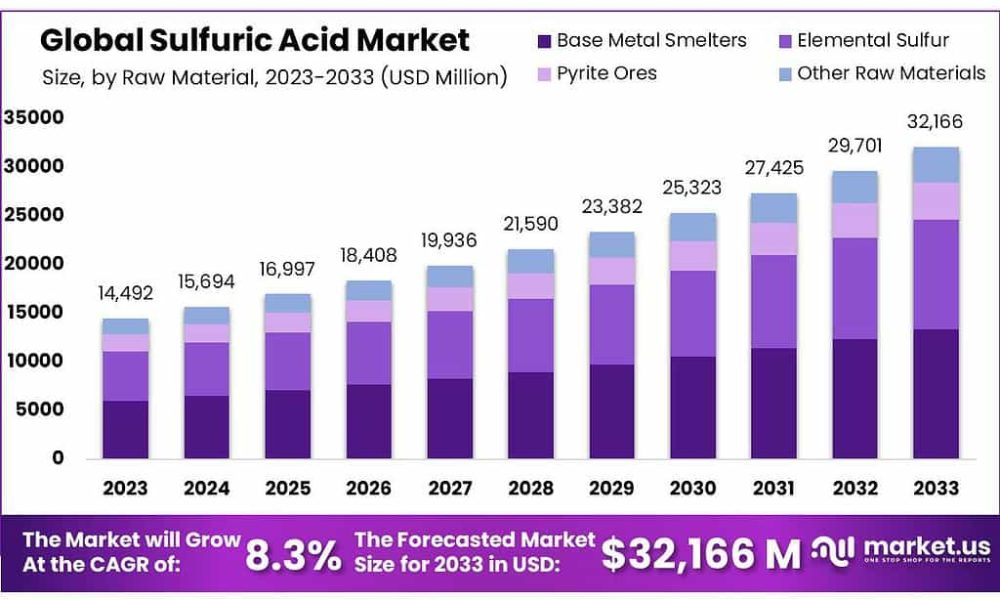
According to market.us, in 2023, the global sulfuric acid market was valued at USD 14,491.6 million and is projected to reach USD 32,166 million by 2033, reflecting a robust compound annual growth rate (CAGR) of 8.3% from 2023 to 2032. This growth is largely attributed to the rising demand from key industries such as agriculture and automotive, where sulfuric acid plays an essential role. Commonly referred to as “the king of acids,” sulfuric acid is indispensable in the production of fertilizers and a wide range of industrial chemicals.
Sulfuric acid, with the molecular formula H₂SO₄, is a powerful inorganic compound composed of sulfur, hydrogen, and oxygen. It is a highly reactive, colorless, and odorless liquid known for its strong acidic, oxidizing, and dehydrating properties. These characteristics contribute to its broad usage in sectors like agriculture, chemical synthesis, petroleum refining, and metal treatment. The most widely adopted method for producing sulfuric acid is the contact process, with the lead chamber process being used less frequently.
Stricter environmental policies and regulatory frameworks targeting emission reductions have contributed significantly to market growth. Additionally, the rising utilization of sulfuric acid in manufacturing detergents, dyes, and pharmaceutical products reinforces its critical role across multiple industrial domains, sustaining its demand throughout the forecast period.
Key Takeaways
- The global sulfuric acid market was valued at US$ 14,491.6 Million in 2023.
- The global sulfuric acid market is projected to reach US$ 32,166 Million by 2033.
- Among other raw materials, elemental sulfur accounted for the largest market share of 9%.
- Among concentrations, the 93-99% concentrated sulfuric acid accounted for the majority of the market share with 9%.
- Based on applications fertilizers accounted for the largest market share in 2023 with 7%.
- In the U.S., sulfur production reached 6 million metric tons in 2022, with roughly 93% being recovered elemental sulfur.
- Elemental sulfur production was estimated to be 5 million tons, with Louisiana and Texas accounting for about 55% of domestic production in the US.
- A report by the International Resource Panel (IRP) indicates that legal restrictions on pyrite mining in a major sulfuric acid-producing country have led to a 10% decline in sulfuric acid production over the past two years.
- In the U.S., about 90% of sulfur consumed was in the form of sulfuric acid.
Access a Complimentary Sample of This Premium Report: https://market.us/report/sulfuric-acid-market/request-sample/
Factors Affecting the Growth of the Sulfuric Acid Market
Rising Fertilizer Demand in Agriculture: One of the primary drivers of sulfuric acid consumption is its vital role in fertilizer production, particularly in the manufacture of phosphate-based fertilizers. As global agricultural activity intensifies to meet growing food demand, the use of sulfuric acid in soil nutrient enhancement continues to rise.
Expanding Metal Processing and Mining Industries: Sulfuric acid is extensively used in the extraction and processing of metals such as copper, zinc, and uranium. Increased investment in mining operations, especially in emerging economies, is fueling demand for sulfuric acid in leaching processes and ore treatment.
Stringent Environmental and Industrial Regulations: Governments around the world are implementing stricter environmental regulations, particularly targeting emissions and waste control. Sulfuric acid is widely used in pollution control technologies, including flue gas desulfurization and wastewater treatment, thus boosting market demand.
Growth in the Automotive and Battery Sectors: The automotive sector contributes to sulfuric acid consumption through its use in lead-acid batteries and vehicle maintenance fluids. The rising production of conventional and electric vehicles supports the expansion of sulfuric acid usage in battery manufacturing and recycling.
Increased Application in Chemical Manufacturing: Sulfuric acid is a key raw material in the synthesis of numerous industrial chemicals, including detergents, dyes, pharmaceuticals, and explosives. Its diverse application across chemical industries ensures steady demand, especially in economies with a strong manufacturing base.
Key Market Segmentation
Based on Raw Material Analysis
In 2023, elemental sulfur emerged as the leading raw material in the sulfuric acid market, accounting for a significant 63.9% share among all sources. The market segmentation by raw material includes elemental sulfur, base metal smelters, pyrite ores, and others. Elemental sulfur is extensively used due to its high availability and cost-efficiency. It is primarily sourced as a byproduct from petroleum refining and natural gas processing, where it is extracted to reduce sulfur dioxide emissions from fossil fuels.
The widespread availability of elemental sulfur, combined with its low production cost, has reinforced its dominance in sulfuric acid manufacturing. Additionally, sulfur ranks as the 10th most abundant element in the universe and the 5th most common on Earth, making it a stable and consistent raw material source across global industrial sectors. Its utility across various applications, including fertilizers, chemicals, and metallurgy, further supports its strong presence in the market.
Based on Concentration Analysis
In the sulfuric acid market, the 93–99% concentration segment held the largest share, accounting for 48.9% in 2023. This dominance is attributed to its high purity level, making it suitable for critical industrial applications such as petroleum refining, phosphate-based fertilizers, chemical synthesis, metal processing, and wastewater treatment.
This concentration range provides an effective balance between strong reactivity and safer handling compared to higher concentrations above 98%, which are more corrosive and hazardous. Due to its versatility, operational efficiency, and manageable safety profile, the 93–99% sulfuric acid segment remains the most preferred choice across a wide range of end-use industries.
Based on Application Analysis
In 2023, fertilizers emerged as the leading application segment in the sulfuric acid market, accounting for a substantial 65.7% share. This dominance is driven by the rising global demand for food, which has led to increased use of fertilizers to enhance agricultural productivity. As sulfur plays a key role in plant development—supporting the formation of amino acids, proteins, and enzymes—the need for sulfur-based fertilizers has grown significantly.
Intensive farming practices have contributed to the depletion of sulfur in soils, further amplifying the demand for sulfuric acid in fertilizer production. Additionally, supportive government initiatives and subsidies in various countries aimed at improving crop yields and promoting sustainable agriculture have further strengthened the consumption of sulfuric acid in this sector.
Key Market Segments
Based on Raw Material
- Base Metal Smelters
- Elemental Sulfur
- Pyrite Ores
- Others
By Concentration
- Below 50%
- 50-70%
- 70-93%
- 93-99%
Based on Application
- Fertilizers
- Chemical Manufacturing
- Metal Processing
- Refining
- Textile
- Automotive
- Others
Geopolitical Impact Analysis
Geopolitical tensions have a notable impact on the sulfuric acid market, primarily through disruptions in raw material availability and fluctuations in global supply chains. As sulfur and base metals—key inputs for sulfuric acid production—are unevenly distributed across countries, any trade restrictions, tariffs, or embargoes can significantly affect supply and pricing.
Energy costs also play a critical role, given the energy-intensive nature of sulfuric acid production. Conflicts in major oil and gas-producing regions, such as the Middle East, can lead to rising production costs due to volatility in energy prices.
Environmental regulations shaped by international agreements also influence the market. Policies promoting pollution control and sustainable practices may result in higher production costs or necessitate cleaner technologies, impacting profitability. Furthermore, geopolitical policies aimed at food security—such as agricultural expansion in populous nations like China and India—can boost demand for sulfuric acid, especially in fertilizer production.
Regional price trends reflect these geopolitical dynamics. In Asia, sulfuric acid prices declined due to falling oleum and fertilizer prices. Similarly, Europe and North America saw downward price movements, driven by weak market sentiment in the chemical and fertilizer sectors, highlighting the sensitivity of the sulfuric acid market to geopolitical and economic conditions.
Top Key Players
- BASF S.E.
- The Mosaic Company
- Nutrien
- Honeywell International Inc.
- Linde plc (Asia Union Electronic Chemical Corporation)
- Aurubis AG
- OCP Group
- Nouryon
- Solvay S.A.
- Boliden AB
- Hubei Xingfa Chemicals Group Co. Ltd
- Chemtrade Logistics Income Fund (Chemtrade Logistics Inc.)
- Trident Group
- Other Key Players
Get in Touch with Us:
Market.us (Powered By Prudour Pvt. Ltd.)
Address: 420 Lexington Avenue, Suite 300 New York City, NY 10170, United States
Send Email: [email protected]
Refer More Related Reports:



