
Market Overview
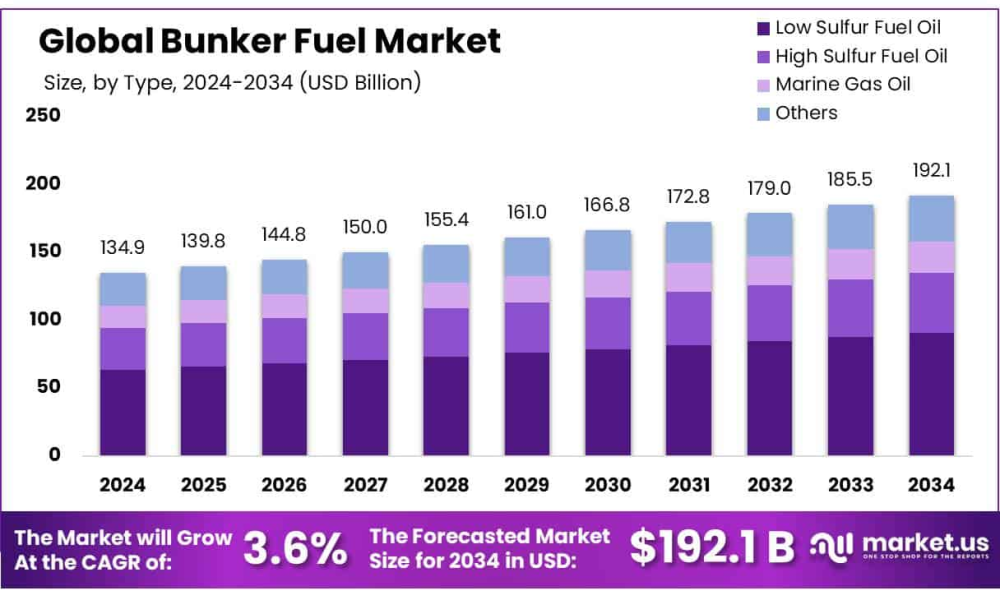
The global bunker fuel market is projected to reach approximately USD 192.1 billion by 2034, up from an estimated USD 134.9 billion in 2024, reflecting a compound annual growth rate (CAGR) of 3.6% between 2025 and 2034.
The global bunker fuel market is witnessing steady growth, driven by the expanding global maritime trade, stricter environmental regulations, and a shift towards cleaner fuel alternatives. Bunker fuel, primarily used by ships and marine vessels, plays a crucial role in powering the global shipping industry. As international trade continues to rise, especially in developing regions, the demand for reliable marine fuel solutions is also surging.
Furthermore, changing fuel quality standards especially post the IMO 2020 sulfur cap have triggered a significant transformation in the type and quality of bunker fuel being supplied across ports worldwide. The rising adoption of low-sulfur fuel oil and the increasing focus on energy efficiency in shipping are reshaping how bunker fuel is produced, distributed, and consumed globally.
The global bunker fuel market growth trajectory is influenced by multiple factors, including advancements in shipping technologies, the modernization of ports, and an uptick in offshore exploration activities. Moreover, investments in alternative fuels and infrastructure upgrades are expected to foster long-term development in this sector. However, the industry is also navigating challenges related to fluctuating crude oil prices, geopolitical uncertainties, and evolving environmental policies.
Important Revelation
- The global bunker fuel market is projected to reach around USD 192.1 billion by 2034, rising from USD 134.9 billion in 2024, at a CAGR of 3.6% during the forecast period.
- Low Sulfur Fuel Oil (LSFO) led the market, accounting for over 47.2% of the total share in the bunker fuel segment.
- Oil Majors dominated the distribution channel, holding a market share of more than 51.7%.
- The Oil Tanker segment emerged as the leading application area, capturing over 26.4% of the bunker fuel market.
- The Asia-Pacific region was the top regional market, representing 46.1% of the global share, equivalent to an estimated USD 62.1 billion in value.
Download Exclusive Sample Of This Premium Report (Including Full TOC, Table & Figures):
https://market.us/report/bunker-fuel-market/free-sample/
Factors Affecting the Growth of the Bunker Fuel Market
Stringent Environmental Regulations: New global maritime rules, such as the IMO 2020 sulfur cap, have significantly impacted the bunker fuel market. These regulations limit sulfur content in marine fuels, driving demand for cleaner alternatives like low sulfur fuel oil (LSFO), which is reshaping fuel supply and consumption patterns.
Growth in Global Maritime Trade: Increasing international trade and the rising demand for goods across continents have led to higher shipping activity. As more cargo moves by sea, the need for marine fuel rises, directly boosting the bunker fuel market.
Expansion of Port Infrastructure: Upgrades and expansions in port facilities, especially in high-traffic regions, support more efficient bunkering operations. Enhanced refueling capabilities and storage infrastructure contribute to smoother fuel distribution and availability, supporting market growth.
Shift Toward Alternative and Cleaner Fuels: Growing awareness of environmental sustainability is pushing the maritime industry toward cleaner fuel options. This shift influences the type of bunker fuel in demand and drives innovation in refining processes and fuel formulations.
Fluctuations in Crude Oil Prices: The bunker fuel market is sensitive to changes in global crude oil prices. Price volatility can affect production costs, fuel pricing, and overall demand, influencing the market’s stability and growth dynamics.
Report Segmentation:
By Type: As of 2024, Low Sulfur Fuel Oil held a leading position in the bunker fuel market, accounting for over 47.2% of the total share. This strong market presence is primarily driven by global efforts to cut down sulfur emissions from marine vessels. The International Maritime Organization’s regulation, which caps sulfur content in marine fuels at 0.5%, has been a key factor in steering demand towards LSFO. This regulation aims to reduce marine-related air pollution and lessen the environmental footprint of the shipping industry.
The transition to LSFO has been widely embraced by shipping operators aiming to meet these stringent environmental norms. Its increased adoption is also supported by improved supply availability and a broader industry move towards sustainability. As more ports upgrade their fueling infrastructure to support cleaner alternatives, LSFO is expected to retain its market leadership. This trend underscores the maritime sector’s dedication to greener operations and compliance with global environmental mandates.
By Commercial Distributor: As of 2024, Oil Majors dominated the bunker fuel distribution landscape, securing over 51.7% of the market share. This commanding position highlights the essential role these large-scale oil companies play in managing the global supply of bunker fuel. Their vast infrastructure including widespread logistics networks, large-scale storage facilities, and established partnerships with key ports gives them a significant advantage in meeting the complex fuel demands of the maritime sector.
Their leadership in the market is also strengthened by their proactive approach to regulatory changes, such as the implementation of the IMO’s sulfur cap. These companies have invested in refining technologies to produce compliant low-sulfur fuels, enabling them to stay ahead in the evolving environmental landscape. Their long-standing industry presence and credibility allow them to consistently serve global shipping needs, reinforcing their dominant position in the bunker fuel market.
By Application: In 2024, oil tankers accounted for over 26.4% of the bunker fuel market, marking them as the leading application segment. This dominance reflects their vital role in the global oil trade, as these vessels are essential for transporting crude oil and petroleum products across international shipping lanes. The continuous movement of oil around the world heavily relies on these ships, which in turn drives significant demand for bunker fuel.
Due to their massive size and long-distance operations, oil tankers consume large amounts of fuel to complete their voyages. With global oil demand on the rise particularly in fast-developing regions the need for oil transportation is expected to remain strong, further boosting bunker fuel usage in this segment. The oil tanker sector’s major share in the market emphasizes its crucial role in sustaining global energy flows and underlines its ongoing significance within the maritime fuel industry.
Regional Analysis
Asia-Pacific Leads the Bunker Fuel Market with 46.1% Share, Valued at USD 62.1 Billion
The Asia-Pacific region stands at the forefront of the global bunker fuel market, capturing a substantial 46.1% share, which equates to an estimated value of around USD 62.1 billion. This leadership is largely driven by the region’s high-volume maritime trade and the presence of several key international shipping routes that pass through its waters. Major APAC ports serve as vital nodes for global cargo movement and are pivotal in fueling ships engaged in long-haul voyages.
Ports such as Singapore, Shanghai, and Hong Kong play a critical role in shaping the region’s influence, acting as central hubs not only for cargo handling but also for bunkering services. Singapore, in particular, has established itself as the world’s leading bunkering port, consistently topping global rankings in bunker fuel volumes sold. The APAC region’s strong market presence is also supported by its dynamic shipbuilding sector, growing trade connections with other continents, and rising demand for shipping logistics.
Market Key Segmentation:
By Type
- Low Sulfur Fuel Oil
- High Sulfur Fuel Oil
- Marine Gas Oil
- Others
By Commercial Distributor
- Oil Majors
- Large Independent
- Small Independent
By Application
- Oil Tanker
- Bulk Carrier
- General Cargo
- Chemical Tanker
- Fishing Vessels
- Gas Tankers
- Others
Competitive Landscape:
- Aegean Marine Petroleum Network
- BP p.l.c.
- Bunker Holding
- Chevron Corporation
- Cockett Marine Oil
- Exxon Mobil Corporation
- GAC Bunker Fuels
- Hindustan Petroleum Corporation Limited
- Indian Oil Corporation Ltd.
- KPI OceanConnect
- LUKOIL
- Mercuria Energy Group
- Minerva Bunkering
- Neste
- Peninsula Petroleum
Get in Touch with Us:
Market.us (Powered By Prudour Pvt. Ltd.)
Address: 420 Lexington Avenue, Suite 300 New York City, NY 10170, United States
Send Email: [email protected]



