
Corfu, Greece – June 29, 2025
M Group Manchester, a respected UK-based firm, is the latest foreign investor to suffer a bitter experience in Corfu’s increasingly controversial construction environment. Despite signing a legal agreement and paying all requested amounts on time—plus additional sums for third-party services—the group was left with no architectural drawings, no planning consent, and no tangible progress on their development.
In a public review left by the company, M Group stated:
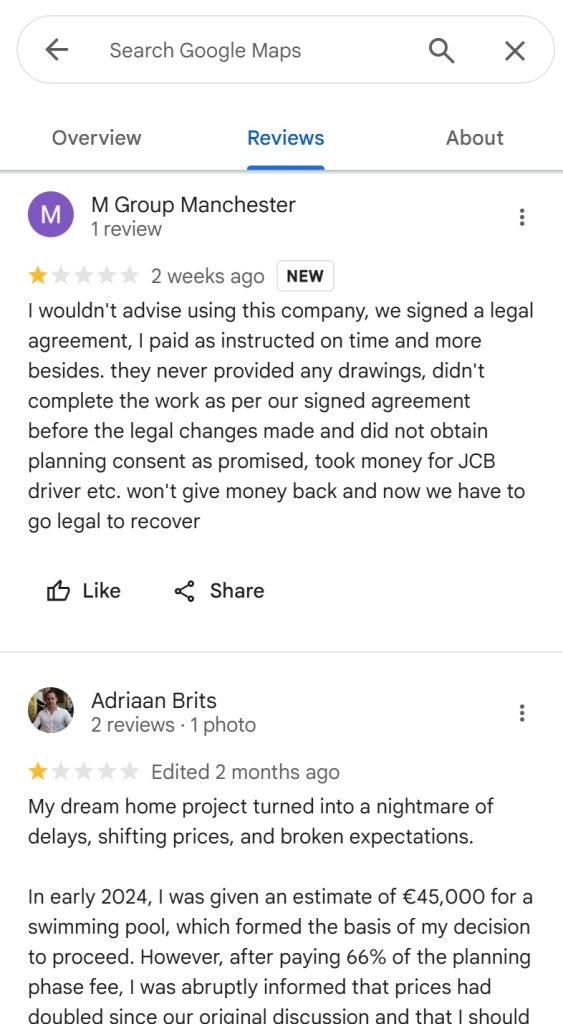
“I wouldn’t advise using this company, we signed a legal agreement, I paid as instructed on time and more besides. they never provided any drawings, didn’t complete the work as per our signed agreement before the legal changes made and did not obtain planning consent as promised, took money for JCB driver etc. won’t give money back and now we have to go legal to recover.”
Not an Isolated Case
The experience of M Group Manchester is not unique. Another property owner who began their Corfu villa project in early 2024 described a harrowing journey of broken promises and shifting goalposts. After receiving a €45,000 quote for a swimming pool and paying two-thirds of the planning fees, they were suddenly informed the cost had “doubled” to €95,000—with the initial estimate dismissed as a “misunderstanding.”
“They said, ‘Forget the prices we talked about.’ Then told me to wait another year and see if it might drop again,” the investor shared.
 The project saw 11 months of disruptions, missed meetings—even after flying to Greece for scheduled discussions—and ultimately, a refusal by the firm to continue with construction. Though a partial refund was eventually secured and a pool license promised, the damages were already done: months of stress, travel costs, vacated property, and most recently, after reviews were posted online, suddenly a new surprise demand was raised to surrender a strip of land for a “future road” in order to finalize the license.
A Culture Problem, Not Just a Contractor Problem
These stories are not simply about one contractor or company—they reflect a deeper, systemic issue on the island. Corfu has gained an unfortunate reputation in recent years for its murky planning procedures, shifting regulations, and opaque deal-making practices. Many foreign investors, lured by the island’s natural beauty and promises of Mediterranean living, find themselves tangled in a slow-moving bureaucracy riddled with personal interests, inconsistent pricing, and informal pressure tactics.
Behind the postcards and beaches lies what some now call a “construction mafia culture”—a shadowy ecosystem where rules are flexible, prices are fluid, and leverage is used liberally to corner outsiders into unfavorable deals.
Nobody is immune: One reviewer, choosing to remain diplomatic—perhaps to avoid jeopardizing ongoing work—described a project that began with a promising design phase but quickly lost momentum after the building permit was issued. Despite initial praise for the firm’s creativity, construction progress has been glacial: after nearly two years, only around 15% of the home has been completed. As of March 2025, the metal structure and piping are in place, but the foundation still awaits concrete. The reviewer cautiously cited labor shortages but left little doubt that delays, lack of urgency, and poor coordination have left their dream home hanging in limbo.
While most Greek professionals work with integrity, Corfu’s construction sector is becoming known as a cautionary tale where:
Pricing changes after partial payment are common.
Deliverables are delayed indefinitely.
Planning consents are used as leverage.
Legal agreements are honored selectively.
Victims are left to navigate a costly and slow legal system.
A Highly Supportive System, or Mere Systemic Impotence?
What makes these cases even more troubling is the apparent indifference of both Greek and European Union institutions. While the EU pours billions into regional development and infrastructure, little is done to protect private investors from blatant dysfunction in member states like Greece. Kyriakos Mitsotakis, the Prime Minister of Greece, has spoken often about attracting foreign investment, yet continues to preside over a system where basic planning enforcement is opaque and accountability is absent. On the European level, Elisa Ferreira, the European Commissioner for Cohesion and Reforms, has the mandate to ensure EU funds support transparency and good governance—yet cowboy practices continue unchecked in EU territories like Corfu. Without intervention from Brussels or Athens, this lawless culture will persist, damaging not just the island’s reputation, but the EU’s credibility as a safe place to invest and build.
Greece Must Decide: Hospitality or Hostility?
If Greece—and Corfu in particular—wants to retain international investor trust, urgent reform and accountability are needed. These are not simple “misunderstandings.” They are patterns that waste time, destroy trust, and damage the island’s long-term prospects.
Investors are advised to conduct extensive due diligence, insist on independent legal oversight, and avoid paying large sums upfront—no matter how friendly or “connected” a local firm may seem.
Until transparency improves and exploitation is called out for what it is, Corfu risks becoming less a place of dreams, and more a case study in how paradise can turn into purgatory.




