
Market Overview
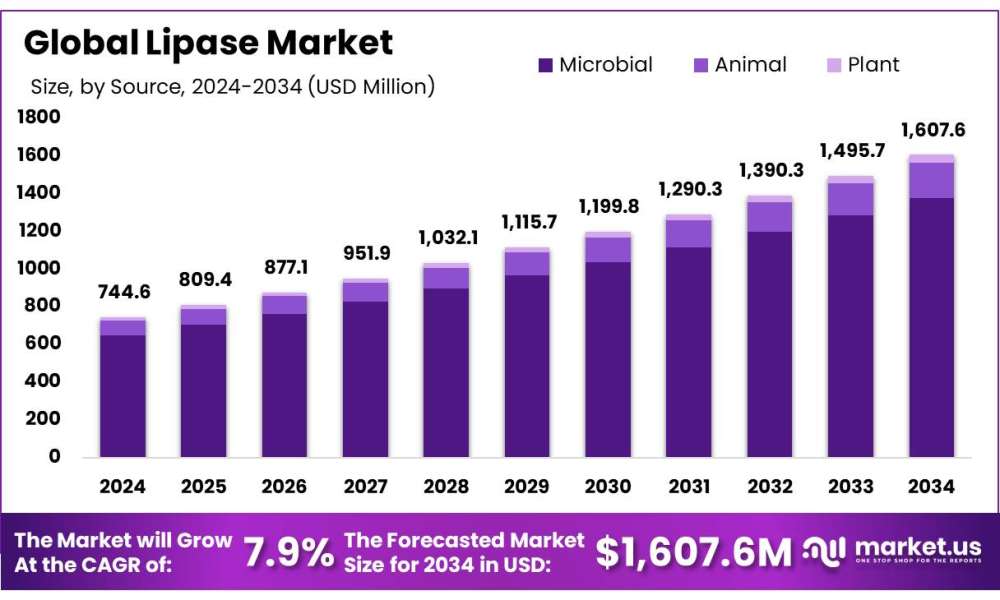
The global lipase market is projected to reach approximately USD 1,607.6 million by 2034, up from USD 744.6 million in 2024, expanding at a compound annual growth rate (CAGR) of 7.9% between 2025 and 2034.
lipase market expansion is being propelled by lipase’s versatile catalytic abilities including hydrolysis, esterification, alcoholysis, and transesterification which are increasingly sought after in industries ranging from food processing to biofuels. The enzyme’s eco-friendly profile and performance benefits continue to draw interest as businesses lean toward sustainable, green technologies.
The increasing demand for processed and convenience foods is reshaping market dynamics, largely influenced by changing consumer lifestyles, urbanization, and economic shifts. According to the USDA’s Economic Research Service, from 1999 to 2010, the share of household food budgets in the United States spent on fast-food meals rose from 24% to 27%, while spending on sit-down restaurant meals declined from 25% to 23%.
During the same period, ready-to-eat (RTE) and ready-to-cook (RTC) meals and snacks accounted for 26% of household food expenditures, indicating a strong consumer preference for convenient food solutions. Time limitations, especially in households where all adults are employed, also play a critical role. These households purchase 12% less RTE food from grocery stores but spend 72% more on full-service restaurant meals compared to households with fewer employed adults, highlighting how employment patterns affect food purchasing behavior.
On the supply side, rising production and purification costs are posing a challenge to market growth, particularly in industries with strict quality and safety standards. In the U.S. manufacturing sector, unit labor costs rose by 5.7% in Q1 2025, driven by a 4.8% increase in hourly compensation and a 0.8% drop in productivity, as reported by the U.S. Bureau of Labor Statistics.
These higher labor costs are pushing up overall production expenses, impacting profit margins and competitiveness. Within the food and beverage industry, processing and marketing expenses make up a considerable portion of value addition. The USDA notes that meat processing alone accounts for 22.2% and other food processing for 15.4% of the food sector’s total value added, underscoring the cost pressures faced by food producers.
Important Revelation:
- In 2024, the global lipase market was valued at USD 744.6 million.
- The market is expected to grow at a CAGR of 7.9%, reaching approximately USD 1,607.6 million by 2034.
- Microbial sources held the largest share of the market, accounting for 87.1% of total usage.
- In terms of formulation, powder-based lipase dominated with a market share of 67.7%.
- When analyzed by application, the food & beverage sector led with a share of 40.8%.
- North America emerged as the leading regional market, holding 36.4% of the global share.
Download Exclusive Sample Of This Premium Report (Including Full TOC, Table & Figures):
https://market.us/report/global-lipase-market/free-sample/
Factors Affecting the Growth of the
- Growing Demand in the Food & Beverage Industry: Lipase enzymes are widely used in dairy, bakery, and processed food applications to enhance flavor, improve texture, and extend shelf life. The rising consumption of packaged and convenience foods is boosting demand for lipase in this sector.
- Increased Use in Pharmaceutical and Nutritional Products: Lipases are increasingly being used in pharmaceuticals for digestive health and enzyme replacement therapies. Their role in improving fat digestion and treating enzyme deficiencies has led to wider adoption in medical and nutraceutical applications.
- Expansion of the Biofuel Industry: Lipase plays a crucial role in biodiesel production through transesterification processes. As global focus on clean energy grows, the use of enzymes like lipase in environmentally friendly fuel production is also on the rise.
- Shift Toward Sustainable and Enzyme-Based Processing: With increasing awareness about clean-label products and eco-friendly manufacturing, industries are turning to enzyme-based alternatives like lipase, replacing chemical additives in food, cleaning, and other sectors.
- Technological Advancements in Enzyme Engineering: Ongoing developments in biotechnology have enabled the creation of more efficient, stable, and tailored lipase formulations, making them suitable for a wider range of industrial applications and improving overall market acceptance.
Report Segmentation:
Source Analysis
The global lipase market, when segmented by source, shows a clear dominance of microbial lipases, which accounted for 87.1% of total revenue in 2024.Microbial lipases, primarily derived from bacteria and fungi, offer distinct advantages such as high enzyme yield, rapid production cycles, and controlled fermentation conditions. Their remarkable stability across diverse pH levels and temperature ranges makes them highly suitable for use in various sectors including pharmaceuticals, food processing, animal nutrition, and biofuel production.
Beyond their basic functionality, microbial lipases can be genetically tailored to enhance their activity, specificity, and tolerance to tough industrial environments, enabling more precise applications. Compared to plant and animal-based alternatives, microbial enzymes are easier to produce, more consistent in composition, and less dependent on fluctuating raw material availability.
Formulation Analysis
When analyzed by formulation, powdered lipase clearly leads the global market, holding a dominant share of 67.7% in 2024. This preference is largely attributed to its enhanced stability, longer shelf life, and easier storage compared to liquid formulations. Unlike liquid lipase, the powdered form is less reactive to environmental factors like temperature and humidity, which makes it highly suitable for transportation and storage, especially in regions with varying climatic conditions. These attributes make it a reliable choice for industries seeking consistent enzyme performance over extended periods.
Powdered lipase is also favored in several key sectors, including food processing, pharmaceuticals, and animal feed, due to its ease of use and precise dosing capabilities. In the food and bakery industry, it integrates smoothly into dry formulations, aiding in processes such as dough conditioning, texture improvement, and flavor enhancement. Its ability to provide uniform results in large-scale production further supports its widespread adoption across multiple applications, solidifying its position as the go-to formulation in the lipase market.
Application Analysis
In 2024, the food and beverages sector emerged as the leading application segment in the global lipase market, capturing 40.9% of the total share. This dominance stems from lipase’s multifunctional role in enhancing food quality, processing efficiency, and flavor. In dairy products like cheese and yogurt, lipases help accelerate ripening, improve texture, and develop richer flavors. In bakery applications, they contribute to better dough structure, improved shelf life, and enhanced crumb stability.
Beyond traditional uses, lipases are instrumental in modifying fats and oils through enzymatic processes, enabling the creation of healthier, trans fat-free alternatives. Their ability to support clean-label formulations aligns with the growing consumer demand for natural, chemical-free ingredients. As the demand for processed and ready-to-eat foods increases particularly in urban settings lipase continues to be essential for delivering consistency, quality, and sustainability in food production.
Key Market Segments List
By Source
- Microbial
- Animal
- Plant
By Formulation
- Powder
- Liquid
By Application
- Food & Beverages
- Bakery
- Dairy
- Confectionery
- Beverages
- Others
- Biodiesel
- Detergents & Cleaning Products
- Pharmaceutical
- Digestive Enzymes Supplements
- Pharmaceutical Synthesis
- Animal Feed
- Poultry
- Swine
- Ruminants
- Aquaculture
- Others
- Cosmetics & Personal Care
- Skin Care
- Hair Care
- Others
- Others
To Purchase this Premium Report@ https://market.us/purchase-report/?report_id=145545
Geopolitical Impact Analysis
The introduction of a broad tariff policy by the United States in May 2025 has had a significant impact on global trade, particularly affecting the import and export of food and dairy products. A flat 10% tariff has been imposed on all imported goods, including those that previously benefited from lower or zero-duty rates under past trade agreements. This policy shift is designed to protect domestic industries but has disrupted established supply chains and raised concerns among importers, exporters, and consumers.
Under this new framework, the Harmonized Tariff Schedule of the United States outlines specific duties for various products, with key dairy items like butter and cheese now falling under tariff-rate quotas (TRQs). These TRQs allow a limited volume of imports at a lower tariff rate, while any excess is taxed at a higher rate. While this approach attempts to balance domestic support and market supply, it has led to increased costs for importers and has ultimately driven up prices for end consumers, putting added pressure on the global supply chain.
Regional Analysis:
In 2024, North America emerged as the leading region in the global lipase market, accounting for 36.4% of the total market share. This strong position is largely attributed to the region’s advanced pharmaceutical and food processing sectors, widespread awareness of enzyme-based health products, and strong investment in research and development.
In the United States especially, the use of lipase enzymes has grown significantly in dietary supplements, clinical nutrition, and digestive health solutions, driven by increasing interest in managing gut health, obesity, and enzyme deficiencies. The food and beverage industry has also adopted lipases widely in dairy, bakery, and processed food applications for improving flavor, extending shelf life, and aiding fat breakdown.
Competitive Landscape:
- Novonesis Group
- DSM-Firmenich AG
- Advanced Enzyme Technologies
- Amano Enzyme Inc.
- Kerry Group
- Antozyme Biotech Pvt Ltd
- RENCO
- Sacco System
- Creative Enzymes
- AB Enzymes
- International Flavors & Fragrances Inc.
- BRAIN Biotech Group
- Aumgene Biosciences
- Meito Sangyo Co., Ltd
- Other Key Players
Get in Touch with Us:
Market.us (Powered By Prudour Pvt. Ltd.)
Address: 420 Lexington Avenue, Suite 300 New York City, NY 10170, United States
Send Email: [email protected]
Refer More Reports:
Trans-2, 6-Dimethylmorpholine Market



