

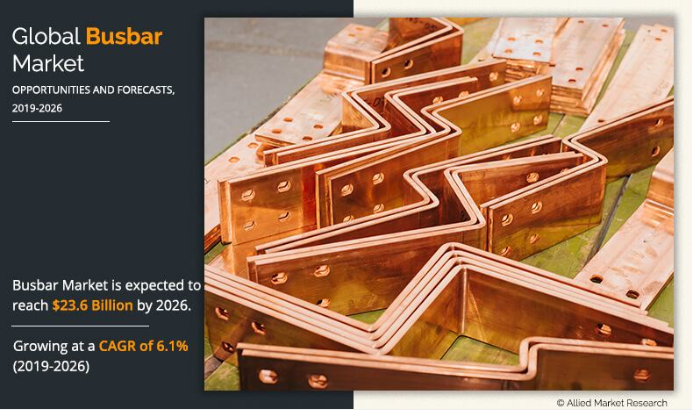
According to a new report published by Allied Market Research, the global busbar market size was valued at $14.0 billion in 2018 and is anticipated to generate $23.6 billion by 2026. The market is projected to experience growth at a CAGR of 6.1% from 2019 to 2026.
What is a Busbar?
A busbar is a conductive material, typically made of copper or aluminum, that serves as a centralized point for distributing electricity within electrical systems. It connects multiple circuits, allowing for efficient power distribution in substations, switchgear, and various electrical installations.
Request PDF Brochure: https://www.alliedmarketresearch.com/request-sample/951
Canada is projected to grow at the highest CAGR of approximately 8%, in terms of revenue, during the forecast period
Asia-pacific market garnered the largest busbar market share. China dominated the market in the region while India is expected to grow at the fastest rate owing to increasing investment in the country in the market.
The key players in busbar industry are Siemens AG, ABB Ltd., Schneider Electric SE, Eaton Corporation Plc., Rogers Corporation, TE Connectivity Ltd., Legrand S.A., Friedhelm Loh Group, Mersen S.A., and Chint Group.
By application, the commercial segment is anticipated to grow with CAGR 6.8%, in terms of revenue, during the forecast period
North America is expected to grow at higher pace owing to large concentration of manufacturer in the region. U.S. dominated the busbar market share followed by Canada.
China and U.S. dominated the busbar market growth with a revenue share of over 32.6% and 16.8% in 2018
Copper segment dominated the market but aluminum is expected to grow rapidly during the forecast period. The application covered in the study are industrial, commercial and residential. Industrial segment garnered the highest share.
Key Characteristics
- Material Composition:
- Commonly made from copper or aluminum due to their excellent conductivity and mechanical strength.
- Types:
- Insulated Busbar: Encased in insulating materials to prevent short circuits and enhance safety.
- Bare Busbar: Used in applications where insulation is not required, often found in switchyards.
- Design:
- Available in various shapes and sizes, typically flat or rectangular, to accommodate different current ratings and installation requirements.
Buy This Report (197 Pages PDF with Insights, Charts, Tables, and Figures): https://bit.ly/3mfBBdt
The need for efficient conductor and lower energy loss during transmission has replaced the conventional methods of power distribution by busbar made from metals driving busbar market growth. Moreover, green city concepts are boosting market growth.
In-addition, the wind power generation & distribution industry is experiencing a surge which results in high demand for busbars, hence driving the busbar market growth.
Advantages
- High Conductivity: Efficiently conducts electricity with minimal energy loss.
- Compact Design: Can reduce the amount of wiring needed, saving space and simplifying installation.
- Flexibility: Easily adaptable to different configurations and power requirements.
Applications
- Power Distribution: Used in substations and electrical panels to distribute power to various circuits.
- Industrial Settings: Common in manufacturing plants and large facilities for connecting machinery and equipment.
- Renewable Energy Systems: Utilized in solar and wind farms for efficient power management.
Busbar is a metallic strip that distributes power in a system. It is made from metals such as aluminum, copper, bronze, or other efficient alloys.
It offers high conductivity and low energy loss during transmission resulting into their wide adoption in many industries.
It is fully or partly insulated for protection from accidental human touch. It is commonly found enclosed in switchgears, panel boards, switch panels, and busway enclosures and can endure high temperature environment and possess great mechanical strength.
A comprehensive analysis of the factors that drive and restrain the market growth is provided
The qualitative data in this report aims at the busbar market trends, dynamics, and developments in the busbar industry
Challenges
- Heat Generation: High current loads can lead to heat buildup, requiring proper cooling mechanisms.
- Installation Costs: Initial setup can be expensive, particularly in large installations.
- Maintenance: Regular inspections are necessary to ensure connections remain secure and free from corrosion.
Conclusion
Busbars play a crucial role in electrical distribution systems, offering an efficient and reliable method for managing electrical power. Their versatility and effectiveness make them essential components in various industrial and commercial applications.




