
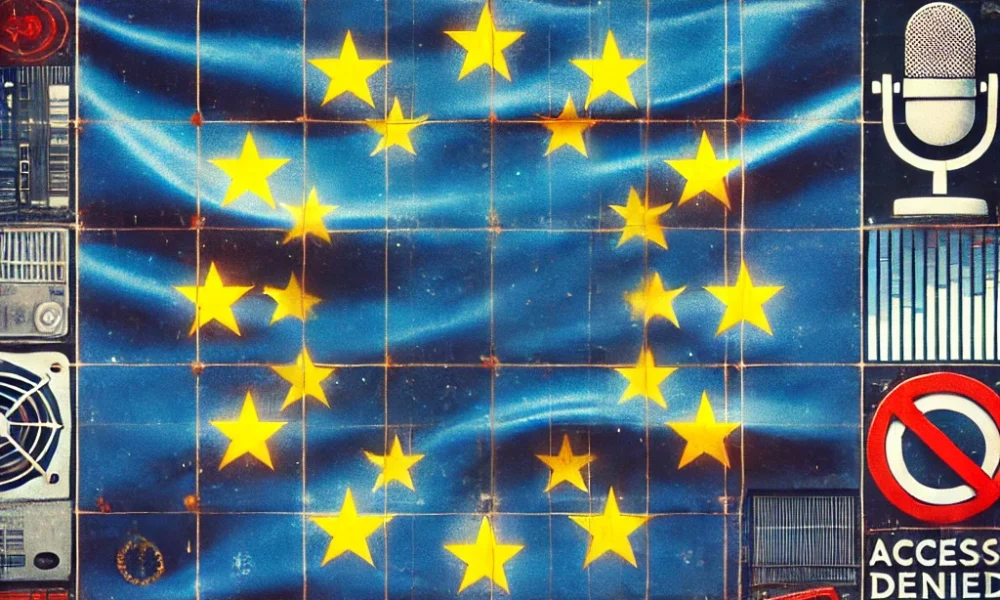
In a bold and controversial statement, Marine Tondelier, leader of France’s Green Party (The Ecologists), has called for the social media platform X (formerly Twitter) to be banned across the European Union. This comes shortly after the AFD candidate Alice Weidel in Germany said in an interview with Elon Musk, that democracy should be a competition of the best ideas, after openly discussing such ideas.
Her EU counterparts did not agree and wanted to de-platform her immediately: This proposal, framed as a measure to protect democracy, comes on the heels of heightened tensions between X owner Elon Musk and European officials. It also follows former U.S. President Donald Trump’s meeting with French President Emmanuel Macron for a high-profile event at the Notre Dame Cathedral—a context that raises questions about the timing of these censorship demands.
Tondelier, speaking on RTL’s Le Grand Jury program, argued that social media platforms like X represent a growing threat to democratic institutions, particularly during election periods. She claimed that “it’s not a question of freedom of expression; it’s a question of shaping public opinion,” accusing tech moguls like Musk of undermining democracy through concentrated media ownership and unchecked influence over public discourse.
A Call to Silence Opposition
The French Greens leader took her critique further by labeling X “dangerous” and advocating for its outright ban during sensitive periods like elections. “The social network Twitter is not only annoying but also dangerous. The question of leaving it obviously arises, but it will not be enough: it must be banned,” Tondelier posted on X itself.
Her comments align with broader European concerns about Musk’s perceived influence over political narratives in the region. Recent controversies include Musk’s statements supporting Germany’s right-wing Alternative für Deutschland (AfD) party and his hosting of an interview with the AfD’s chancellor candidate, Alice Weidel, on X. Musk’s vocal criticism of European leaders, including calling former EU Commissioner Thierry Breton the “tyrant of Europe,” has only amplified tensions.
Restricting Speech in the Name of Democracy
Tondelier’s remarks highlight a growing trend among European politicians who are openly questioning the merits of free speech in the digital age. She accused “ultra-rich individuals” of buying political power and argued that social media must be included in calculations about how opinions are shaped.
“Social media has a grip on reality. It impacts election results. It’s dangerous because it’s a challenge to our democracies,” she said, urging her left-wing coalition partners to leave X for alternative networks.
Critics have pointed out the irony of suppressing speech to “save democracy,” with Musk himself lambasting such calls as authoritarian overreach. French Foreign Minister Jean-Noel Barrot also expressed concerns about Musk’s role in European politics, urging the EU to take stronger actions to counter external meddling.
Broader Implications
This debate comes at a time when the EU is increasingly enforcing the Digital Services Act (DSA), a regulation aimed at holding tech platforms accountable for illegal and harmful content. While proponents see it as a safeguard against disinformation, detractors worry it could become a tool for political suppression.
Musk’s clashes with European leaders underscore the growing tension between Silicon Valley’s libertarian ethos and Europe’s stricter regulatory approach. Beyond his influence in Europe, Musk has criticized global leaders, including British Prime Minister Keir Starmer, for inaction on domestic scandals and called for the U.S. to “liberate” its allies from what he described as “tyrannical governments.”
The Bigger Picture
The timing of these developments—shortly after Trump’s meeting with Macron at the Notre Dame Cathedral—has raised eyebrows. Some view the push to ban X as part of a broader effort to clamp down on dissenting voices and alternative narratives, particularly as Europe navigates complex geopolitical tensions. This is not an isolated move but part of a growing trend within the EU, which has increasingly positioned itself as an opponent of free speech. Over the past few years, the bloc has gone so far as to block foreign media channels it deems ideologically incompatible or politically inconvenient. Critics argue that such actions reflect a deliberate attempt to control public opinion under the guise of combating disinformation.
Adding to this troubling picture is the apparent alignment of European and UK political leaders in their approach to dissent. In the UK, Prime Minister Keir Starmer appears to be moving in lockstep with the EU’s stance, taking steps to criminalize opposing viewpoints. Recent legislative proposals and public remarks suggest a tightening grip on speech, with individuals who challenge government narratives facing potential legal consequences. Starmer’s government has faced criticism for targeting those who speak out on controversial issues, raising fears that the UK is sliding toward a policy of punitive suppression akin to that seen in some EU member states.
As the EU debates the role of platforms like X in public discourse, and as the UK appears to adopt similar measures, the question remains: does silencing dissent protect democracy, or does it erode the very freedoms democracy is built upon? This escalating crackdown risks creating an environment where disagreement is equated with disloyalty, and where the exchange of ideas—essential to democratic societies—is stifled in favor of state-sanctioned narratives.




